

Denver to open ‘gender responsive’ jail space for women
A report in January from the Colorado Division of Criminal Justice says women made up 9.9 percent of the state’s inmate population last year – the highest proportion in nine years.
And over the next six years, while the male population behind bars in Colorado is projected to climb 37 percent, the female inmate population is expected to grow at an even faster pace of 49.7 percent, the report says.
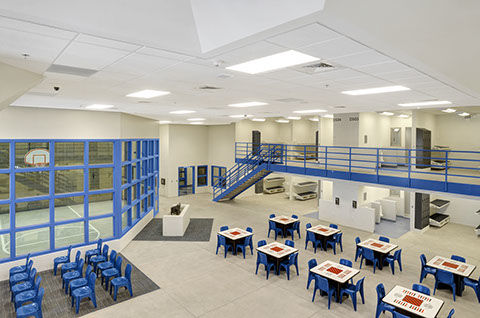
That helps to explain why Denver plans to build additional jail space specially designed for women.
The $6 million project has been approved by Mayor Michael Hancock and the Denver City Council. If construction goes as planned, women will move into the 96-bed unit at Denver County Jail’s Building 24 at Smith Road and Havana Street in July.
The design includes privacy walls or partitions in bathrooms, color palettes that are more inviting to women, special exercise equipment, and communal or side-by-side style sleeping arrangements, instead of the flimsy bunk beds they are now using, just to name a few of the unit’s features.
This effort is being led by the Denver Sheriff Department’s chief of operations, Elias Diggins.
Diggins said the department recognized that when both the Downtown Denver Detention Facility and the county jail were built, women’s issues weren’t at the forefront.
Historically, the number of incarcerated men has exponentially outweighed the number of women, and most jails were created with males in mind. But as the paradigm shifts, local jails are trying to catch up.
To create solutions, some cities have been redesigning jails that are intended to be more “gender-responsive.”
This concept was introduced by Stephanie Covington and Barbara Bloom, who did extensive research on how the criminal justice system has adversely impacted female inmates.
In 2003, they released a study called “Gender-Responsive Strategies: Research, Practice and Guiding Principles for Women Offenders.”
In other words, they reviewed how socialization, gender roles and inequality can impact a woman’s stay during incarceration and how it greatly differs for women versus their male counterparts.
Essentially, they concluded that participation in treatment, interactions with other inmates and recidivism prevention should be very specific to the female experience and shouldn’t be handled as a one-size-fits-all model.
“The way you treat someone while they are in custody directly affects how they reenter the community. If we begin to help women to reenter back into the community better than when they came to us and stay out of jail by the way they are treated while they are here, not have those trauma triggers, we’re hoping we’re hoping they’ll become successful citizens when they go back into the community,” Diggins said.
Leading up to the construction, the sheriff’s department invited community groups, civilian staff, deputies and inmates to help inform the design.
In November 2016, the Denver Sheriff Department teamed up with the Community Reentry Project (CRP) and the Denver African American Commission (DAAC), a division of the Human Rights and Community Partnerships, to conduct inmate focus groups to get an idea of what they would like to see come out of the redesign.
(Full disclosure: At the time the inmate focus groups were conducted, I served as project lead with the DAAC and worked closely with the reentry program and the sheriff’s department to complete the inmate surveys.)
Colorado Politics went into the Denver County Jail and spoke with members of the inmate counsel, which is composed of several inmates selected by their peers to represent their pods.
With the supervision of sheriff’s deputies and Lisa Calderon, former director of the Community Reentry Project, we talked with inmates about their living conditions.
Lack of changing space when getting out the shower, inadequate storage space for personal items and better exercise accommodations were on the list.
Diggins said the Building 24 design would address some of these concerns.
“I believe that this was a good step in the process. My concern with the Denver Sheriff Department is with the implementation,” said Calderon, who is no longer working with the department.
Calderon worked in the Denver jail system from 2007 to 2017 under a contract with the Community Reentry Project. During this time, she and her organization offered GED classes, cognitive behavioral training and was on their way to launching college prep courses for inmates until her program ended.
Barry Burch Jr., Denver’s director of boards and commissions, was chair of the DAAC during the time the inmate focus groups were conducted and wants to make sure community organizations and members stay on top of the sheriff’s department to ensure fair representation and implementation.
“Their intentions are good, but there may be some things they’re overlooking or just not seeing and by bringing other groups that may specialize in certain constituencies or realms of expertise helps them to be a better agency,” Burch said.
Another concern of this project is the men who are currently housed at Building 24,will be moved and occupy the space where the women are being moved from. Calderon calls it “swapping one issue for another.”
Diggins notes that at a later time the sheriff’s department hopes to reconstruct a space that will be more gender-responsive to the men in that are in custody as well.

Benavidez chosen to fill Senate District 21 vacancy after Michaelson Jenet resigns
Marianne Goodland
marianne.goodland@coloradopolitics.com
Updated 4 minutes ago
A Democratic Senate District 21 vacancy committee Thursday night chose former Rep. Adrienne Benavidez, D-Adams County, to replace former Sen. Dafna Michaelson Jenet. Michaelson Jenet resigned on Feb. 13 to become the director of the David and Laura Merage Foundation...

Colorado delegation’s plus-one picks convey messages at Donald Trump’s State of the Union | TRAIL MIX
Ernest Luning
ernest.luning@coloradopolitics.com
Updated 2 hours ago
It’s become a tradition for members of Congress to deliver messages of their own at the State of the Union address, though this year none of the Colorado lawmakers shouted at the president during the speech, nor did the delegation...

Colorado Democrat John Hickenlooper becomes first statewide candidate to submit nominating petitions
Ernest Luning
ernest.luning@coloradopolitics.com
Updated 2 hours ago
U.S. Sen. John Hickenlooper on Thursday became the first statewide candidate to submit petition signatures for Colorado’s June Democratic primary, according to his campaign and the Colorado Secretary of State’s Office. Seeking reelection to a second term, Hickenlooper is facing...

Bill Clinton faces grilling from lawmakers over his connections to Jeffrey Epstein
Stephen Groves
stephen.groves@associatedpress.com
Updated 2 hours ago
WASHINGTON (AP) — Former President Bill Clinton is testifying Friday before members of Congress investigating convicted sex offender Jeffrey Epstein, answering for his connections to the disgraced financier from more than two decades ago. The closed-door deposition in Chappaqua, New...

Toll to sexual assault survivors rises if they feel blamed and disbelieved
Jenny Deam
jenny-deam@coloradopolitics.com
Updated 50 minutes ago
Natalie, a single mother, dropped off her son at daycare, went to therapy and then returned home. She swallowed a fistful of pills, washing them down with a six-pack of beer. She was ready to end her life. “I just...

Colorado rape cases rarely result in an arrest and prosecution
Jenny Deam
jenny-deam@coloradopolitics.com
Updated 46 minutes ago
Authorities say they are especially difficult cases. In Colorado, most go nowhere. Over the past decade, for every 10 reports of rape, there is only one arrest. Warning: This story contains descriptions of sexual violence. Kiersten May remembered a fuzziness...
10th Circuit upholds finding of no misconduct against Colorado federal judge
Michael Karlik
michael.karlik@coloradopolitics.com
Updated 17 hours ago
A judicial committee for the Denver-based federal appeals court upheld the chief judge’s finding last week that a federal judge in Colorado did not engage in misconduct by handling a civil case involving other attorneys and judges in the state....

Denver mayor says city police will detain ICE officers using ‘excessive force’
Deborah Grigsby
deborah.smith@denvergazette.com
Updated 16 hours ago
Denver Mayor Mike Johnston on Thursday outlined his city’s response to immigration enforcement operations, including intervening to stop federal officers when local police observe them using “excessive” force. Johnston also said the city will not allow federal authorities to “stand...
SCOTUS whisperer? Justice Carlos Samour may get second opportunity to turn state dissent into national precedent
Michael Karlik
michael.karlik@coloradopolitics.com
Updated 1 hour ago
For the second time in two years, Justice Carlos A. Samour Jr. occupies an unusual position: Having his dissent in a Colorado Supreme Court case potentially forming the basis of U.S. Supreme Court precedent. Earlier this week, the nation’s highest...

Republicans roll out first ad pinning Democrats for not standing during State of the Union
Emily Hallas, Washington Examiner
emily.hallas.washington.examiner@gazetteedit.wpenginepowered.com
Updated 22 hours ago
A conservative group is launching a sweeping ad campaign on Thursday, seeking to capitalize on Democrats‘ refusal to stand during a portion of President Donald Trump’s State of the Union address centered on illegal immigration. American Sovereignty created a message...
PREV
PREVIOUS

Church and state divide GOP, Democratic Colorado lawmakers
Democrats and Republicans argued over two bills that mixed church and state last week at the Colorado Capitol. Senate Bill 201 would extend an three-hour exemption from childcare licensing requirement for churches to six hours during church activities. The bill is set for another recorded vote on the Senate floor next Thursday. The legislation is […]

U.S. Supreme Court gerrymandering cases could influence Colorado
WASHINGTON, D.C. – Cases pending before the U.S. Supreme Court could have an impact on a potential Colorado vote on gerrymandering. Supporters of a change in Colorado’s redistricting law want to get the issue on the upcoming ballot in November. On March 28, the Supreme Court heard arguments in the case of Benisek v. Lamone concerning […]