

Noonan: Who says money doesn’t count in public education?
Colorado’s public K-12 education system went broke in 2008-2009. The brokenness was so bad the Legislature created the “negative factor,” the difference between the state dollars per student schools receive and the dollars they should receive.
The negative factor reached a $1,278 per student deficit in 2012-13. It’s now down to $1,000 per student. Children in public schools since 2009 have lost out on $6,006 per student, or $180,180 for a classroom of 30 kids. During the same period, education foundations poured money into the state.
The Bill and Melinda Gates Foundation is the star money pusher at $121,084,495 since 2010. The Colorado Education Initiative, the Colorado Department of Education’s foundation, scored $22,220,340 from Gates. Denver Public Schools took in $25,532,007, with an additional $759,938 sent to two charters, Denver School of Science and Technology and STRIVE Prep.
Charter schools received a huge boost from the Gates’ donation to Charter School Inc., dba Charter School Growth Fund, at $33,716,724. The Fund invested in DPS’s DSST, STRIVE Prep, and Rocky Mountain Prep charters. Education reformer Stand for Children took in $12,110,821. The Gates Foundation pitched $400,000 to Colorado Succeeds, run by Scott Laband, a former staffer of state Senator Michael Johnston, who sponsored SB10-191, the Great Teachers and Leaders Act.
The money creates winners and losers. Clear winners are education reformers such as CEI, Stand for Children, and Johnston and Laband, who managed to get a $300,000 fiscal note price tag on SB10-191 when the teacher evaluation program costs districts millions of dollars.
Testers also won, reaping profits from student assessments used for teacher evaluation. Employees at CEI won. CEI even paid several of its staffers as they worked for CDE on implementing SB10-191, creative accounting that kept their salaries off CDE’s books.
Losers include transparency aficionados who want to track spending that affects state policy. CEI’s mission is to support CDE, which supports the whole state. CEI’s programs show great concern with college readiness, and not much, if any, concern for career readiness.
It’s impossible to tell how broadly or fairly CEI distributes its grants to various programs. CEI will be under scrutiny if it’s the funder of alternative assessment pilots under HB15-1323, the revised assessment bill. CEI’s latest Annual Report, published in 2013, only lists gross assets and liabilities.
Losers also include many neighborhood schools across the state, particularly in Denver, when compared to the richly funded DSST and STRIVE Prep. While most schools have lost funding since 2009, these two charters are swimming in it.
Green Valley Elementary School, a neighborhood school in the 80249 ZIP Code, scored 56.95 on reading in 2014. DSST Green Valley middle and high schools, in the same ZIP Code, scored 71.4 and 72.95. The math gap is lower: 56.62 at GV Elementary, 63.11 at DSST GV Middle, and 61.71 at DSST GV High School.
All that money bought 14.45 more points in reading scores and about 5.5 points higher in math. Anyone want to fund a Colorado Neighborhood School Growth Fund?
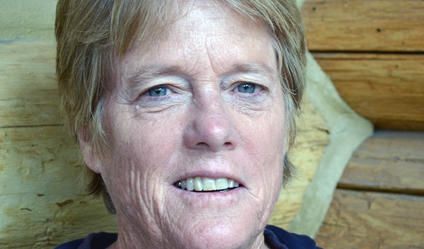
Paula Noonan owns Colorado Capitol Watch, the state’s premier legislature tracking platform.
CORRECTION: It was Charter School Inc., dba Charter School Growth Fund, that received $33,716,724 from the Bill and Melinda Gates Foundation, not, as stated in an earlier version of this article, the Colorado League of Charter Schools. We regret the error.

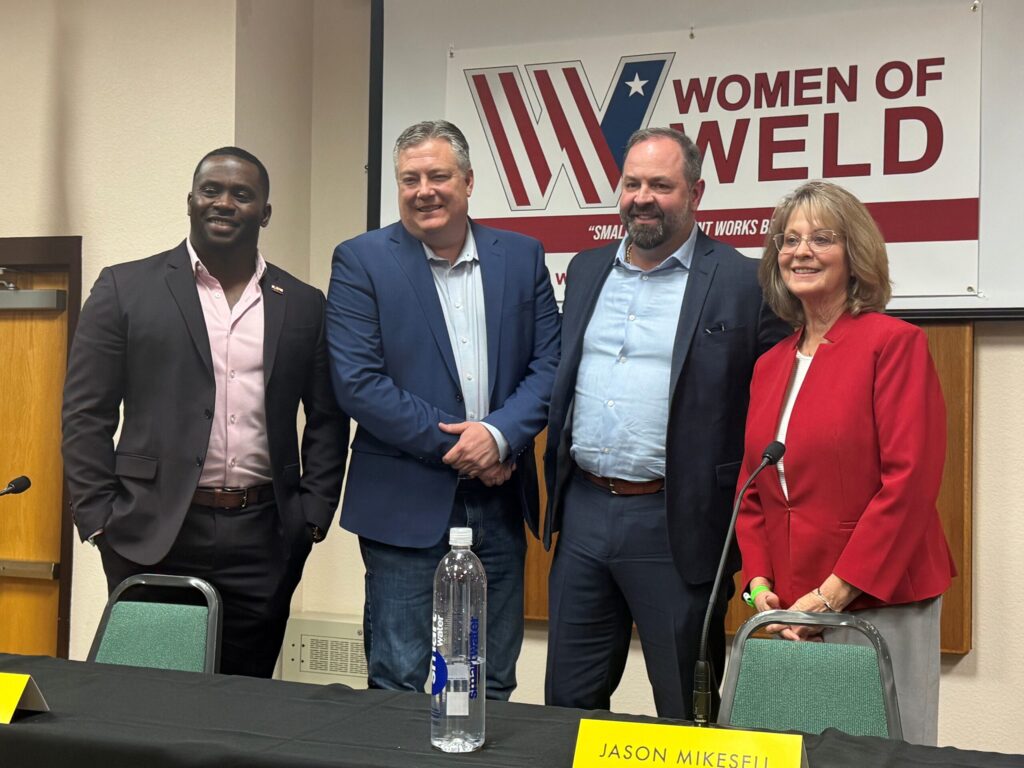
Republican candidates debate how to win the governor’s seat in Colorado — a position the GOP last secured in 2002
Thelma Grimes
thelma.grimes@coloradopolitics.com
Updated 8 hours ago
Colorado has not elected a Republican governor since 2002. On Thursday night, four candidates offered competing visions for how the party can reverse its 20-plus years of failing to secure the seat. The discussion hosted by the Women of Weld...

Colorado’s charitable gaming board to study Denver Gazette’s findings
David Migoya
david.migoya@gazette.com
Updated 9 hours ago
Colorado’s freshman board overseeing the state’s $110 million charitable gaming industry on Friday created a committee to tackle issues raised in a Denver Gazette investigation that exposed, among other issues, poor supervision and illegal operators. The Colorado Charitable Gaming Board,...
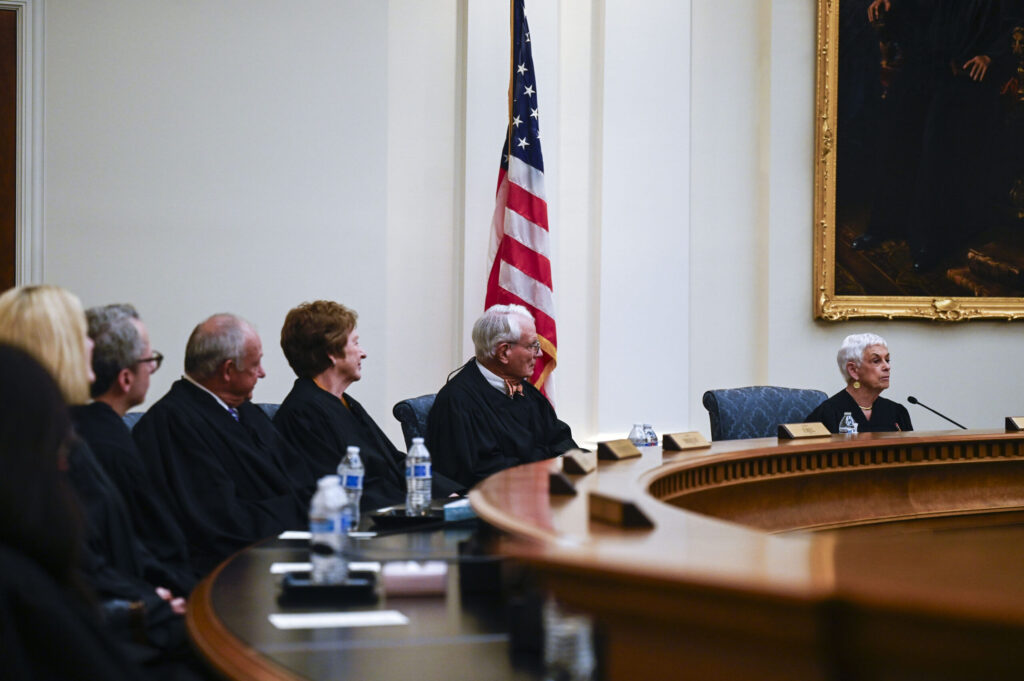
10th Circuit to address resentencing of probation violators in rare all-judges hearing
Michael Karlik
michael.karlik@coloradopolitics.com
Updated 13 hours ago
The Denver-based federal appeals court agreed on Thursday to hold a rare all-judges hearing to determine the proper procedure for resentencing a criminal defendant who has violated the terms of his probation. In the federal appellate courts, the vast majority...

Vape shops challenge Denver’s flavored tobacco ban in court
Deborah Grigsby
deborah.smith@denvergazette.com
Updated 10 hours ago
The smoke has yet to settle in the battle over the city’s flavored tobacco ban as local vape shop owners have sued the City and County of Denver, asking the court to declare the ordinance unconstitutional and stop its enforcement....

US officially leaves the World Health Organization
Washington Examiner Staff, Washington Examiner
washington.examiner.staff.washington.examiner@gazetteedit.wpenginepowered.com
Updated 15 hours ago
The United States officially withdrew from the World Health Organization on Thursday, slightly over a year after President Donald Trump announced his intention to withdraw the U.S. from the WHO via an executive order on the first day of his...

Report: Colorado government has grown beyond TABOR’s limits
Marissa Ventrelli
marissa.ventrelli@coloradopolitics.com
Updated 7 hours ago
Colorado’s government has grown substantially over the past three decades beyond the limits that voters approved to restrain that expansion, according to a new report from a think tank. The analysis from the Independence Institute, which examines state spending, revenue...
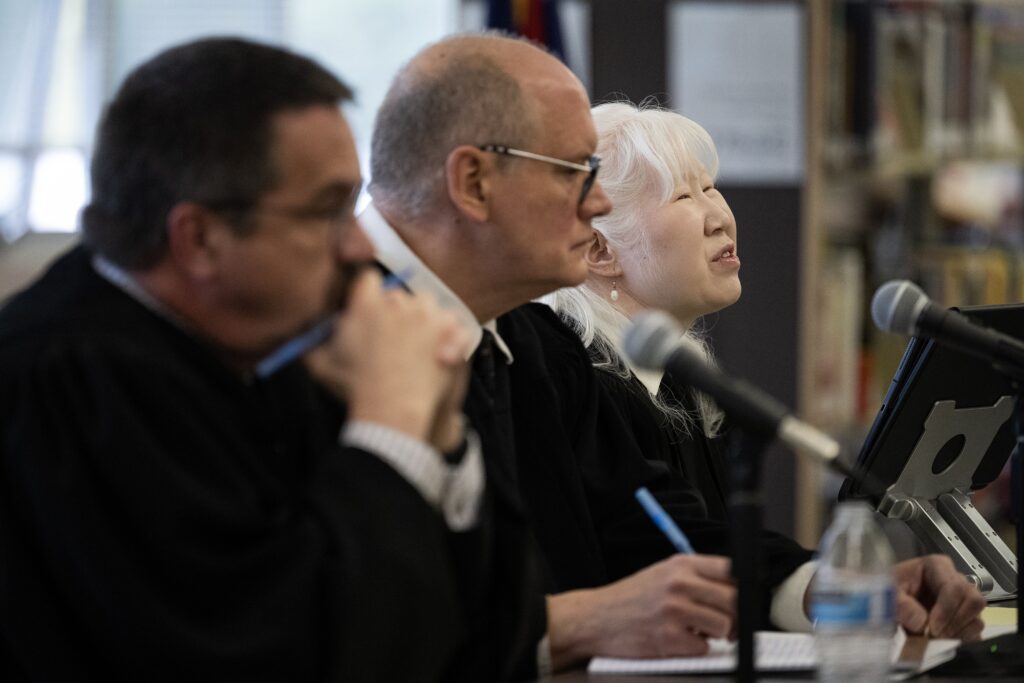
Appeals court overturns Adams County sex offense convictions due to prosecutor’s misconduct
Michael Karlik
michael.karlik@coloradopolitics.com
Updated 17 hours ago
Colorado’s second-highest court reversed multiple child sex assault convictions on Thursday after concluding an Adams County prosecutor committed misconduct while cross-examining the defendant. A three-judge Court of Appeals panel observed the charges against Daniel Michael Boerner depended on the jury...

ACA enrollment in Colorado sees slight dip amid rising costs
Nico Brambila
nico.brambila@denvergazette.com
Updated 9 hours ago
Despite handwringing over enhanced federal subsidies going away for many Coloradans enrolled in health insurance on the state’s marketplace, officials reported Friday just a 2% enrollment dip. More than 277,000 Coloradans enrolled in health insurance through the Affordable Care Act...
Rep. Ron Weinberg won’t seek reelection
Marianne Goodland
marianne.goodland@coloradopolitics.com
Updated 1 day ago
Republican Rep. Ron Weinberg of Loveland announced on Thursday evening that he will not seek another term in the Colorado House. “Serving this community has been one of the greatest honors of my life,” the two-term state representative said on...

Colorado title board OKs ballot measures to eliminate flat income tax in favor of graduated brackets
Marianne Goodland
marianne.goodland@coloradopolitics.com
Updated 8 hours ago
Proponents hoping to change Colorado’s income tax structure from a flat rate to graduated tiers — thereby raising taxes for some brackets — walked away from a Wednesday meeting with eight ballot measures approved by the title board. The coalition...
PREV
PREVIOUS
Letter: Time to level playing field between retailers, e-tailers
Editor: Online retail giants have been challenging Colorado’s Main Street merchants on price for nearly a generation now, unfairly helped by an out-of-date U.S. Supreme Court ruling that leaves most online sales free of sales tax. Every year, this unfair competition makes it more difficult for these stores to continue to offer the jobs, personal […]

Littwin: Cory Gardner and the GOP adopt abortion politics and a government-shutdown showdown … again
OK, it wasn’t like we weren’t warned. But here was the U.S. Senate not only voting on whether to defund Planned Parenthood, but promising that this is just the beginning of a long fight, maybe one that would last even longer than Congress’s summer recess. As expected, Democrats successfully filibustered the bill, but the defunding […]