

Time to consider data-driven justice system?

Big data is a big deal to more and more industries and professions.
Financial firms have crunched reams of numbers for decades. Barak Obama dedicated a whole floor of his campaign to data-driven decision-making. And of course, baseball — and every other major sport — has followed the sabermetric path blazed by Billy Beane.
So, where do we find big data being applied to the legal field? How does the criminal justice system use the vast array of statistical information it collects to increase efficiency and decrease costs?
Surprisingly, it seems the legal field has been relatively immune to the transformations taking place in other sectors. Of course, there are some practice areas such as insurance litigation that are notorious for cost-benefit analyses, and there are plenty of academic, social science studies analyzing courts. But use of data-driven analytical tools for decision-making continues to play only a bit part in our country’s legal system. However, with the help of some zealous advocates, that may be changing.
When I went poking around on this topic, I came across a TED Talk by Anne Milgram, the former New Jersey attorney general. She applied big data to crime-fighting decisions made in her office and believes that helped remove Camden, N.J., from atop the list of most violent cities in America. In fact, Milgram believes in the process so strongly she works through the Laura and John Arnold Foundation to urge more jurisdictions to adopt similar changes.
At this time, the primary change being promoted by the foundation is reform to the pretrial process. It’s a small start for big data in the legal world, but an important one.
The costs to the criminal justice system, and to the people caught up in it, are often front-loaded. The costs range from paying for people who have been arrested and are awaiting trial to costs incurred directly by defendants who might lose jobs or homes while sitting in jail. Conversely, society pays an even greater cost when an offender likely to commit a violent crime is prematurely released onto the streets. And all those costs must be balanced by a judge making a quick decision, based on relatively minimal information and the judge’s gut instinct.
Too often, that limited information has kept people who are unlikely to commit another violent crime in jail while freeing those who present a clear danger to our neighborhoods.
To assist judges, the Laura and John Arnold Foundation developed a data-driven tool that applies a few key factors, compares them against a data set with more than 1.5 million data points, and provides a recommendation for release or retention. Of course, the final decision is left to the judge. Nobody is advocating diminished judicial discretion, the tool is only an aid for judges making those important decisions.
To date, the tool has been adopted in more than 20 jurisdictions including the State of Kentucky and Cook County, Ill. For the pretrial process in this country, that’s a good start. For big data in the legal system, we can hope it’s only the very beginning.
For more information about the data-driven decision-making tools being developed by the Laura and John Arnold Foundation, visit https://www.arnoldfoundation.org/initiative/criminal-justice/
Mario Nicolais is an attorney and legal scholar at the Denver law firm of Hackstaff & Snow LLC.


Colorado lawmakers propose to close $1.2B budget gap with deep cuts
Marianne Goodland
marianne.goodland@coloradopolitics.com
Updated 11 minutes ago
The panel of Colorado legislators in charge of crafting next year’s budget has finalized the 2026–27 spending plan built on deep cuts and one‑time cash transfers in an attempt to close a shortfall of more than $1.2 billion. The plan...

Denver judge denies Gov. Polis request to dismiss ICE-related records case
Marianne Goodland
marianne.goodland@coloradopolitics.com
Updated 15 minutes ago
A year after blocking the release of state records to federal immigration agents, a Denver judge has now denied Gov. Jared Polis’ effort to end the lawsuit at the center of the dispute. The lawsuit filed against the governor in...

10th Circuit grants rare all-judges’ review of Colorado banking regulation
Michael Karlik
michael.karlik@coloradopolitics.com
Updated 2 hours ago
The Denver-based federal appeals court announced on Thursday that it will hold a rare all-judges review of a recent decision that permits Colorado to require out-of-state banks to abide by the state’s maximum interest rates when they lend to in-state...
Colorado appeals court orders new sentencing for Tina Peters, upholds convictions
Michael Karlik
michael.karlik@coloradopolitics.com
Updated 3 hours ago
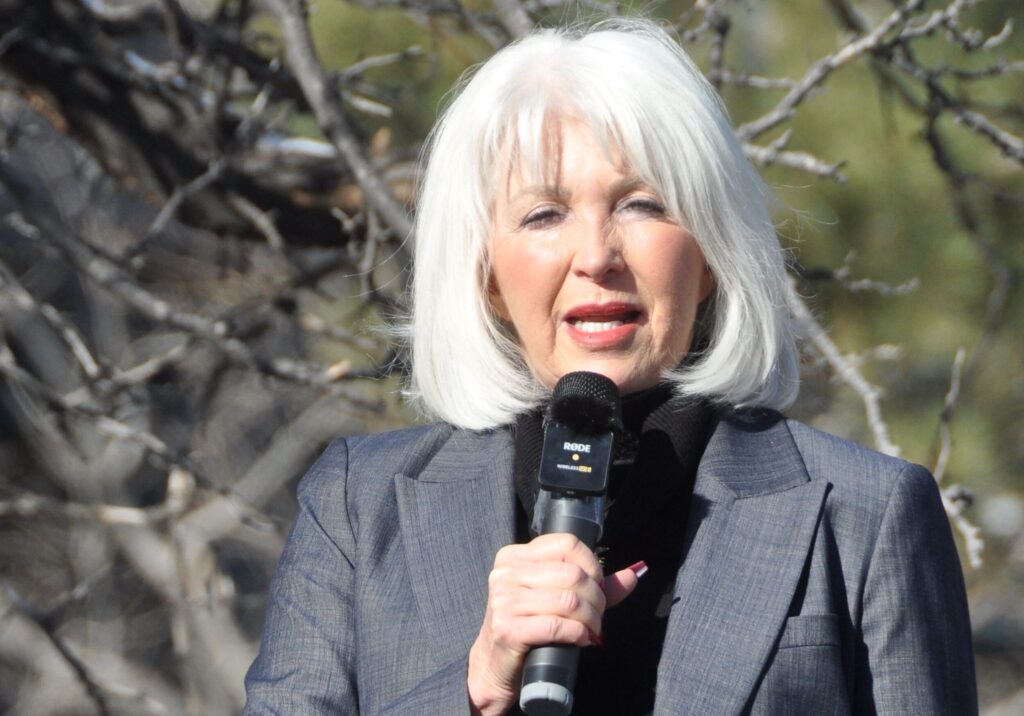
Colorado’s second-highest court determined on Thursday that a trial judge improperly sentenced former Mesa County clerk Tina Peters based upon her exercise of protected speech, while at the same time upholding her convictions. The three-judge Court of Appeals panel also...

Denver promised every school funding from $1B bond — but campuses later closed received far less | Analysis
Nico Brambila
nico.brambila@denvergazette.com
Updated 46 minutes ago
Denver voters overwhelmingly approved the largest bond measure in Denver Public Schools history on the promise that every school — including charter campuses — would receive something. And they did. But the nearly $1 billion bond was not distributed evenly....

National conservation area growing by 4,000-plus acres in western Colorado
Seth Boster
seth-boster@coloradopolitics.com
Updated 5 hours ago
A formerly private, sweeping swath of western Colorado is growing a public, red rock wonderland. Spanning 4,000-plus acres, Escalante Ranch has been transferred to the Bureau of Land Management and incorporated into Dominguez-Escalante National Conservation Area, The Conservation Fund recently...

Judge rules that Colorado law makes it too hard for parties to bar unaffiliated voters from primaries
Ernest Luning
ernest.luning@coloradopolitics.com
Updated 4 hours ago
A federal judge ruled in favor of the Colorado Republican Party late Tuesday, saying that a portion of the state law that allows unaffiliated voters to cast ballots in party primaries is unconstitutional because it imposes an unrealistic burden on...
10th Circuit upholds regulator’s methodology for Tri-State exit fees
Michael Karlik
michael.karlik@coloradopolitics.com
Updated 4 hours ago
The Denver-based federal appeals court upheld a regulatory agency’s methodology for calculating the fee owed by entities seeking to withdraw from Tri-State Generation and Transmission Association last week. Tri-State is a Westminster-based cooperative that provides and transmits electricity to member...
Federal judge proposes sanctions against Mike Lindell’s lawyers for continued fake citations
Michael Karlik
michael.karlik@coloradopolitics.com
Updated 23 hours ago
A federal judge is once again pursuing sanctions against lawyers for MyPillow CEO Mike Lindell for continuing to cite to court cases that do not exist, likely based on the faulty output of artificial intelligence tools. Last year, a jury...

Front Range cities oppose Democratic proposal to permit lot‑splitting
Marianne Goodland
marianne.goodland@coloradopolitics.com
Updated 2 hours ago
Colorado lawmakers are pressing ahead with a plan to let homeowners split their lots to make room for smaller, less expensive houses — a proposal that has drawn sharp opposition from Aurora, Colorado Springs, Denver and other Front Range cities...
PREV
PREVIOUS

Hickenlooper, Burwell discuss curbing prescription drug abuse
Blair Hubbard’s heroin addiction began with the popping of a few pain pills she was prescribed after wisdom teeth surgery. “I accidentally took more than the recommended prescribed dose at one point and realized that I really liked the way it felt,” said Hubbard, 34, who lives in Denver. Blair Hubbard talks about overcoming addiction […]

Hemisphere's future talk of Biennial of the Americas Festival
It was fitting that Denver’s third Biennial of the Americas festival launched the same day as the Legislative Audit Committee’s report of shrinking crowds attending the Colorado State Fair in Pueblo. A staff of several dozen has spent the past six months finalizing the schedule of events that make up this cross-cultural festival of arts, […]