

Denver’s pay-for-performance shelter plan falls short on key metric

Denver’s recent shift to a pay-for-performance contract model has improved day-to-day operations across the city’s seven noncongregate homeless shelters, but has struggled to deliver promising numbers on its most important metric: getting people out of shelters and into housing.
However, city officials still plan to expand the model to five additional city shelters while working to improve and adjust metrics to drive housing outcomes, which the city’s Department of Housing Stability states is the program’s biggest constraint.
Due to limited housing opportunities, officials said, the number of long-term shelter stays increased, as did the average length of stay for all properties from 166 days to 229.
The bottom line, city officials said, is that performance-based contracting is working and providers have exceeded expectations. But in the next
phase, HOST must pair providers’ efforts with continued metric refinement and more housing resources, officials said.
Jeff Kositsky, HOST deputy director, told members of a Denver City Council committee that available options for housing exits from shelters have decreased “significantly” between 2025 and 2026 due to the loss of housing authority vouchers, as well as American Rescue Plan Act funding that covered a large swath of rapid rehousing.
“So, despite the fact that our providers really did an outstanding job, the housing outcomes that we’re seeing are somewhat mixed,” he said.
The pay-for-performance “pilot” program launched in January 2026 and replaced the city’s former “flat-fee and invoice compliant” contract model, tying shelter provider payments to measurable performance metrics to produce better outcomes before expanding the model citywide.
Covering seven city-owned homeless hotel shelters, 769 units and more than $50 million in funding over three years, Kositsky told committee members the numbers for the pay-for-performance program actually exceeded expectations this early in the game.
“We’re obviously very pleased with the results of this and are going to expand it for HOST,” Kositsky said. “You know, good enough is never good enough. We’re always going to be trying to do better for our clients and for our community.”
Current contracts for shelter providers include Urban Alchemy, which operates the Aspen, St. Francis Center, which operates Stone Creek, and Bayaud, which operates the Tamarac Family Shelter.
Under terms of the contracts, shelter providers must meet specific performance standards, which are tracked using the Homeless Management Information System dashboard.
Funding breakouts include number of sheltered nights, 45% of budget; rapid rehousing, 5%; housing-focused case management, 40%; and housing queue, 10%.
Six of seven shelters showed improved occupancy scores year over year, and the program’s overall performance came in at 93%, exceeding the 90% contract target — an increase of nine points over the Q2 2025 mark.
Engagement with shelter residents increased, as did the number of individual residents actively participating in case management.
But the progress has come in the wake of great public scrutiny.
The Denver City Council reluctantly approved Urban Alchemy’s 11th-hour contract last year amid media reports about the nonprofit’s finances and oversight practices in San Francisco, Austin and other cities.
“There’s a ton of very concerning legal mess related to Urban Alchemy in a number of cities,” Councilmember Paul Kashmann said at the time. “These are not from 10 years ago. They’re current. They continue to grow at a rapid pace, and I’m just not sure that this is the direction that Denver needs to go.”
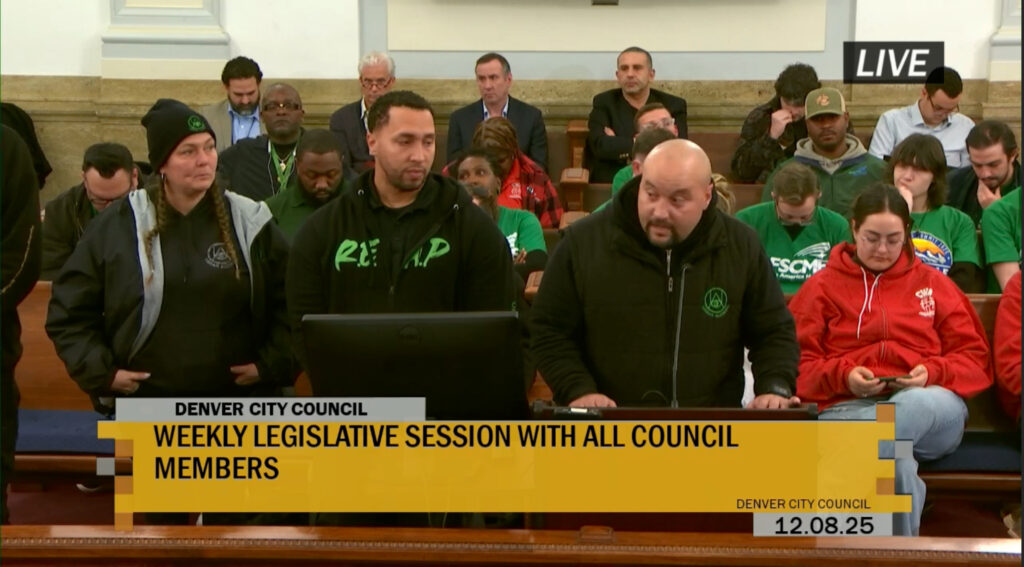
Kositsky told the council that if the Urban Alchemy contract were not approved, significant “retooling” would be required to go back and select and vet a replacement provider.
“We would have to seek out another provider,” Kositsky said. “There was not a great deal of interest when we put out the RFP to operate this site, and the panel went with the provider that they thought was the most qualified and the most able to operate the site.”
Shortly after he was elected in 2023, Denver Mayor Mike Johnston, who promised to end homelessness in his first term as mayor, declared a state of emergency and launched what he called the “House 1000” initiative. After the emergency ended, the program transitioned to what he dubbed “All In Mile High.”
As envisioned, it would deliver homeless services through the Mayor’s Office, the Department of Housing Stability and other city agencies.
During an October presentation to the Denver City Council, Johnston’s office reported that the total cost of the program from July 2023 through June 2025 was about $158 million.
When auditors compared expenses in Workday, the city’s official system of record, they found that roughly $178.1 million was spent over the same period, an estimated $20 million more than previously reported,
Auditors added that the initiative was poorly planned, with underreported expenses, no monitoring plan, inadequate “equity” considerations in shelter siting and no one responsible for tracking the program’s citywide expenses.
Johnston’s office fired back in a statement, arguing that the audit “misstates key facts and is, in some instances, willfully misleading.”


Emerald ash borer confirmed in Colorado Springs, ‘pest is here to stay’
Brennen Kauffman
brennen-kauffman@coloradopolitics.com
Updated 31 minutes ago
Colorado Springs is asking residents to be on the lookout for an invasive beetle species that has jumped down the Front Range and into local ash trees. City officials said Wednesday that a confirmed emerald ash borer infestation had been...

What happens if voters pass Colorado’s two competing income tax measures?
Marianne Goodland
marianne.goodland@coloradopolitics.com
Updated 2 hours ago
The battle between two competing ballot measures — one seeking to cap Colorado’s income tax rate, the other pushing for a tiered system depending on income levels — might come down to whichever ballot proposal gets one more vote. The...

Northglenn city manager resigns immediately after 8 years
Kyla Pearce
kyla.pearce@gazette.com
Updated 2 hours ago
Northglenn will have a new city manager after the current one resigned effective immediately after eight years with the city. City Manager Heather Geyer was appointed in July 2018 and was the first woman to hold the role in the...

Bennet settles campaign finance complaints, admits violating state law
Marianne Goodland
marianne.goodland@coloradopolitics.com
Updated 16 hours ago
U.S. Sen. Michael Bennet’s gubernatorial campaign has agreed to pay a $7,433 fine for using his Senate campaign account to pay for gubernatorial campaign travel expenses. The July 31 settlement includes an admission by Bennet and his campaign that they...

Sarah Parady steps down from Denver City Council, special election announced
Deborah Grigsby
deborah.smith@denvergazette.com
Updated 2 hours ago
Denver City Councilmember Sarah Parady officially resigned Wednesday, citing an undisclosed illness. Her resignation prompted the Denver City Council to pass a resolution declaring the seat vacant and setting a special election for Nov. 3 to coincide with Colorado’s general...

Colorado records 17th wolf death, a yearling tied to livestock losses
Marianne Goodland
marianne.goodland@coloradopolitics.com
Updated 17 hours ago
A yearling male wolf in Grand County has become the 17th wolf to die in Colorado in the past two years. Colorado Parks and Wildlife announced that its staff killed the wolf on Aug. 4 because it was believed to...

Appeals filed to send Project Taurus decision to the Colorado Springs City Council
Brennen Kauffman
brennen-kauffman@coloradopolitics.com
Updated 2 days ago
At least one appeal has been filed over the proposed large-scale data center in Colorado Springs, sending the final decision to the Colorado Springs City Council. The filing seeks to overturn the Planning Commission’s decision on July 23 to deny...

Denver City Council keeps 2 a.m. nightlife cutoff, approves $18 million for George Floyd protest claims
Deborah Grigsby
deborah.smith@denvergazette.com
Updated 2 days ago
Nightlife establishments will not get a two-hour operating extension after the Denver City Council passed an amended version of a bill that keeps the current 2 a.m. closing time. As originally proposed, venues would have been able to keep music,...

Group submits signatures for proposed Colorado graduated income tax
Marianne Goodland
marianne.goodland@coloradopolitics.com
Updated 2 days ago
The measure, which eliminates Colorado’s flat tax, is expected to raise $2 billion in new revenue The proposal to amend the Colorado constitution to change the state’s flat rate into a graduated income tax came in under the wire Monday,...
Judge denies Calderon injunction case against Denver, Johnston
Deborah Grigsby
deborah.smith@denvergazette.com
Updated 3 days ago
A U.S. District Court judge has denied a preliminary injunction in the case of Jessica Calderon, the Denver city employee who won a temporary restraining order preventing the City and County of Denver from terminating her amid the 2025 citywide...
PREV
PREVIOUS

'Explosive' diarrhea-causing parasite cyclosporiasis cases nearly triple in Colorado
Cases of the “explosive” diarrhea-causing parasite cyclosporiasis nearly tripled in Colorado over the past month, prompting renewed attention after related deaths were reported in Michigan. Twenty-nine counties in Colorado have reported cases, according to the Colorado Department of Public Health and Environment. Colorado has had 241 cases of cyclosporiasis since January, state data shows. Of […]

Colorado records 17th wolf death, a yearling tied to livestock losses
A yearling male wolf in Grand County has become the 17th wolf to die in Colorado in the past two years. Colorado Parks and Wildlife announced that its staff killed the wolf on Aug. 4 because it was believed to be responsible for killing four calves in Jackson and Grand counties between June 29 and […]