Home rule has protected Colorado cities for over 125 years | Cronin and Loevy

Colorado is currently gripped by a political struggle between the governor plus the state legislature in Denver and populous “home-rule” city governments, mainly on the Front Range, such as Colorado Springs.
In the past few years, the legislature has been passing bills that applied to city government policies, which for many years had been the sole province of city mayors and city councils.
These new state laws have mainly provided for higher population densities in cities in hopes of generating more low-cost housing or affordable housing.
What is home rule? How did it come about in Colorado? And why is the state legislature in Denver suddenly challenging this long-established concept of urban government?
Back in the late 1800s, the state legislature mainly passed laws governing what happened in Colorado cities. That meant that the state representatives and state senators from the city were more powerful politically in city affairs than the local mayor and the city council combined.
This conflict was particularly intense in Colorado’s largest city, Denver, which was also the state capital. For example, the Colorado governor, not the Denver mayor, appointed the members of the various boards and commissions that made policy for the city.
In 1894, this led to Denver’s famous “City Hall War.” Governor Davis Waite tried to fire two members of the Denver Fire and Police Board, but they locked themselves in their City Hall offices and refused to leave.
Governor Waite ordered the state militia to surround City Hall and forcefully remove the two board members, who were protected by men armed with pistols and rifles who looked ready to fight the state militia.
Cooler heads prevailed, and Governor Waite ordered the state militia to stand down without a shot being fired. The Colorado Supreme Court sided with the governor, and the two men peacefully left their offices.
But the Denver City Hall War had perfectly illustrated the competition for power between the governor plus the state legislature and Denver city officials.
Ten years later, in 1904, conditions in Denver were continuing to deteriorate. Saloons and gambling houses were operating at full steam. Political machines openly bought votes on Election Day, keeping corrupt political leaders in office.
Reformers believed that a major cause of the trouble was that the governor and the state legislators continued to wield direct control over city affairs.
A reform movement began in Denver to support a state constitutional amendment that would give Denver the right to establish a “home rule” city government.
Rather than being governed by the governor and the state legislature, Denver citizens would adopt a “city charter” that would create their own form of city government tailored directly to their particular needs.
Denver would thus have a wide range of local powers to inspire citizens to look to the city government rather than the state government to solve their problems.
It was a major victory for progressive local government when, at the general election in 1904, the Home Rule Amendment for Denver was adopted to the state constitution by Colorado voters.
Then, a subsequent constitutional amendment was adopted to extend home rule powers to other Colorado cities. Shortly thereafter, all the major cities in Colorado had adopted their own city charters and became full-fledged home-rule cities.
The big point is this. The adoption of the state constitutional amendment in 1904, giving home-rule powers to all the major cities in the state, was the most significant event in the history of local government in Colorado.
Municipal home rule was firmly instituted as the norm rather than the exception in Colorado. The state became well known nationally for its strong home rule city governments.
Many people, including those from Colorado, think of Colorado as a land of beautiful snow-capped Rocky Mountains and wide-open spacious prairies.
In reality, however, Colorado is highly urbanized, and the vast majority of its citizens live in cities. That makes the strong home-rule powers of those cities even more significant.
For 120 years after 1904, the strong home-rule powers of Colorado cities were not seriously challenged. The more populous cities in the state were left to govern themselves as the state constitution instructed.
To longtime observers of Colorado state and local government, the recent efforts of the state legislature and the governor to take control of home-rule city zoning and subdivision laws and altering them to favor population densification has been a shock.
More than a century of land-use policy favoring home-rule cities has been sharply challenged in recent years by Colorado legislators.
The state legislators argue that the shortage of affordable housing in major cities on the Front Range has forced the legislature to step in.
The legislature has overridden concerns about home rule and created state requirements that residential lots be split into two and that apartments be built along major arterial streets, despite the zoning.
The final result is that, after a century and a quarter of home-rule protection for Colorado cities in the state constitution, these protections are now being challenged and set aside.
Tom Cronin and Bob Loevy are news columnists who write about Colorado and national politics.


Brass Ring 2026: Fashions, fun and a six-figure boost for diabetes research, care | NONPROFIT REGISTER
Joanne Davidson Special to Colorado Politics
joanne-davidson-special-to-colorado-politics@coloradopolitics.com
Updated 18 hours ago
CHILDREN’S DIABETES FOUNDATION Denver News: Lisa Corley, who has supported the Children’s Diabetes Foundation and its work on behalf of the Barbara Davis Center for Diabetes for 25 years, received the T1D Changemaker Award on April 7 when the foundation hosted its...

Officials, residents respond to Lakewood rezoning special election results
Sage Kelley
sage.kelley@denvergazette.com
Updated 2 days ago
Nearly 17,000 residents fought back against Lakewood zoning changes on Tuesday, reversing the ordinances put in place that sought to allow for more housing density. The City of Lakewood’s special election regarding the zoning code changes put in place in...
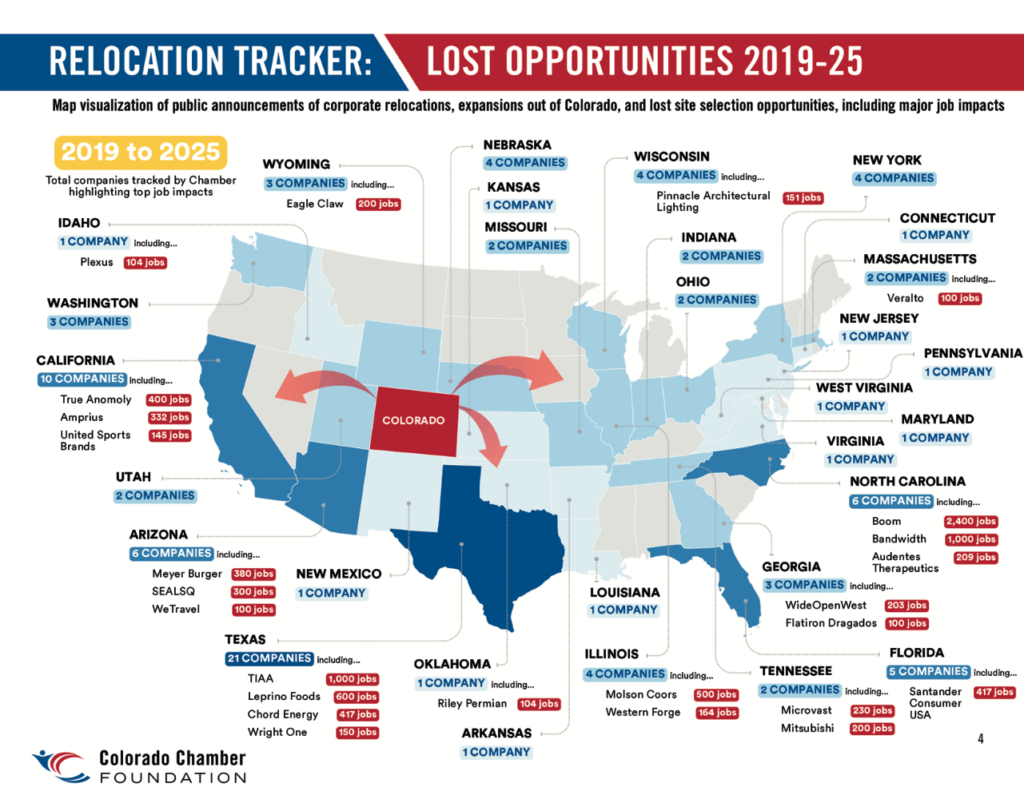
Exit of corporate HQs cited in Colorado Chamber Foundation report
Mark Samuelson Special to The Denver Gazette
mark.samuelson@denvergazette.com
Updated 11 hours ago
Amid worries that Colorado has lost its edge in competing for businesses, the Colorado Chamber Foundation has issued a report tracking companies that are relocating out of state. “While Colorado has significant strengths as a state, we are also becoming...

CDOT begins installing 66 new highway cameras
Scott Weiser
scott.weiser@gazette.com
Updated 14 hours ago
The Colorado Department of Transportation started construction on a project to install 66 new traffic cameras across the state, many of them in remote mountain areas where real-time highway views help drivers navigate changing conditions. Work began March 30 at...

Senate-passed farmworkers overtime bill easily clears Colorado House committee
Marianne Goodland
marianne.goodland@coloradopolitics.com
Updated 4 days ago
A proposal to ease Colorado’s overtime requirements for agricultural employers cleared a key House committee Monday, setting up a broader fight over whether the state should scale back a labor policy adopted just five years ago. The House Agriculture, Water...

SeriesFest Soiree: A night of celebration, creativity and connection | NONPROFIT REGISTER
Joanne Davidson Special to Colorado Politics
joanne-davidson-special-to-colorado-politics@coloradopolitics.com
Updated 17 hours ago
SERIESFEST Denver News: John J. Sie, a cable television pioneer and founder/former chairman of Starz Entertainment, will receive the inaugural Visionary Award at the May 8 SeriesFest Soiree. The $300-a-ticket fundraising gala begins at 6 p.m. at Asterisk, an event space at 1075 Park Ave. West, Denver. In...

Bill to accelerate police access to online data clears Colorado committee
Marissa Ventrelli
marissa.ventrelli@coloradopolitics.com
Updated 5 days ago
A proposal to speed up law enforcement’s access to social media data is advancing in the Colorado Legislature, drawing testimony from the residents of Evergreen, where a school shooting took place, and questions from opponents worried about privacy and constitutional...

Striking JBS workers to return on promise of talks
The Associated Press
the-associated-press@coloradopolitics.com
Updated 4 days ago
Workers at one of the nation’s largest meatpacking plants have agreed to return to work and halt a three-week strike after plant owner JBS USA agreed to resume negotiations, labor union representatives announced The strike by thousands of workers at...

Colorado ski resorts announce early closures amid historic snowpack lows, high temperatures
Kyla Pearce
kyla.pearce@gazette.com
Updated 7 days ago
Vail Resorts is the latest area to announce season closure Wednesday As Colorado’s historically low snowpack year comes to a close and spring conditions take over the mountains, the state’s major ski resorts are announcing closing dates — some of...

Douglas County task force targets development regulations
Nicholas Fogleman
nicholas.fogleman@denvergazette.com
Updated 1 week ago
Douglas County kicked off its first Red Tape Reduction Task Force Thursday aimed at speeding up commercial and industrial development timelines in the county, a move leaders said is necessary to keep the county competitive with other regions nationwide. The...