

Proposal outlines $300M deal separating Pinnacol from Colorado state government
Colorado lawmakers are weighing a proposal that would allow Pinnacol Assurance to sever its remaining ties to the state in exchange for a $300 million payment, a long‑debated shift that supporters say could stabilize the insurer’s future and help plug a looming budget shortfall.
A draft of the bill obtained by Colorado Politics spells out just how Pinnacol would “disaffiliate” from the state.
Notably, the bill’s authors include members of the Joint Budget Committee, which, as a panel, had been skeptical of the concept. Rep. Rick Taggart, R-Grand Junction, and Sen. Judy Amabile, D-Boulder, are listed as cosponsors.
The push to let Pinnacol fully separate from the state has circulated at the Capitol for decades, beginning in 2002 when lawmakers directed the insurer to operate as an independent, member‑owned mutual company.
Pinnacol, the state’s workers’ compensation insurance of last resort, has remained a quasi-state entity, which keeps the insurer from offering workers’ compensation insurance to Colorado companies with workers in other states.
While the insurer is still the largest workers’ compensation insurance provider in the state, with about a 50% market share, that share has dropped substantially in recent years, and the change would be key to the insurer’s long-term success, according to supporters of the company breaking away from the state.
“We’re trying to ground folks” on the dollars, said Wes Parham, vice president for public affairs at Pinnacol, in an interview with Colorado Politics last week.
The state shed its liability for Pinnacol in 2002, when the company became a mutual insurance company. Since then, the law has been clear — the state assumes no risk or liability for Pinnacol’s financial condition, and the company is solely funded by employers’ premiums.
The proposal from House Speaker Julie McCluskie would require Pinnacol to pay at least $300 million to the state. The money would be divided among various programs.
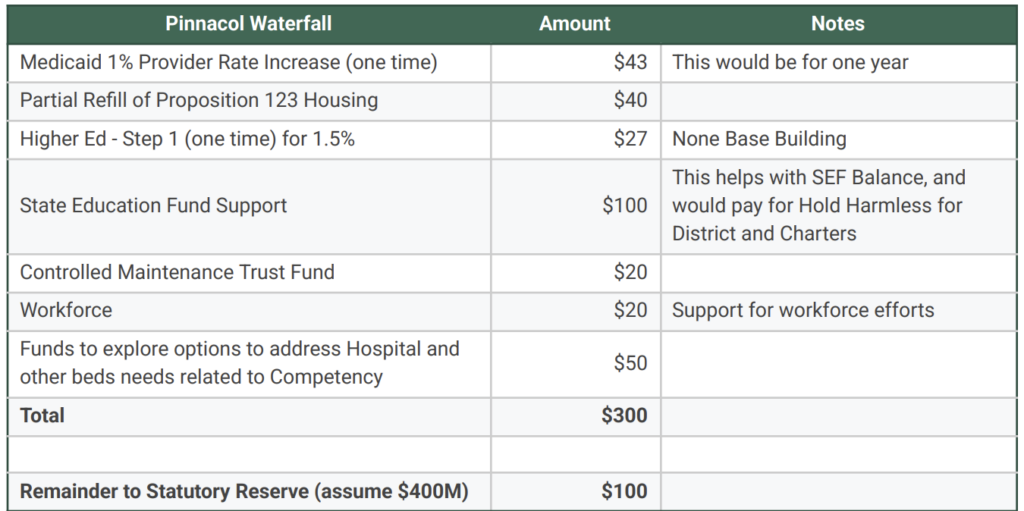
Pinnacol would also pay the state pension plan an amount equal to a 6.25% discount rate. The state pension plan had previously asked for $302 million.
Unions and employee groups have raised a central worry — whether Pinnacol would continue serving as the insurer of last resort, the role that requires it to cover any business, no matter how risky.
Under McCluskie’s proposal, Pinnacol would be required to continue serving that market for three years. After three years, the state Division of Insurance would contract with a workers’ compensation insurer to serve that market and the insurer would get a break on its premium taxes, the proposal said.
The renewed push for disaffiliation comes as lawmakers work to balance the 2026–27 budget, relying on what they described as painful cuts and more than $1 billion in cash transfers to close a general fund shortfall.
McCluskie’s bill is not the only proposal attempting to allow Pinnacol to disaffiliate. A ballot measure from Colorado Succeeds would take a different approach, putting $150 million into a workforce training fund. The state would get nothing.
The state title board approved the measure on March 18.
The Pinnacol legislation is not expected to be introduced until after the House completes its work on the 2026-27 state budget.

Colorado justices accept appeals on Netflix taxation, children pursuing neglect cases
Michael Karlik
michael.karlik@coloradopolitics.com
Updated 6 hours ago
The Colorado Supreme Court announced on Monday that it will decide whether Netflix subscriptions are subject to the state’s sales tax as “tangible personal property.” At least three of the court’s seven members must agree to hear an appeal. The...
Bill requiring employers to grant unpaid leave to Colorado lawmakers heads to governor’s desk
Marissa Ventrelli
marissa.ventrelli@coloradopolitics.com
Updated 5 hours ago
Colorado lawmakers are one step away from securing guaranteed unpaid leave from their day jobs during the legislative session after the House narrowly approved the proposal Thursday. Senate Bill 087 would require businesses to allow employees who are members of...
Redistricting fight escalates as Colorado Title Board clears competing ballot proposals
Marianne Goodland
marianne.goodland@coloradopolitics.com
Updated 5 hours ago
Colorado’s title board on Wednesday gave final approval to multiple ballot measures related to congressional redistricting, setting up a series of proposals that could alter how the state draws its U.S. House districts for the 2028 and 2030 elections. The...

Colorado lawmakers propose deep cuts to close $1.2B budget gap
Marianne Goodland
marianne.goodland@coloradopolitics.com
Updated 4 hours ago
The panel of Colorado legislators in charge of crafting next year’s budget has finalized the 2026–27 spending plan built on deep cuts and one‑time cash transfers in an attempt to close a shortfall of more than $1.2 billion. The plan...

Denver judge denies Gov. Polis request to dismiss ICE-related records case
Marianne Goodland
marianne.goodland@coloradopolitics.com
Updated 8 hours ago
A year after blocking the release of state records to federal immigration agents, a Denver judge has now denied Gov. Jared Polis’ effort to end the lawsuit at the center of the dispute. The lawsuit filed against the governor in...
Colorado appeals court orders new sentencing for Tina Peters, upholds convictions
Michael Karlik
michael.karlik@coloradopolitics.com
Updated 4 hours ago
Colorado’s second-highest court determined on Thursday that a trial judge improperly sentenced former Mesa County clerk Tina Peters based upon her exercise of protected speech, while at the same time upholding her convictions. The three-judge Court of Appeals panel also...

Denver promised every school funding from $1B bond — but campuses later closed received far less | Analysis
Nico Brambila
nico.brambila@denvergazette.com
Updated 9 hours ago
Denver voters overwhelmingly approved the largest bond measure in Denver Public Schools history on the promise that every school — including charter campuses — would receive something. And they did. But the nearly $1 billion bond was not distributed evenly....

National conservation area growing by 4,000-plus acres in western Colorado
Seth Boster
seth-boster@coloradopolitics.com
Updated 13 hours ago
A formerly private, sweeping swath of western Colorado is growing a public, red rock wonderland. Spanning 4,000-plus acres, Escalante Ranch has been transferred to the Bureau of Land Management and incorporated into Dominguez-Escalante National Conservation Area, The Conservation Fund recently...
Judge rules that Colorado law makes it too hard for parties to bar unaffiliated voters from primaries
Ernest Luning
ernest.luning@coloradopolitics.com
Updated 12 hours ago
A federal judge ruled in favor of the Colorado Republican Party late Tuesday, saying that a portion of the state law that allows unaffiliated voters to cast ballots in party primaries is unconstitutional because it imposes an unrealistic burden on...

Front Range cities oppose Democratic proposal to permit lot‑splitting
Marianne Goodland
marianne.goodland@coloradopolitics.com
Updated 7 hours ago
Colorado lawmakers are pressing ahead with a plan to let homeowners split their lots to make room for smaller, less expensive houses — a proposal that has drawn sharp opposition from Aurora, Colorado Springs, Denver and other Front Range cities...
PREV
PREVIOUS
Bill requiring employers to grant unpaid leave to Colorado lawmakers heads to governor's desk
Colorado lawmakers are one step away from securing guaranteed unpaid leave from their day jobs during the legislative session after the House narrowly approved the proposal Thursday. Senate Bill 087 would require businesses to allow employees who are members of the Colorado General Assembly to take unpaid leave during the regular legislative session and special […]

Colorado justices accept appeals on Netflix taxation, children pursuing neglect cases
The Colorado Supreme Court announced on Monday that it will decide whether Netflix subscriptions are subject to the state’s sales tax as “tangible personal property.” At least three of the court’s seven members must agree to hear an appeal. The justices also accepted cases that question whether a minor’s legal representative can pursue an appeal […]