

Colorado’s newest federal judge speaks about techniques for advancing cases

U.S. Magistrate Judge Cyrus Y. Chung described on Wednesday the various tactics he employs to resolve court cases, summing up his role with a laxative-based metaphor.
“Someone told a group of us federal magistrate judges that magistrate judges are the Metamucil of the federal system. Our job is to move things through,” he quipped.
Chung is the newest member of Colorado’s federal bench, having been sworn in in January 2025. Speaking to attorneys at the Alfred A. Arraj U.S. Courthouse in Denver, he described how the job differed from his perceptions as a federal prosecutor.
“I only saw magistrate judges during detention hearings or when I needed search warrants from them, which makes you think criminal work is a big part of what’s going on,” he said. But “it’s a very small part of what I do.”
Unlike presidentially nominated and U.S. Senate-confirmed district judges, magistrate judges are appointed to eight-year terms and primarily handle preliminary and administrative matters in cases. However, if the litigants consent in a civil case, a magistrate judge may handle the entire proceeding.
Chung said that the work of Colorado’s federal trial court has exploded in recent months, with civil case filings surpassing 4,000 for the first time in 2025. They are on track to exceed 5,000 this year, he added. In part, a wave of immigration detention challenges has hit the court, with Chung and the other magistrate judges handling the litigation alongside the district judges.
“One of the things that is surprising is how my very presence encourages people to be more civil,” said Chung, raising an example of litigants’ disputes over evidence. “It is surprising how many times I might come into a discovery dispute hearing and I’ll ask the plaintiff’s side, ‘All right, I see your discovery request. What is it you’re actually looking for?’ They say the thing. And the other side is like, ‘That’s the first time I’ve ever heard this.’ I say, ‘Are you OK with it?’ They say, ‘We’re OK with it!’
“I think being in the room sometimes causes attorneys to think twice about taking more extreme positions,” he added.
A significant portion of magistrate judges’ work involves facilitating settlement conferences between litigants in civil cases. Chung’s predecessor, Michael E. Hegarty, was prolific at settling cases, and Chung said the work involves “understanding the real human side of things.”
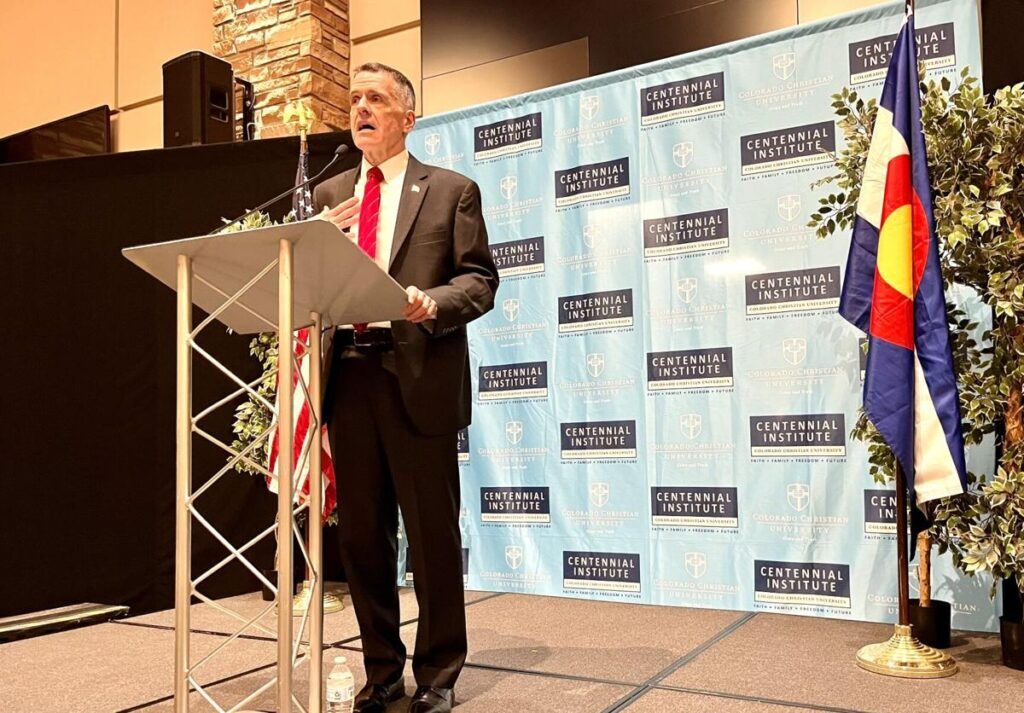
(Photo by Michael Karlik/Colorado Politics)
“Ninety-nine percent of civil cases end up settling or get resolved prior to trial. Very few of them go to trial,” he said. “Most of the time, they are coming to me because my criteria is: both parties have to agree that this is a worthwhile effort.”
What he does not appreciate, Chung added, is encountering unrealistic expectations at the settlement conference.
“If your demand six weeks ago was $100,000, and a week before the settlement conference, your demand is now $250,000, and there’s no real good explanation why … the attorneys know the settlement range is probably not going to be between $100,000 and $250,000. It’s going to be somewhere below the initial demand,” Chung said. “It doesn’t mean I can’t settle the case. I have done that. It just takes longer, though, because it means you’re further apart.”
Chung also said he adopted procedures specifically for self-represented, or “pro se,” litigants, including a letter with basic things to know about pursuing a case in federal court.
“I read that to every pro se litigant. I say, ‘It’s not because I think you’re gonna break the rules, but I do it for everyone in your situation so we’re all on the same page,'” he said.
He described a common situation in which a defendant files a motion to dismiss against a pro se plaintiff, who then responds by alleging additional facts that did not appear in their original complaint. In that scenario, Chung talks to the parties and lets them know the plaintiff could simply amend their complaint with the new allegations, or he could grant the defendant’s dismissal motion — and permit the plaintiff to refile their case anyway.
Occasionally, the ability to appoint attorneys through the court’s pro bono program is “immensely helpful in clearing up the issues,” he said.
“I’m trying to look for, ‘Is there some sort of objective marker that would indicate this case has enough merit to move forward that I would assign a pro bono attorney to it?’” Chung said. “If something with my name pops up on that list, you can be assured I have gone through that (consideration).”
Finally, Chung said he is open to feedback on how he conducts himself in the courtroom.
“One of the things about becoming a judge is your feedback loop gets almost entirely cut off. People will tell me I’m doing a great job. No one tells you you’re doing a bad job,” he said. “If there are areas I can be more efficient, while also respecting the rights of the parties, I am open to that.”
The discussion was sponsored by the Faculty of Federal Advocates.

Federal judge dismisses claims against medical contractor for Eagle County jail suicide
Michael Karlik
michael.karlik@coloradopolitics.com
Updated 1 day ago
A federal judge dismissed the claims against a medical contractor for the Eagle County jail and its employees earlier this month, concluding there were insufficient allegations that they violated the constitutional rights of a man who died by suicide in...

Federal judge advances lawsuit seeking overtime compensation for Aurora firefighter trainees
Michael Karlik
michael.karlik@coloradopolitics.com
Updated 2 days ago
A federal judge gave preliminary approval earlier this month to a class of Aurora firefighter trainees who may sue the city over allegations that they were denied overtime pay in violation of federal law. Joseph Elias, who attended Aurora’s fire...
Appeals court says jury not obligated to apply discounts to determine value of stolen merch
Michael Karlik
michael.karlik@coloradopolitics.com
Updated 2 days ago
Colorado’s second-highest court concluded on Thursday that it was up to a Douglas County jury to determine the value of stolen merchandise at a defendant’s theft trial, after both sides presented different estimates of the items’ value. Under state law,...
Public figures have limited path to sue over accusations of criminality, says appeals court
Michael Karlik
michael.karlik@coloradopolitics.com
Updated 2 days ago
Colorado’s second-highest court ruled last week that a public figure cannot sue for defamation solely because a person publicly accuses them of committing a crime, as the statement may be constitutionally protected opinion. A three-judge Court of Appeals panel narrowed...
Federal judge to consider sanctioning ex-Colorado judicial discipline director
Michael Karlik
michael.karlik@coloradopolitics.com
Updated 2 days ago
A federal judge ordered Colorado’s former head of judicial discipline on Wednesday to explain why she should not sanction him for making inaccurate statements about the defendants in his lawsuit against the Colorado Supreme Court and related entities. U.S. District...

Federal judge green-lights trial against Denver officer over race-based enforcement
Michael Karlik
michael.karlik@coloradopolitics.com
Updated 1 day ago
A federal judge green-lit a jury trial last week on a man’s claim that a Denver police officer engaged in racially selective enforcement of the law by arresting him for video recording at a police station, while not arresting a...
Federal judge says 8 years in solitary confinement not grounds to reduce man’s sentence
Michael Karlik
michael.karlik@coloradopolitics.com
Updated 3 days ago
A federal judge concluded earlier this month that a man’s eight years allegedly spent in solitary confinement did not justify granting his request for a sentence reduction. However, U.S. District Court Senior Judge William J. Martínez signaled his willingness to...

10th Circuit rejects ‘potential for violence’ when police arrest vehicle occupant’s romantic partner
Michael Karlik
michael.karlik@coloradopolitics.com
Updated 2 days ago
The Denver-based federal appeals court rejected the idea on Tuesday that a vehicle occupant poses a danger to police solely because they are romantically involved with another occupant who officers are arresting. By 2-1, a three-judge panel of the U.S....

Colorado justices grill debt collector about compliance with law
Michael Karlik
michael.karlik@coloradopolitics.com
Updated 3 days ago
The Colorado Supreme Court repeatedly pressed a debt collection company last week to explain how its lawsuit against a Boulder woman for an unpaid credit card balance complied with the specific requirements that state lawmakers have created. Portfolio Recovery Associates,...
Appeals court agrees defendant’s speech constitutionally protected against El Paso County judge
Michael Karlik
michael.karlik@coloradopolitics.com
Updated 4 days ago
Colorado’s second-highest court agreed last week that a defendant’s critical statements toward an El Paso County judge were constitutionally protected and could not form the basis of a retaliation charge. A three-judge Court of Appeals panel concluded that, in context,...
PREV
PREVIOUS

Colorado's Polis joins coalition of governors urging Congress to reject Trump tariffs
Colorado Gov. Jared Polis has joined 18 other governors in writing a letter to members of Congress, urging them to reject President Donald Trump’s efforts to codify tariffs that the U.S. Supreme Court recently invalidated. “Governors across the country are witnessing the same thing: higher prices for families and greater uncertainty for businesses,” Polis said. […]

Colorado auditor finds serious issues with labor agency's unemployment insurance accounting
Colorado’s state auditors found serious issues with the accounting practices of the unemployment insurance division of the Department of Labor and Employment, concluding the agency underestimated and overestimated figures to the tune of billions of dollars. The auditors labeled the problems with its most serious concern — a “material weakness,” an indication of a significant […]