

Judicial discipline commission reports increased transparency, increased submissions
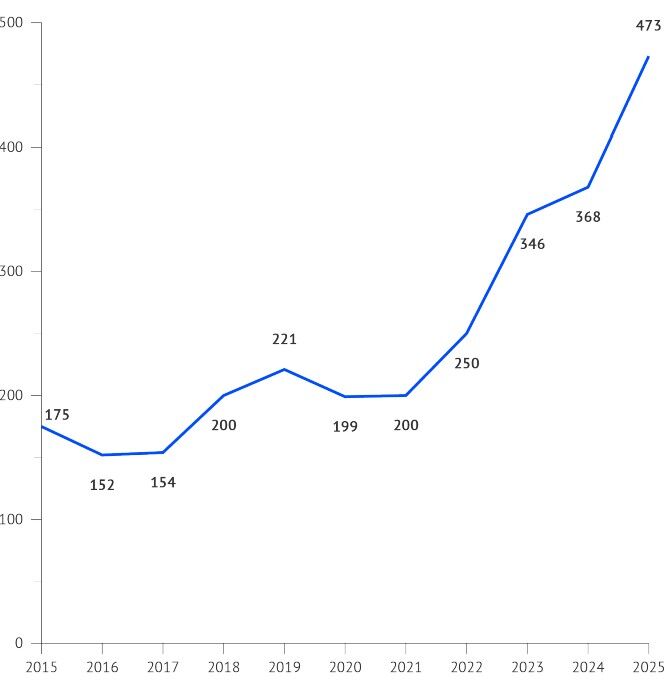
The Colorado Commission on Judicial Discipline received 473 misconduct complaints about judges in 2025, which was nearly 29% higher than in 2024 and substantially greater than any time in the past decade.
However, only 31 complaints were referred to the commission for further action after an initial screening, the organization noted in its annual report released on Tuesday. As in prior years, the vast majority of complaints pertained to judges’ rulings, which must typically be challenged on appeal, not through the disciplinary process.
The commission’s report largely mirrored what executive director Anne Mangiardi told members of the legislature’s judiciary committees in January during annual oversight hearings.
“I think this increase is positive and there’s a couple of factors that are going on. One is that we are in the press,” she said. “More people know we exist.”
She also attributed the increased number of reports to the commission’s updated website, which now has an online complaint form. Further, reports are coming from “high-quality” sources in greater numbers.
“Attorneys, public defenders, district attorneys, other court staff like probation officers and interpreters. Those people who are in courtrooms every day,” Mangiardi said. “We are getting a level of trust with that group of legal professionals and that is really positive.”
The commission’s biggest concern is complaints about delayed rulings, Mangiardi told lawmakers. Commonly, the commission will hear that a judge is overworked and has let a case fall through the cracks.
“Rural judges struggle in different ways than judges in urban jurisdictions. They tend to have different kinds of experience coming onto the bench. But more importantly, they don’t have that kind of built-in mentorship,” she said. “They’re not around their colleagues all the time.”
The commission’s annual report contained new information about the discipline privately imposed on judges whose courtroom behavior was problematic. In 2025, three unidentified judges received private reprimands or censures.
One judge ordered a competency evaluation for a criminal defendant in a “minor criminal matter where the defendant’s in-court conduct showed that order was unwarranted,” the commission wrote. The judge then “unnecessarily escalated the situation by repeatedly asking the defendant questions but not allowing the defendant an opportunity to answer those questions.”
A second judge issued a ruling based on an “unfounded” factual conclusion in a criminal case. The judge was “disrespectful to both the defendant and counsel and repeatedly interrupted counsel and the defendant,” wrote the commission.
Finally, a third judge lost their temper with a self-represented litigant. The judge “screamed at the litigant” and threatened to decide a case-ending motion in the other side’s favor, even though no such motion existed.
The commission’s report also disclosed that it dismissed three cases “with concern” last year. The commission takes that step when “personalized communication with a judge regarding their ethical obligations would be illuminating or helpful,” but their conduct does not warrant discipline.
In addition to the commission’s anonymous interventions, three trial judges underwent public disciplinary proceedings last year, and two have left the bench.
District Court Judge Justin B. Haenlein of Northeastern Colorado resigned following multiple instances of misconduct that included giving legal advice to a former client, failing to disclose a personal relationship when that same client appeared before him as a criminal defendant, and failing to recuse from the case of the client’s boyfriend.
San Miguel County Court Judge Sean K. Murphy also resigned after the commission learned that undisclosed health issues affected his conduct, including his extreme delays in issuing rulings.
The proceedings against Montezuma County Court Judge Ian J. MacLaren are still pending, related to his handling of a criminal case and his interaction with law enforcement stemming from his failure to register his boat as instructed. The discipline commission’s website shows that the three-member panel assigned to adjudicate his case has still not responded to a procedural motion that has been awaiting action since November.
The commission’s report indicated that the Fourth Judicial District of El Paso and Teller counties generated the highest number of misconduct complaints. It is also the most populous of the state’s 23 judicial districts. Mangiardi, during her presentation to the legislative judiciary committees, said there was nothing abnormal happening in the jurisdiction to her knowledge.


Appeals court overturns Douglas County vehicular homicide conviction due to faulty jury instructions
Michael Karlik
michael.karlik@coloradopolitics.com
Updated 21 hours ago
Colorado’s second-highest court overturned a defendant’s vehicular homicide conviction and 12-year prison sentence on Thursday after determining a Douglas County judge omitted key language from the jury instructions that could have resulted in a different outcome. James Paul McDonald was...

Federal judge dismisses malicious prosecution claim against former Denver prosecutor
Michael Karlik
michael.karlik@coloradopolitics.com
Updated 2 days ago
A federal judge concluded on Monday that a former Denver prosecutor could not be sued for allegedly causing the arrests of two plaintiffs after they failed to appear for trial on the scheduled date, even though the trial had been...
Colorado Gov. Jared Polis ignites fierce debate after raising clemency questions in Tina Peters case
Marianne Goodland
marianne.goodland@coloradopolitics.com
Updated 2 days ago
Gov. Jared Polis ignited a political firestorm Tuesday night after weighing in on the prison sentences of two former Colorado officials — a Democrat and a Republican — convicted of attempting to influence a public servant. The comments quickly fueled...

Colorado Supreme Court signals intervention in dispute over treatment for trans children
Michael Karlik
michael.karlik@coloradopolitics.com
Updated 3 days ago
The Colorado Supreme Court ordered Children’s Hospital Colorado on Tuesday to explain why it should not direct the organization to resume providing certain types of services to transgender children in compliance with the state’s non-discrimination law. Last month, a Denver...

Judge nixes latest policy requiring 7 days’ notice for Congress members to visit ICE facilities
Michael Kunzelman
michael.kunzelman@associatedpress.com
Updated 3 days ago
WASHINGTON (AP) — A federal judge agreed on Monday to temporarily suspend the latest version of a Trump administration policy that requires members of Congress to provide a week’s notice before they can visit immigration detention facilities. U.S. District Judge...
Judge nixes latest policy requiring 7 days’ notice for Congress members to visit ICE facilities
Michael Kunzelman
michael.kunzelman@associatedpress.com
Updated 3 days ago
WASHINGTON • A federal judge agreed on Monday to temporarily suspend the latest version of a Trump administration policy that requires members of Congress to provide a week’s notice before they can visit immigration detention facilities. U.S. District Judge Jia...

Colorado Supreme Court clarifies restraining order violations can always support burglary charge
Michael Karlik
michael.karlik@coloradopolitics.com
Updated 2 days ago
The Colorado Supreme Court’s majority ruled on Monday that a violation of a restraining order can also serve as a basis for finding a defendant guilty of burglary. Under state law, a person commits second-degree burglary by unlawfully entering or...

10th Circuit judge creates vacancy, district court gets new chief judge | COURT CRAWL
Michael Karlik
michael.karlik@coloradopolitics.com
Updated 3 days ago
Welcome to Court Crawl, Colorado Politics’ roundup of news from the third branch of government. A longtime member of the Denver-based federal appeals court will give the president a vacancy to fill, plus Colorado’s federal trial court will see a...

Morgan County man accused of killing wife, staging her suicide charged with first-degree murder
Kyla Pearce
kyla.pearce@gazette.com
Updated 3 days ago
A grand jury announced the indictment of 52-year-old Ronald Lowry, who is accused of killing his wife in October 2023 and staging the crime scene to look like a suicide. Lowry, who was arrested Friday in Morgan County, was charged...
Gov. Jared Polis moves to end ICE subpoena fight over Colorado workers’ personal data
Marianne Goodland
marianne.goodland@coloradopolitics.com
Updated 7 days ago
The effort by Gov. Jared Polis to comply with an administrative subpoena from U.S. Immigration and Customs Enforcement for information held by several state agencies is over. Polis, in a motion filed Feb. 20, asked for a permanent injunction and...
PREV
PREVIOUS

Colorado Gov. Jared Polis ignites fierce debate after raising clemency questions in Tina Peters case
Gov. Jared Polis ignited a political firestorm Tuesday night after weighing in on the prison sentences of two former Colorado officials — a Democrat and a Republican — convicted of attempting to influence a public servant. The comments quickly fueled speculation about possible clemency for former Mesa County Clerk Tina Peters and drew sharp pushback […]

Federal judge dismisses malicious prosecution claim against former Denver prosecutor
A federal judge concluded on Monday that a former Denver prosecutor could not be sued for allegedly causing the arrests of two plaintiffs after they failed to appear for trial on the scheduled date, even though the trial had been postponed. Victoria Carbajal and Luis Leal first filed suit more than a decade ago, alleging […]