

Front Range Passenger Rail pitches to Colorado Springs ahead of possible ballot measure

If all goes to plan, a measure for a sales tax to fund passenger rail service could be coming to Front Range ballots in 2026.
“We have a plan that we think is viable, and we’ll actually be able to get things started,” said John Putnam, chair of the Front Range Passenger Rail District Board.
On Thursday, Putnam and others were in Colorado Springs to answer questions at a packed Mt. Carmel Veterans Service Center forum.
Attendees asked about station location, cost, safety, train speed and how passenger trains would share track space with freight trains. If a ballot measure were approved this year, Colorado Springs might have a station in the works before 2031.
The most likely location for the envisioned station is near America the Beautiful Park and the U.S. Olympic and Paralympic Museum.
To the south, Pueblo has gone even further in the planning process, creating a Station Action Plan last year to revitalize the area around Pueblo Union Depot. The project, with passenger platforms, a pedestrian bridge and station restoration, is estimated to cost between $31 and $37 million.
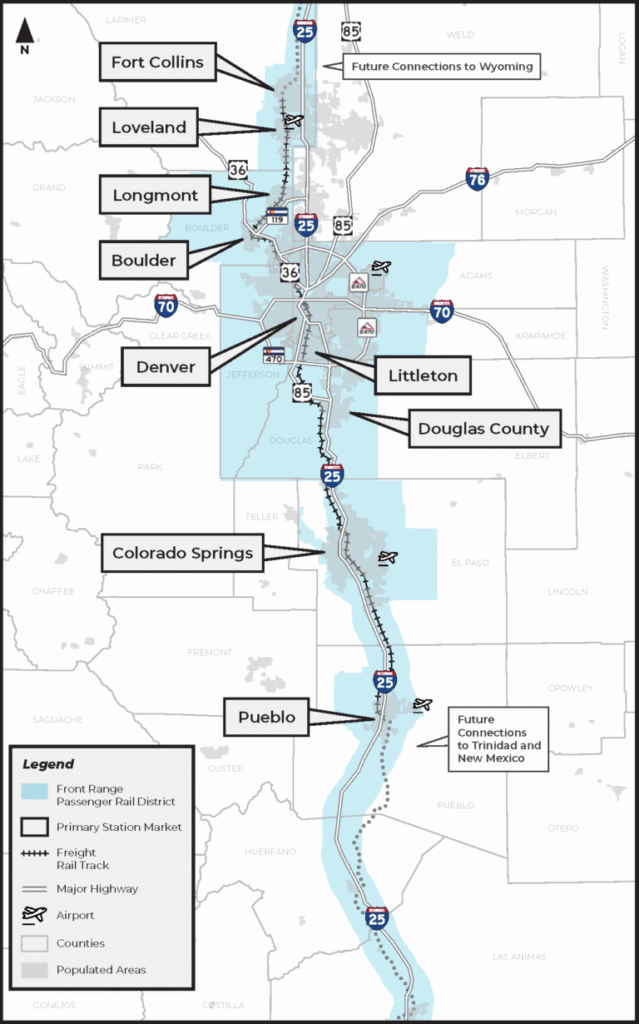
A ballot measure would go to the voters in the district’s bounds: over a dozen communities in a north-south corridor that might benefit from one connected passenger rail line. Before that happens, however, rail leaders need to figure out how to deliver an already-promised line running north from Denver.
District manager Sal Pace said the ballot measure was contingent on multiple transportation stakeholders and BNSF Railway reaching an agreement to create a “starter service” in the northern Front Range by 2029.
The service, with a starting budget of nearly $900 million, would be paid through existing tax revenue streams. The line would run three daily round-trip trains on existing freight lines.
If agreements get signed for the starter service, then the plan would be to use money from the proposed Front Range Passenger Rail sales tax to fund extensions south and an expansion of service to 10 trains a day. Part of the ballot measure would be built in “local returns” for communities to budget improvements around train stations.
Under current estimates, Colorado Springs would receive about $80 million to improve transportation, repair streets and develop other necessities around a proposed station near America the Beautiful Park.
The passenger rail system has some unavoidable drawbacks. One is speed. Since laying new track would likely be cost-prohibitive in the foreseeable future, the plan is to reach agreements with BNSF and Union Pacific to use existing tracks. That means passenger trains would need to work around existing traffic, relying on “very careful negotiations,” according to Putnam.
One downtown Colorado Springs resident, Ken Green, said he was concerned about the sharing strategy.
“Are we going to find out in 10 years, oh gee, we’ve got to put in a whole new system?” he said.
District officials said that freight traffic has declined over the past two decades, creating track space capacity that didn’t previously exist. Putnam said the opportunity was for “good level of service but not an infinite level of service.”
The existing tracks are also not built for speed: trains set a relatively lumbering pace of 79 mph around and over the Front Range’s hilly geographical features.
A nonstop trip from downtown Colorado Springs to downtown Denver — with stops in Douglas County and Littleton — would probably take about an hour and 45 minutes, with not much room for improvement. One forum attendee pointed out her usual route to Denver by car takes a fraction of that time.
The district argues traffic is an increasing problem on Interstate 25, which would make a train a more attractive option. A train would also create a better option for people who don’t have regular access to a car.
Another potential concern is cost.
Putnam said the district was still working on what tax rate it wants to bring to voters. In any case, he said, a train system is not going to become self-sustaining. Except for air travel, Putnam said that no type of transportation infrastructure generates enough profit to pay for itself, including highways.
“We subsidize transportation in the United States,” said Putnam.
Train fares are currently planned at about 20 cents a mile, or about a $15 ticket from Colorado Springs to Denver.
While a decision about a ballot measure is still up in the air, the district is also pursuing a change in its borders to adjust to the newest plans for line location.
Some opportunities for input on a “vision process” to name the line may also be coming in the next few months. Passenger rail used to run from Pueblo to Denver under the name Colorado Eagle until the 1960s: Pace said that name was now overused.
Other well-known U.S. passenger routes include the New Mexico Rail Runner Express, the California Zephyr, Sunset Limited and the Brightline.

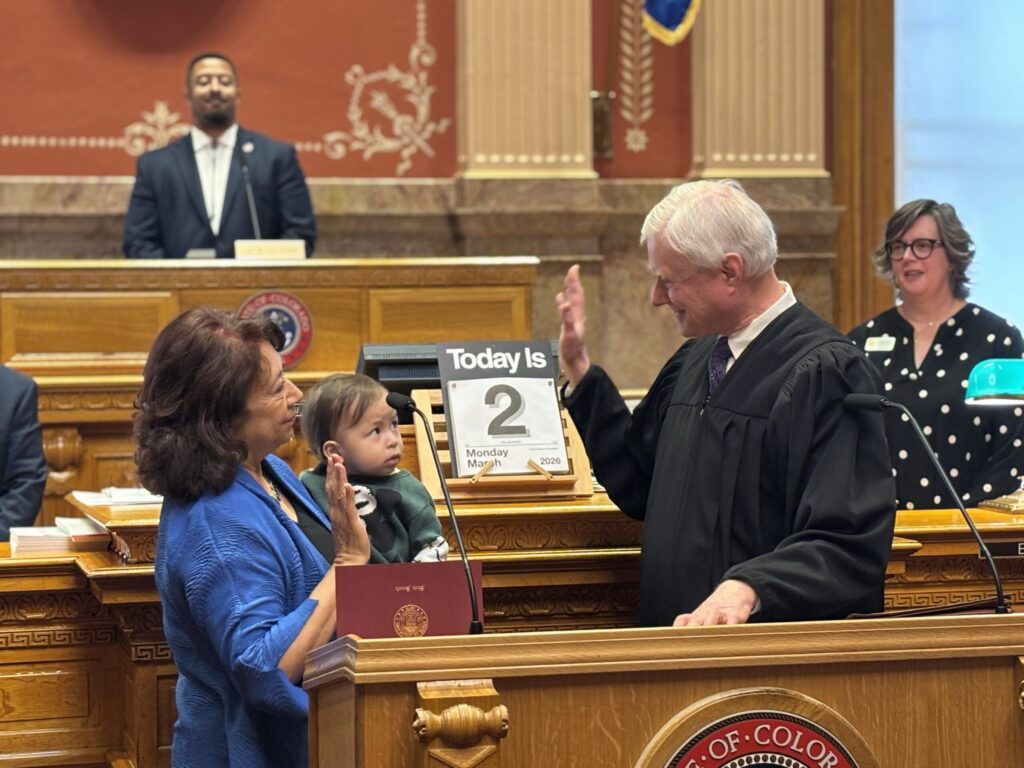
Colorado Senate swears in Adrienne Benavidez after SD 21 vacancy win
Marianne Goodland
marianne.goodland@coloradopolitics.com
Updated 39 minutes ago
Sen. Adrienne Benavidez, D-Adams County, was sworn in Monday to the Colorado Senate, just four days after winning a vacancy election in District 21. She was sworn in by Colorado Court of Appeals Justice Lino S. Lipinsky de Orlov. Usually,...

Denver mayor says his commute time tripled following Alameda traffic change
Mark Samuelson Special to The Denver Gazette
mark.samuelson@denvergazette.com
Updated 2 hours ago
Mayor Mike Johnston is pushing back sharply against the claim by Denver councilmembers and bike activists that the city succumbed to lobbying pressure in revising a “road diet” plan for East Alameda Avenue, while noting that his own commute time...

Rural legislators, Colorado farmers defeat pollinator bill backed by Gov. Polis
Marianne Goodland
marianne.goodland@coloradopolitics.com
Updated 29 minutes ago
A proposal to limit the use of neonicotinoid-coated crop seeds collapsed in the Senate Agriculture and Natural Resources Committee last week, as rural lawmakers, including two Democrats, joined Republicans to reject what they called an expensive, impractical mandate on farmers....

Competing overtime bills for agriculture workers split Colorado Democrats
Marianne Goodland
marianne.goodland@coloradopolitics.com
Updated 4 hours ago
Competing bills setting the overtime threshold for farmworkers have split legislators at the Colorado state Capitol, with one group saying a law passed in 2021 has harmed, rather than helped, farming operations and workers alike, while the other side insists...

Iranians in Colorado weigh in on Khamenei’s death
Mark Samuelson Special to The Denver Gazette
mark.samuelson@denvergazette.com
Updated 1 day ago
As the joint U.S.-Israeli attack on Iranian targets continued into a second day following the death of leader Ayatollah Khomeini, Iranians living in Denver weighed in, saying they welcome the opportunity for a regime change in the Islamic Republic. “The...
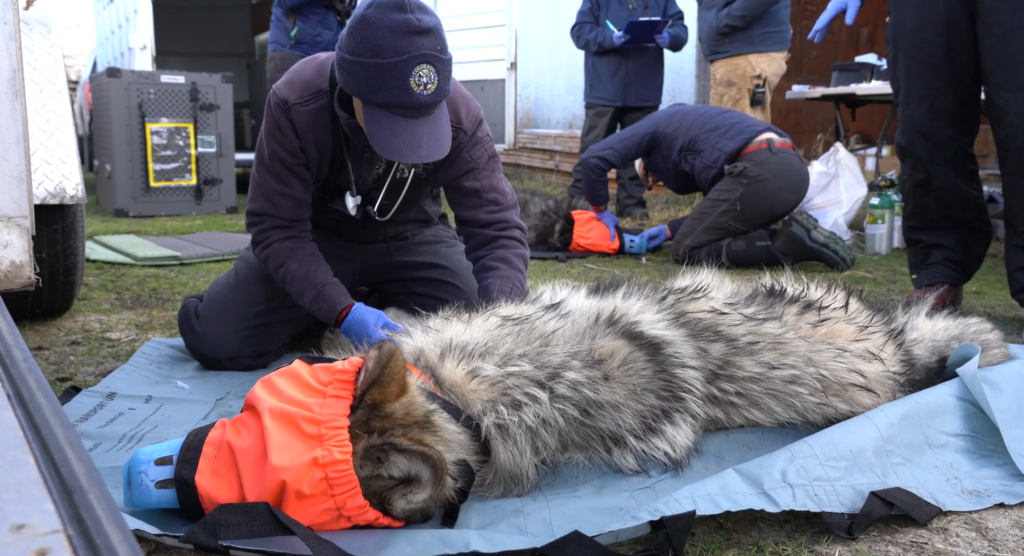
Male wolf dies after capture attempt in Colorado
Marianne Goodland
marianne.goodland@coloradopolitics.com
Updated 23 hours ago
One of the original wolves brought to Colorado from Colorado has died after an attempt to capture it, the’s state wildlife agency said. The Colorado Parks and Wildlife identified the wolf as No. 2305 — meaning it was one of...

Democrat Michael Bennet turns in petitions for Colorado’s gubernatorial primary, plans to skip caucuses
Ernest Luning
ernest.luning@coloradopolitics.com
Updated 1 day ago
U.S. Sen. Michael Bennet, a Democratic candidate for governor, submitted nominating petitions for Colorado’s June primary ballot on Friday, his campaign and the Colorado Secretary of State’s Office said. Bennet plans to rely on his petitions to get on the...

Colorado Republicans, Democrats clash over Iran military operation
Thelma Grimes
thelma.grimes@coloradopolitics.com
Updated 2 days ago
Colorado’s congressional delegation split sharply along party lines Saturday after the U.S. and Israel attacked Iran, triggering a fresh debate in America over presidential war powers. Trump announced early Saturday morning that U.S and Israeli forces had begun “Operation Epic...
Cute puppy overload and an audition of a different kind: Capitol M | Week of Feb. 28, 2026
Marianne Goodland
marianne.goodland@coloradopolitics.com
Updated 4 days ago
The lighter side of the Capitol, and most days, you ought to be really grateful for it. There’s a rumor (jk) floating around that an amendment is coming for the bill to legalize prostitution. The amendment would ban condoms made...
Garfield County sheriff illegally collaborated with ICE, cease and desist letter claims
Michael Braithwaite
michael.braithwaite@gazette.com
Updated 3 days ago
A cease and desist letter filed Wednesday alleged that the Garfield County sheriff intentionally violated state law by collaborating with the U.S. Immigration and Customs Enforcement (ICE). The letter, filed by the law firm Towards Justice, claimed that Garfield County...
PREV
PREVIOUS

US and Israel launch a major attack on Iran and Trump urges Iranians to 'take over your government'
The U.S. and Israel launched a major attack on Iran on Saturday, and President Donald Trump called on the Iranian public to “seize control of your destiny” by rising up against the Islamic leadership that has ruled the nation since 1979. Some of the first strikes appeared to hit areas around the offices of Supreme Leader Ayatollah Ali Khamenei, and Iranian media […]

World leaders react cautiously to US and Israeli strikes on Iran
BRUSSELS • World leaders reacted warily to U.S. and Israeli strikes on Iran on Saturday that triggered worries of a broader conflict. European leaders held emergency meetings and took measures to protect their citizens in the Middle East, with key leaders calling for a negotiated settlement between Iran and the U.S. Australia and Canada were more open […]