

Protecting satellites in space, on the ground a priority for Colorado companies
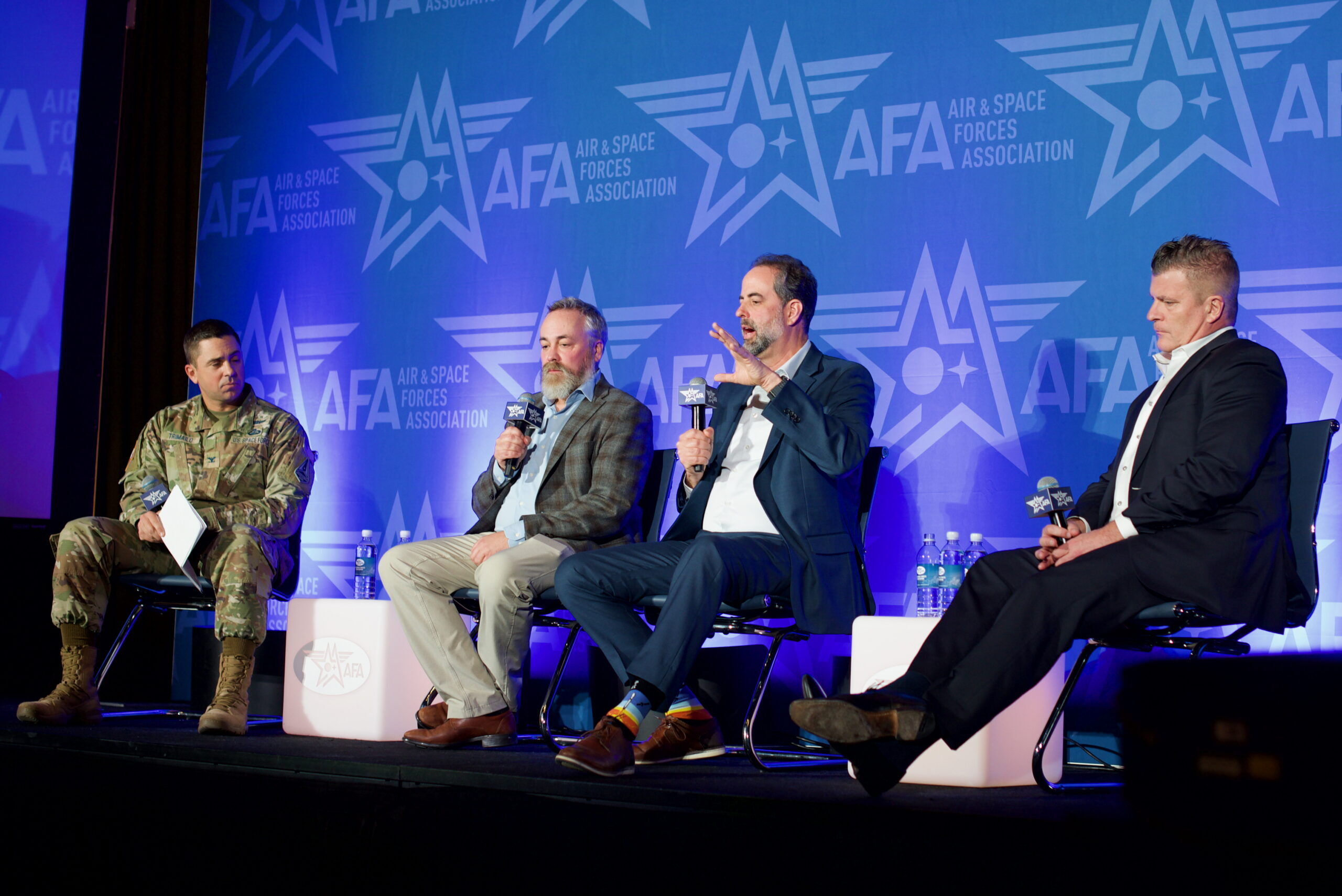
As the Department of Defense moves toward utilizing more commercial partnerships, building a resilient space-based commercial field is contingent on several factors, according to industry leaders at the annual Warfare Symposium in Aurora.
The symposium features businesses of all sizes from around the world to showcase advancements in aerial, cyber and space warfare. During a panel discussion on Tuesday, executives from Viasat, Radia and SAIC, all of which have a presence or headquarters in Colorado, took on the challenge of answering how to “harden” commercial space in the event of a future war.
Hardening commercial space means enhancing its resilience and survivability if a hostile nation attacks. But it means more than just building satellites that can survive an attack, said Mark Lundstrom, CEO of Boulder-based Radia.
“(When) you think about battle hardening, you have to start to think about a system which starts from the factory and goes all the way to orbital insertion,” he said, adding that it requires flexibility on the ground as well as in space.
“Being able to reposition things terrestrially is as important as being able to position things in space,” he said.
Radia is building a plane that might enable that earth-based mobility. The aircraft can carry roughly 10 times as much cargo as a Boeing 777. It would dwarf the C-5 Galaxy, a large cargo airplane used by the Air Force.
Lundstrom said Radia envisions fleets of the airplane, named Windrunner, transporting all the pieces of a launch facility — antennas, gantries and even rockets — to a new location.
Renderings show it carrying helicopters, fighter jets and rockets. It enables mobility, which itself is a part of survivability, Lundstrom said.
Communication relies on networks like GPS-3 that connect cell phones to satellites to banks, according to past coverage by The Gazette. Cyber-attacks that could cripple various networks – such as power grids – are a major threat, and reinforcing them will be critical if the U.S. is ever facing a grave national security threat, the panelists said.
One way to ensure networks, including the internet and communication used by civilians and the military, survive a war could be to close the commercial and civilian use of that network entirely.
But David Schmolke, the vice president of mission connections and cybersecurity at Viasat does not favor this approach. Rather, he thinks there could be an advantage in a hybrid system, one that handles military and commercial traffic.

This way, he said, it’s harder for an adversary to see where and how sensitive information is being networked, because there would be too much data to sift through. It’s a form of camouflage.
Shutting off a network to some users is just bad business, and the businesses need to remain commercially viable, all three panelists agreed.
“It inhibits our ability to get the investment from the purchase space that allows us to scale our satellite network,” said Schmolke. “If I purely just focus on a government customer and ignore commercial all together, then the government has to bring forward all the investment.”
Building a commercial network that the military can use and possibly prioritize in times of need gets the company hundreds of thousands of people on the network. This offsets costs and can result in a more robust and advanced network in the future as companies upgrade their networks, he said.


Greenland is now Colorado’s problem. And that’s a good thing. | Vince Bzdek
Vince Bzdek
vince.bzdek@gazette.com
Updated 1 month ago
The conclusion to the dizzying odyssey over Greenland this week reminded me a little of the ending of the “Wizard of Oz.” If you recall, Dorothy, the Scarecrow, the Lion and the Tin Man finish a great and frightful quest...

NASA taps Colorado companies to lead development on telescope searching for life on other planet
Alexander Edwards
alexander-edwards@coloradopolitics.com
Updated 1 month ago
NASA has selected two Colorado companies to help develop a future NASA space telescope that will look for signs of life on other planets. The flagship project, called the Habitable Worlds Observatory, will be the first space telescope purpose built...

Q&A: Colorado Chamber of Commerce CEO sees warning signs for state economy, despite strengths | FISCAL ROCKIES
Thelma Grimes
thelma.grimes@coloradopolitics.com
Updated 3 months ago
Editor’s Note: Once among the nation’s fastest-growing economies, Colorado today confronts mounting challenges that threaten its momentum. This series reveals how a state once defined by prosperity is navigating economic cliffs and ridges. We explore the impact that increased regulations, tariffs,...

Once a step ahead, Colorado’s economy cools, burdened by rising costs and regulations | FISCAL ROCKIES
Thelma Grimes
thelma.grimes@coloradopolitics.com
Updated 3 months ago
Editor’s Note: Once among the nation’s fastest-growing economies, Colorado today confronts mounting challenges that threaten its momentum. This series reveals how a state once defined by prosperity is navigating economic cliffs and ridges. We explore the impact that increased regulations, tariffs,...

DIA seeks federal OK to pay for salaries of air traffic controllers
Luige DelPuerto
luige.delpuerto@gazette.com
Updated 4 months ago
The Denver International Airport is seeking permission from the federal government to pay for the salaries of air traffic controllers amid news that the Federal Aviation Administration plans to reduce air traffic by 10% across 40 “high-volume” markets beginning Friday morning...
PREV
PREVIOUS

Bipartisan opposition sinks eviction bill in Colorado
Two Democrats sided with Republicans on a legislative panel to reject a proposal that would have made several changes to eviction filings and proceedings, including requiring judges to suppress court records. Sponsored by Rep. Junie Joseph, D-Boulder, House Bill 1047 would also have required landlords to provide tenants with an additional rent payment option beyond […]

House Ethics Committee dismisses some claims, advances others against Rep. Ron Weinberg
The House Ethics Committee voted on Wednesday to accept three allegations filed against Rep. Ron Weinberg, R-Loveland, but combined two into one subject area. The two issues involve inappropriate comments made to female lawmakers in two separate incidents and the alleged use of a master key to access restricted areas of the state Capitol without […]