

San Miguel County’s mining regs threaten Colorado’s uranium revival | OPINION

By Marjorie Haun
In southwestern Colorado’s historic mining town of Telluride — now a haven for the uber-rich, the San Miguel County Commission recently approved mining regulations that will effectively halt new uranium exploration and mining in the county’s mineral rich west end. The vote, delayed nearly two years amid hearings and opposition from rural stakeholders and industry experts, highlights divisions between Telluride’s wealthy liberals and the prospectors, miners, ranchers and working residents in the county’s rural towns.
Telluride, the county seat and population center, is popular with celebrities like Daryl Hannah, Dierks Bentley and Oprah Winfrey who own properties with values in the tens of millions of dollars. Perhaps due to its outsized cultural and financial influence, commissioners tend to favor upscale Telluride and Mountain Village over their rural constituents.
The regulations impose unreasonable barriers to exploration and mining on private and federal lands. They are unnecessary, as state and federal laws already address environmental concerns. They create overlapping requirements that conflict with frameworks for Bureau of Land Management (BLM) and Department of Energy (DOE) lands, risking Supremacy Clause violations by infringing on mineral rights on public domains.
Permits are required for any disturbance beyond casual prospecting, with exhaustive submissions on transportation, noise, blasting, dust, wildlife, vegetation, drainage, erosion and proof of financial/technical expertise. Activities face public hearings before the Planning and County Commission. Reclamation bonds are adjustable; permits expire after three years of inactivity, with extensions creating time-consuming additional processes. Violations risk revocation and bond forfeiture, creating administrative quagmires for the smallest exploration or extraction operations.
Though some of the regulatory conflicts with state and federal laws have been removed, the vaguely defined “Impact Area” clause makes court delays and added costs inevitable. County oversight extends to any “adverse” impact location, triggering a two-step review which demands excessive and unnecessary documentation. Applicants pay for county-selected consultants and exhaustive reports on emissions, habitats, plant monitoring, and light pollution in remote areas. This invites inspections and lawsuits that target the uranium/vanadium industry and threaten the economic future of the county’s small towns.
The framework effectively bans mining to appease Telluride’s elite environmentalist class and eco-tourists who see extraction as an affront to their idyllic scenery, while disregarding the working families in Norwood, Egnar, Redvale and neighboring Nucla, Naturita and Dove Creek. These towns, home to ranchers, miners, tradesmen and small businesses, thrived on the Uravan Mineral Belt in the 1950s and 1970s, which yielded 11% of U.S. uranium and 80% of vanadium during the Cold War.
Veteran uranium professionals warn the county regulations will thwart a revival of uranium and vanadium mining in the southern Uravan Belt where new operations could add $1.3 billion to Colorado’s economy by 2040.
Adam Eckman, president of the Colorado Mining Association (CMA), testified the regulations unlawfully give the county “veto authority” over Division of Reclamation, Mining and Safety approvals, creating duplicative hurdles conflicting with BLM/DOE mandates. It undermines state jurisdiction without improving environmental protections. He noted national implications: “The Department of Energy must secure domestic uranium for nuclear fuel to power electrical expansion for the AI Revolution.” Passage risks federal preemption, as seen in previous local oil-and-gas bans that have been struck down in court.
Montrose County (Nucla, Naturita) Commissioner Sean Pond explains, “These regulations show ideology replacing science and stewardship. They stack hurdles, vague standards, and reviews to impose a de facto mining ban while pretending otherwise.”
With passage of the regulations on Jan. 21, the backlash will be swift. The CMA and allies plan federal lawsuits alleging Fifth Amendment takings and preemption. From a legal standpoint, the county is picking an unwinnable fight. Court fees and damages could reach into the millions; defense costs might bankrupt the county, diverting funds from rural services, roads and schools. Rural taxpayers should not have to carry the financial burden of legally problematic county policies.
San Miguel’s uranium and vanadium ore deposits are where they are because of geology. These ore deposits cannot be moved to some other location. They cannot be replaced. Long before transplanted elites discovered its remote beauty, Telluride was one of Colorado’s oldest and most productive mining towns. A new mining boom would have very little effect on Telluride as it is today. Nevertheless, good mining jobs and related industries would bring a flowering of prosperity to the struggling towns also situated in and near San Miguel County.
The mining regulations aren’t protection — they’re privilege masquerading as conservationism. San Miguel County now faces a harsh reckoning that could cost the county amounts of money that would leave even Telluride’s nouveau riche bewildered.
Marjorie Haun is a freelance journalist who specializes in natural resources policy and western agriculture. She is a longtime contributor to RANGE magazine and owns and manages the website Free Range Report.


Killing off the Regional Transportation District | Miller Hudson
Miller Hudson
miller-hudson@coloradopolitics.com
Updated 10 hours ago
This column is appearing the same day state Sen. Matt Ball (D) of Denver and his legislative co-sponsors unveil legislation implementing many of the recommendations advanced by last summer’s Regional Transportation District Accountability Committee. Although it isn’t readily apparent, they...

Green energy shouldn’t come at expense of Colorado farmers, ranchers feeding us | Rachel Gabel
Rachel Gabel
rachel-gabel@coloradopolitics.com
Updated 10 hours ago
In 2023, the Department of Energy released the National Interest Electric Transmission Corridors (NIETC) study identifying areas they speculate would experience transmission capacity constraints of congestion. The map identified more than 2 million acres or 24% of the state of...

Bill in state legislature would put large apartment projects in single-family neighborhoods | Cronin & Loevy
Tom Cronin Bob Loevy
tom-cronin-bob-loevy@coloradopolitics.com
Updated 9 hours ago
There is an old joke that goes something like this: “When the state legislature is in session, no person and their property are safe.” That is not a joke in the older, more traditional neighborhoods that surround the downtown regions...

Colorado hates its disabled citizens | Jon Caldara
Jon Caldara
jon-caldara@coloradopolitics.com
Updated 4 days ago
This is a selfish column. The legislature is about to hurt my disabled son. My son, Chance, has Down syndrome and a few years ago would have been labeled “retarded.” Then “developmentally delayed.” Now the hypersensitive prefer “intellectually disabled.” Whatever...

Phil Weiser wins top spot in Colorado’s Democratic gubernatorial primary at party’s state assembly
Ernest Luning
ernest.luning@coloradopolitics.com
Updated 2 days ago
Attorney General Phil Weiser’s name will appear first on Colorado’s Democratic gubernatorial primary ballot after his overwhelming win Saturday at the party’s state assembly in Pueblo. Weiser joins U.S. Sen. Michael Bennet in the June 30 primary for the office...

Denver Democrat Diana DeGette trails challenger Melat Kiros at assembly as both qualify for primary
Ernest Luning
ernest.luning@coloradopolitics.com
Updated 2 days ago
U.S. Rep Diana DeGette, a Denver Democrat, qualified for Colorado’s June primary by the skin of her teeth Friday at the party’s district assembly, where the 15-term incumbent received fewer than half as many delegate votes as her challenger, 28-year-old...

Federal judge upholds constitutionality of Colorado campaign contribution limits
Michael Karlik
michael.karlik@coloradopolitics.com
Updated 3 days ago
A federal judge upheld Colorado’s individual campaign contribution limits as constitutional on Thursday, finding that three Republican plaintiffs failed to prove the campaign finance framework violates their First Amendment rights. U.S. District Court Senior Judge John L. Kane recognized that...

Seligman, Bridges, Gonzales lead downballot races heading into Colorado Democrats’ state assembly
Ernest Luning
ernest.luning@coloradopolitics.com
Updated 3 days ago
As Colorado Democrats prepare to designate candidates to the June primary ballot at the party’s state assembly in Pueblo on Saturday, three candidates appear poised to win top-line designation in downballot statewide races, according to data compiled by the state...
Planned Parenthood, groups launch campaign against transgender ballot measures in Colorado
Marissa Ventrelli
marissa.ventrelli@coloradopolitics.com
Updated 3 days ago
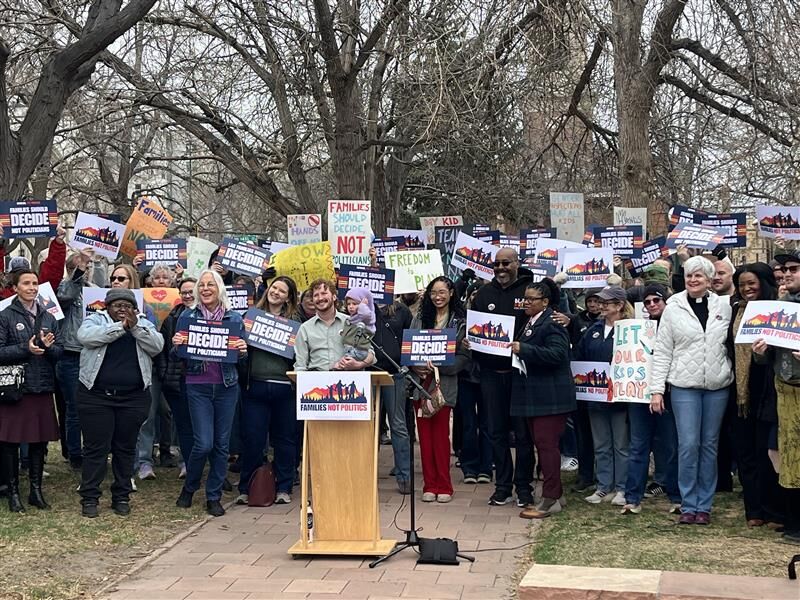
Planned Parenthood and other groups have launched a coalition to oppose two ballot measures that would ban transgender surgeries among children and require student athletes to only join sports teams that correspond to their biological sex. The two measures will...
From pause to progress — a better path on AI policy | OPINION
Colorado Politics
colorado-politics@coloradopolitics.com
Updated 3 days ago
By Brittany Morris Saunders and Loren Furman Last year, following the Special Legislative Session, we wrote in Colorado Politics that delaying Colorado’s AI Act was not a setback. It was an opportunity. We asked state leaders to pause, bring more...
PREV
PREVIOUS

SB 26-066 will make patient care harder, not safer | OPINION
By Kristen Youngdahl As a pharmacist in Colorado, I am proud of the opportunity I have to work with patients consulting them on their specific medical situation and serving as a valuable partner to their overall health. As a trusted partner, I recognize every patient’s needs are uniquely their own. This is why I am […]

Freight rail is Pueblo County's competitive advantage | PODIUM
By Miles Lucero Pueblo County is helping drive Colorado’s next era of economic expansion. From clean energy to steel production to advanced manufacturing, our region is earning recognition for the kind of long-term industrial investment that creates durable, future-ready communities. Rail access is central to that momentum. I spent many years in the freight rail industry, including at one of […]