

DA’s withdrawal from veterans treatment court not judge’s problem, ethics panel says

There are no ethical concerns from a judge continuing to participate in a specialty veterans treatment court if the district attorney’s office has withdrawn from the program, the Colorado Supreme Court’s ethics committee advised on Wednesday.
Colorado law permits chief judges of judicial districts to establish an “appropriate program for the treatment of veterans and members of the military.” The probation, district attorney and public defender offices are involved in developing the guidelines for the program.
An unidentified judge wrote to the Colorado Judicial Ethics Advisory Board to say that his DA’s office announced it would no longer participate in the veterans treatment court, effective Feb. 5. The judge sought guidance on whether he could continue to attend meetings of the specialty court. He was concerned about running afoul of the general prohibition on “ex parte” communications, which means communications that take place without notice to all interested parties.
The advisory board concluded the judge was within his rights to continue participating in the veterans treatment court, as the meetings are not ex parte. Rather, the DA’s office is aware of the meetings and is choosing not to participate.
“Even if those meetings were to be considered ex parte, the Code (of Judicial Conduct) provides that a judge is permitted to engage in ex parte communications as authorized by law or by consent of the parties. In this case, the VTC was authorized by statute and established pursuant to the requirements thereof, including through the participation of the District
Attorney’s Office,” wrote the board in a Feb. 4 advisory opinion.
A spokesperson for the judicial branch told Colorado Politics that District Attorney George Brauchler, who represents Douglas, Elbert and Lincoln counties, was the one who withdrew from his veterans treatment court. Brauchler, who served in the Army, wrote in a Jan. 6 letter that he is concerned the program encompasses too many people by not requiring a connection between a veteran’s service and their diagnosis, and by including those with dishonorable discharges.
“My decision to withdraw should not be interpreted as a rejection of treatment courts as a whole, nor as a departure from our strong commitment to supporting Veterans,” he wrote. “Rather, it merely reflects our disagreement with the current eligibility standards.”
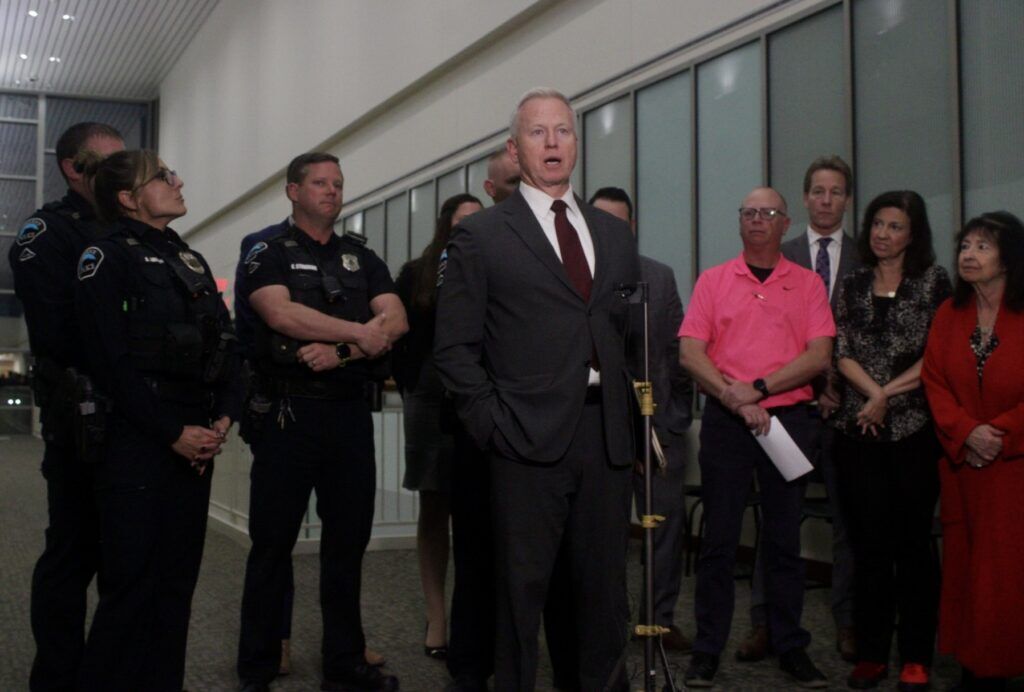
The judge who requested the advisory opinion told the board that a steering committee set up his jurisdiction’s veterans treatment court. The participants included the court, probation officials, the prosecutor’s office, the public defender and the sheriffs’ offices. The specialty court is aimed at criminal defendants who are veterans with a behavioral health disorder. The goal is to help the defendants achieve sobriety and engage in treatment post-conviction, while they serve a probationary sentence.
Before the docket for the veterans treatment court is heard in an open courtroom, the various participants meet privately to discuss each veteran’s compliance with the terms of their probation.
“The attendees may also discuss whether the probation officer intends to file a complaint to revoke probation for noncompliance. Overall, the meeting attendees discuss how to help the VTC Participants succeed and comply with the terms and conditions of VTC probation,” the ethics panel described.
Attendance at the closed-door meetings is limited to entities that signed the memorandum of understanding establishing the program. But non-signatories may be present if they sign a confidentiality agreement. Any motions to terminate a defendant’s probation occur in open court.
When Brauchler’s office withdrew from the memorandum and stopped participating as of Feb. 5, the judge was concerned about continuing to participate in the closed-door meetings with everyone but the prosecution present.
The ethics board, consisting of judges, attorneys and a non-lawyer, concluded it was not problematic for the judge to continue his attendance.
“The judge’s role is more interactive and designed to be part of the team helping Participants to recover, achieve stability, and manage their recovery,” the board wrote. “As explained by the requesting judge, the information discussed in staffing meetings is the same information later discussed in open court on the docket — the meetings simply allow the entire team to work together to support Participants’ compliance.”


Colorado leaders weigh next steps after Supreme Court rejects state ban on ‘conversion therapy’
Marissa Ventrelli
marissa.ventrelli@coloradopolitics.com
Updated 12 hours ago
Colorado leaders said they are weighing next steps after the U.S. Supreme Court on Tuesday rejected the state’s ban on “conversion therapy” for children, as critics and supporters cheered or lambasted the ruling. The court’s near-unanimous decision called the Colorado...
Federal judge dismisses U.S. government lawsuit against Colorado, Denver’s ‘sanctuary’ laws
Michael Karlik
michael.karlik@coloradopolitics.com
Updated 12 hours ago
A federal judge dismissed the U.S. government’s lawsuit against Colorado and Denver on Tuesday, which alleged that various local policies impermissibly infringed on federal immigration enforcement. U.S. District Court Judge Gordon P. Gallagher followed the lead of judges in Illinois...
Federal judge finds DOJ adequately searched for, disclosed records related to Bidens
Michael Karlik
michael.karlik@coloradopolitics.com
Updated 16 hours ago
A federal judge determined on Friday that the U.S. Department of Justice adequately searched for and disclosed records to a Colorado attorney in response to his request for documents related to former President Joe Biden’s son and brother. In November...
10th Circuit warns lawyers after finding fake case in filing
Michael Karlik
michael.karlik@coloradopolitics.com
Updated 10 hours ago
The Denver-based federal appeals court warned attorneys to be more careful last month after discovering one lawyer cited a fake case in his arguments. In recent months, federal and state judges in Colorado have begun cautioning lawyers explicitly about the...

10th Circuit rules cognitively impaired man’s risk of lobotomy, mistreatment in Mexico not ‘torture’
Michael Karlik
michael.karlik@coloradopolitics.com
Updated 1 day ago
The Denver-based federal appeals court concluded last month that a man’s risk of mistreatment or forced lobotomy in his native Mexico did not amount to “torture” that should shield him from deportation. A three-judge panel of the U.S. Court of...
Colorado justices side with news organizations for disclosure of high-level child abuse data
Michael Karlik
michael.karlik@coloradopolitics.com
Updated 13 hours ago
The Colorado Supreme Court ruled on Monday that the state must disclose the number of child abuse reports at individual group living facilities in response to an open records request, as the addresses are already in the public domain. The...
Divided Colorado Supreme Court finds Denver detective did not violate defendant’s Miranda rights
Michael Karlik
michael.karlik@coloradopolitics.com
Updated 1 day ago
The Colorado Supreme Court determined on Monday that a Denver detective did not improperly resume questioning of a defendant in custody after he invoked his right to counsel. By 4-3, the justices reversed a trial judge’s order that found a...

Out-of-state judges address ex-discipline director’s lawsuit, Colorado justices accept federal invitation | COURT CRAWL
Michael Karlik
michael.karlik@coloradopolitics.com
Updated 2 days ago
Welcome to Court Crawl, Colorado Politics’ roundup of news from the third branch of government. A pair of out-of-state judges got down to business in a lawsuit brought by Colorado’s former judicial discipline director, plus the state Supreme Court has...
Federal judge upholds constitutionality of Colorado campaign contribution limits
Michael Karlik
michael.karlik@coloradopolitics.com
Updated 4 days ago
A federal judge upheld Colorado’s individual campaign contribution limits as constitutional on Thursday, finding that three Republican plaintiffs failed to prove the campaign finance framework violates their First Amendment rights. U.S. District Court Senior Judge John L. Kane recognized that...

Appeals court rejects theory that existing tax revenue undermines need for new fees
Michael Karlik
michael.karlik@coloradopolitics.com
Updated 5 days ago
Colorado’s second-highest court rejected a plaintiff’s claim on Thursday that the tax revenue generated by an existing activity should prevent local governments from imposing new fees aimed at regulating the activity. The question stemmed from Colorado’s unique constraints on taxation...
PREV
PREVIOUS

As federal vaccine guidance shifts, Colorado legislator favor recommendations from pediatric groups
Colorado legislators are pushing to codify a practice adopted by some 20 states to use guidance from the American Academy of Pediatrics and other medical associations when setting vaccine policies and immunization schedules. In some cases, the move supplements or diverges from recommendations issued by the Trump administration and the Centers for Disease Control and […]

Federal judge blasts government for violating court order, confiscating man's property
A federal judge gave the government three hours on Friday to return the property of a man released from immigration detention, which it allegedly retained in violation of her previous order. “At its most benign, this failure is an unforced error of preventable dimension. At its worst, this is unjustifiable intransigence, where retention of Petitioner’s […]