

Election 2026 will be a big Democratic year, unless President Trump avoids the ‘sixth-year’ jinx | Bob Loevy

Here is analysis of which political party, the Democrats or the Republicans, will win the 2026 general elections for the U.S. Senate and the U.S. House of Representatives next November.
Because the U.S. president will not be on the ballot in November of 2026, such elections are often referred to as “midterm” elections.
More important, however, these midterm elections are occurring in the “sixth year” of Donald Trump’s presidency.
Trump, a Republican, was elected to his first four-year term as president in 2016. He failed to be reelected in 2020 (losing to Democrat Joe Biden), but Trump was elected to a second four-year term in 2024.
The 2026 elections this coming November for U.S. Senate and U.S. House thus are occurring in the “sixth year” of Donald Trump’s split-term presidency.
It is a well-established long-range pattern in United States elections the incumbent president’s political party loses large numbers of U.S. Senate and U.S. House seats in a normal “sixth-year” general election.
A classic example of this occurred when World War II U.S. General Dwight D Eisenhower was first elected president of the United States in 1952 and reelected in 1956 by a large majority.
However, in the sixth year of Eisenhower’s presidency, 1958, there was a severe economic recession. Eisenhower’s Republican Party lost heavily in the 1958 U.S. Senate and U.S. House elections, giving the rival Democrats large working majorities in both houses of Congress.
Another example of this longtime “sixth year” rule occurred in 1974. Republican Richard Nixon, first elected president in 1968 and reelected in 1972, became involved in the Watergate scandal and had to resign the presidency.
The Democrats made large gains in both the U.S. Senate and the U.S. House elections in the “sixth year” congressional elections of 1974.
So here is one possible and historically reasonable prediction for the 2026 U.S Senate and U.S. House elections, now only 10 months away.
Based on the historical pattern and no other factors, President Trump’s political party, the Republicans, should lose large numbers of seats in the U.S. Senate and U.S. House in the “sixth-year” elections of 2026.
Given the Republican majorities in the present U.S. Senate and U.S. House are very narrow, this possible 2026 outcome would guarantee the Democrats will win solid majorities in both legislative chambers in Congress and switch both majorities from narrowly Republican to clearly Democratic.
That means President Trump will have to deal with a hostile Democratic Congress during his final two years as president of the United States (2027 and 2028). He will need considerable Democratic support to get any of his legislation enacted.
So, what could happen that would upend this historical pattern of the incumbent president’s political party losing big in U. S Senate and U.S. House of Representative elections in the “sixth-year” of the presidency.
Begin with foreign policy.
There are three big foreign policy issues facing the United States that offer President Trump the opportunity to score some victories and thereby reduce the anticipated electoral damage to the Republicans in this “sixth-year” election.
One issue is the Russian-Ukrainian War.
If real and durable peace can be negotiated and the combat deaths and destruction stopped, Trump and the Republicans running for the U.S. House and U.S. Senate will have a winning issue.
A second foreign policy issue is the struggle between Israel and Hamas for control of Gaza.
If, by Election Day, Israel and Hamas have stopped fighting and the peaceful rebuilding of Gaza is underway, then President Trump will look good and Republican losses in the November 2026 “sixth-year” congressional elections will be reduced.
A third foreign policy problem for Trump and Republicans running in the 2026 congressional elections will be the continuing threats by China to militarily invade and control Taiwan.
Here again, Trump and the Republican candidates for Congress will benefit if the Chinese threats against Taiwan are muted and the danger of war in that section of the Pacific Ocean is reduced.
To sum up on foreign policy, Trump must visibly make solid progress on all three of these critical foreign policy issues if he wants to avoid big Democratic gains and severe Republican losses in the U.S. Senate and U.S. House “sixth-year” elections of 2026.
And now a shift from foreign policy to domestic policy.
Trump and Republican candidates for Congress in 2026 must counteract the creeping inflation that has raised prices for average American voters at the grocery store, at the department store and online.
Inflation, which is defined here as a more than 2% annual rise in the cost of living for a number of recent years, is what can be called a “life space” issue.
Unlike foreign policy issues, which are interesting but unlikely to affect a voter’s daily life, “life space” issues like inflation directly affect voters every time they make a purchase.
Life space issues thus have a much bigger effect on citizens’ lives and are a much more powerful influence on how they vote.
And there are other issues that could work to President Trump’s benefit in the November 2026 “sixth-year” elections.
For instance, Trump supporters in states like Texas have succeeded in redistricting the state so Republicans will win more seats in the U.S. House than the Democrats.
A final point is the results of a big electoral shift in a “sixth-year” election will not just affect races for the U.S. Senate and U.S. House.
In other words, if the anticipated Democratic sweep in November 2026 does indeed take place, it will elect Democrats running for state legislatures and other elected offices down the ballot.
A final summation:
The Democrats could be headed for the customary “sixth-year” sweep in the November 2024 general elections.
If that predicted result is not to happen, President Trump will have to score a series of both foreign policy and domestic policy victories, as noted above, to offset those well-known “sixth-year” influences.
As this crucial election year 2026 goes by, keep your eye on those three foreign policy issues and inflation. If President Trump cannot make progress on those four issues, the “sixth-year” jinx should hit him — and the Republican Party — hard.
Bob Loevy is a retired professor of political science at Colorado College who writes about United States and Colorado politics.


If only walls could talk in Colorado governor’s office | Dick Wadhams
Dick Wadhams
dick-wadhams@coloradopolitics.com
Updated 3 hours ago
Restoring the office of the governor in the Colorado State Capitol to its historic glory was a worthy project despite its cost. There is probably never a good time to spend $2.4 million on such a restoration but it is...

TABOR and the Colorado Constitution’s fiscal Gordian Knot | Miller Hudson
Miller Hudson
miller-hudson@coloradopolitics.com
Updated 3 hours ago
A corporate president advised me once there are two kinds of lawyers: “those who tell you why you can’t do things and those who figure out how to get things done anyway.” He only hired the latter. Since the adoption...

Fierce, capable women at the Super Bowl of livestock shows | Rachel Gabel
Rachel Gabel
rachel-gabel@coloradopolitics.com
Updated 3 hours ago
The first cattle to show in the CoBank Arena in the Sue Anschutz-Rodgers Livestock Center at the National Western Stock Show were the Herefords of the Catch-a-Calf program. Anschutz is an ardent supporter of the program and a big fan...

Colorado is shrinking — time for our elected officials to take notice | Jon Caldara
Jon Caldara
jon-caldara@coloradopolitics.com
Updated 3 days ago
By Jon Caldara Something strange is happening in Colorado — strange enough that the political class should notice. People are leaving Colorado. After years of being one of the fastest-growing states in the nation, net in-migration has stopped and may...

National Western Junior Livestock Auction sets record
Marianne Goodland
marianne.goodland@coloradopolitics.com
Updated 2 days ago
The 120th National Western Stock Show, which closes Sunday, saw a standing-room only crowd in the CoBank auction arena at the new Sue Anschutz-Rodgers Livestock Center. Bidders set a record Friday for the top eight livestock – steers, lambs, goats...

Capitol M: Return to Gold Dome High, 2026 edition, and a salute to old IU
Marianne Goodland
marianne.goodland@coloradopolitics.com
Updated 4 days ago
Welcome back, campers! The 2026 legislative session is upon the good citizens of Colorado, and for a few, the first Monday of the session, Jan. 19, was pretty special. There are at least four folks in the Capitol who are...

Report: Colorado government has grown beyond TABOR’s limits
Marissa Ventrelli
marissa.ventrelli@coloradopolitics.com
Updated 2 days ago
Colorado’s government has grown substantially over the past three decades beyond the limits that voters approved to restrain that expansion, according to a new report from a think tank. The analysis from the Independence Institute, which examines state spending, revenue...

The ramifications of President Trump’s pursuit of Greenland | Kelly Sloan
Kelly Sloan
kelly-sloan@coloradopolitics.com
Updated 3 days ago
President Donald Trump has evidently stepped back from his threatened fantasy of invading Greenland — the sovereign territory of a U.S. ally — to which many a sigh of relief has been expressed, including by the markets. There was next...
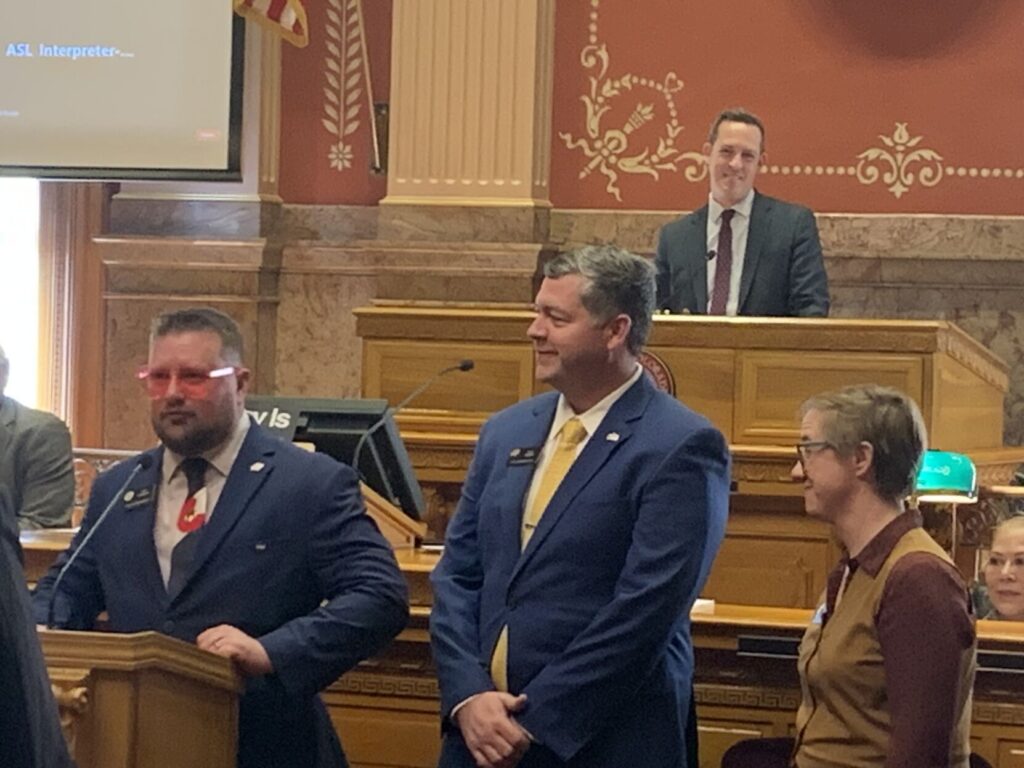
Rep. Ron Weinberg won’t seek reelection
Marianne Goodland
marianne.goodland@coloradopolitics.com
Updated 3 days ago
Republican Rep. Ron Weinberg of Loveland announced on Thursday evening that he will not seek another term in the Colorado House. “Serving this community has been one of the greatest honors of my life,” the two-term state representative said on...

Colorado title board OKs ballot measures to eliminate flat income tax in favor of graduated brackets
Marianne Goodland
marianne.goodland@coloradopolitics.com
Updated 2 days ago
Proponents hoping to change Colorado’s income tax structure from a flat rate to graduated tiers — thereby raising taxes for some brackets — walked away from a Wednesday meeting with eight ballot measures approved by the title board. The coalition...
PREV
PREVIOUS

Colorado is shrinking — time for our elected officials to take notice | Jon Caldara
By Jon Caldara Something strange is happening in Colorado — strange enough that the political class should notice. People are leaving Colorado. After years of being one of the fastest-growing states in the nation, net in-migration has stopped and may be reversing. According to Federal Reserve Bank data, the last time Colorado’s population took a […]

Fierce, capable women at the Super Bowl of livestock shows | Rachel Gabel
The first cattle to show in the CoBank Arena in the Sue Anschutz-Rodgers Livestock Center at the National Western Stock Show were the Herefords of the Catch-a-Calf program. Anschutz is an ardent supporter of the program and a big fan of a burly Hereford, so it was fitting. She was ringside watching in her signature […]