The biggest accelerant of our political tribalism | SONDERMANN
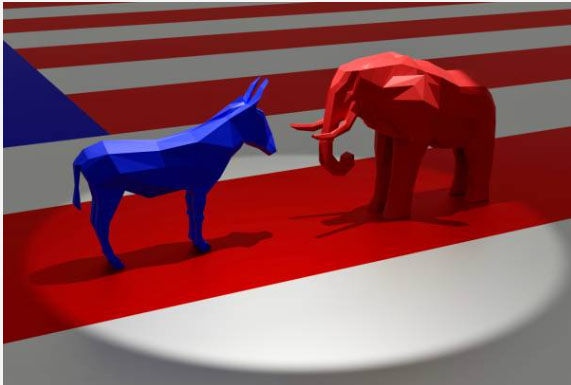
In years past, my go-to word in describing our political condition was “polarization.” I used it endlessly and still do on occasion.
But as time has moved on, and the divide has only grown in depth and toxicity, polarization no longer seems to fully capture the magnitude of what has overtaken us.
In its place, I have largely turned to the word “tribal” as a more accurate depiction. American politics and broader culture at the quarter-point of this century are marked by a tribalism not all that different from the feudal clans of medieval Europe, the African tribes that continue to hold back much of that continent, and the ethnic nationalism that led to the Balkan brutality of the 1990s.
For many, too many, of our countrymen, their affiliation with team red or team blue is definitional and all-encompassing.
There are innumerable causes of this contagion. The practice of curating our media sources as we would a playlist is high on that list. Though, for my money, the largest contributor to this grand fracture goes by a single word: Algorithm.
On a conceptual level, algorithms need not be divisive or problematic. The dictionary defines an algorithm as “a procedure for solving a mathematical problem (as of finding the greatest common divisor) in a finite number of steps that frequently involves repetition of an operation.”
That sounds harmless enough, if over the head of most of us lacking degrees in advanced mathematics.
In practical terms, algorithms are a key component of the internet. Per the website, Nerd News for Normal People (got to love it), “When you type a query into a search engine, the algorithm analyzes billions of web pages to find the most relevant results for you. Similarly, social media algorithms determine which posts you see on your feed based on factors like your interests and interactions.”
It is that latter piece that is so divisive, having technologically sorted us into warring camps. The algorithm serves to show us more and more of what we react to, either in shared agreement or shared hatred.
So many live in social media bubbles with “friends” or “followers” overwhelmingly of like mind. The algorithm reinforces that and dials it up to maximum volume. In the process, one’s viewpoint is constantly bolstered and intensified, and only rarely challenged.
The result has been to make social media a tool of tribal identity. Those who find solidarity with MAGA become ever more animated in that loyalty. On the flip side, those who get out of bed every morning thinking that MAGA is destroying the country find nothing but concurrence and amplification.
By providing a constant dose of what binds one to his or her tribe, the algorithm accelerates the country’s core split. Critical analysis and independent thought fall victim.
Let’s illustrate with a few recent issues. On the subject of undocumented immigrants, deportations and ICE roundups, one side is fed a steady supply of stories of persons here illegally committing violent crimes, abusing public dollars and acting aggressively toward law enforcement. While their opposites receive a comparably one-sided litany of families separated, danger back in the individual’s home country and masked ICE officers acting with belligerence.
Suffice to say that life is more complex and neither side is receiving anything approaching a full and balanced picture.
Or take the ouster and arrest of Venezuelan strongman Nicolas Maduro. Those predisposed to like the current administration hear only of the President’s boldness and the joy of many Venezuelans, both at home and in south Florida, at Maduro’s involuntary exit. Those committed to oppose the administration are exposed solely to questions of presidential authority and doubts as to what comes next.
Or with respect to the current upheaval in Minnesota, one mass of social media users gets an unending drumbeat of immigrant fraud schemes and harassment of ICE officers while their mirror images receive a torrent of stories about a dead Colorado woman, the nobility of resisters and the fear in communities under siege.
Due to the almighty algorithm, social media today brings to mind the old high school football cheer, “Hit ‘em again, hit ‘em again, harder, harder.”
That made for a fun expression of teenage aggression and allegiance. But it hardly answers the call of a contentious age that demands adult thinking beyond our self-imposed boxes. Where reason, rationality, and consideration of other viewpoints are needed, we are instead served doses after doses of tribal dopamine and demonization.
Algorithms are really nothing more than computer code. That programming across platforms now favors division and tribal cohesion. Such code could just as easily give preference to the sharing of conflicting viewpoints and the exchange across hardened political lines.
Were it only so.
Eric Sondermann is a Colorado-based independent political commentator. He writes regularly for Colorado Politics and The Gazette. Reach him at EWS@EricSondermann.com; follow him at @EricSondermann


Capitol M: Return to Gold Dome High, 2026 edition, and a salute to old IU
Marianne Goodland
marianne.goodland@coloradopolitics.com
Updated 2 days ago
Welcome back, campers! The 2026 legislative session is upon the good citizens of Colorado, and for a few, the first Monday of the session, Jan. 19, was pretty special. There are at least four folks in the Capitol who are...

The ramifications of President Trump’s pursuit of Greenland | Kelly Sloan
Kelly Sloan
kelly-sloan@coloradopolitics.com
Updated 21 hours ago
President Donald Trump has evidently stepped back from his threatened fantasy of invading Greenland — the sovereign territory of a U.S. ally — to which many a sigh of relief has been expressed, including by the markets. There was next...
Let’s find out who’s up to the gubernatorial task post Polis | Paula Noonan
Paula Noonan
paula-noonan@coloradopolitics.com
Updated 2 days ago
Gov. Jared Polis is bold and his policies are bolder than bold. That’s the paraphrase of his State of the State speech to open the 2026 General Assembly and start off his last year in office. His sweeping review of...
Volunteer homeowners’ associations to be hit with new lot-splitting law | Bob Loevy
Bob Loevy
bob-loevy@coloradopolitics.com
Updated 2 days ago
Volunteer homeowners’ associations in Colorado Springs, particularly those close to the downtown area, are preparing for another attack on single-family zoning from Gov. Jared Polis and the state legislature during the just underway 2026 legislative session. The new proposal is...
Pardon me? Nah, Gov. Polis — Tina Peters deserves her time | Hal Bidlack
Hal Bidlack
hal-bidlack@coloradopolitics.com
Updated 4 days ago
As my regular reader (Hi, Jeff!) will recall, I’ve oft praised Gov. Jared Polis for exercising great skill in balancing the outcomes of the many, many issues that cross his desk. As a moderate myself, I’ve stood by Mr. Polis...

Political interference, activism a constant under Polis’ Colorado Parks & Wildlife | Rachel Gabel
Rachel Gabel
rachel-gabel@coloradopolitics.com
Updated 5 days ago
Colorado Parks & Wildlife can’t catch a break. If polling were used to measure public trust in agencies, it would be a dreary picture. This, however, is the result of political interference with the agency, not as a result of...

Democratic-socialist experiments in New York, Seattle well worth watching | Miller Hudson
Miller Hudson
miller-hudson@coloradopolitics.com
Updated 5 days ago
Despite writing just once a week, I find myself trying to make content choices two or three weeks ahead — if for no other reason than gathering information. Late last year I theorized Zohran Mamdani just might replace our Tangerine...

French Revolution comes to Colorado Democrats | Jon Caldara
Jon Caldara
jon-caldara@coloradopolitics.com
Updated 1 week ago
The border skirmishes are increasing, and we could be looking at full-blown combat. The simmering civil unrest inside Colorado’s Democratic ranks is heating up, and during this legislative session it might boil over into all-out civil war. If it does,...
Colorado oilmen may play key role in Trump’s Venezuelan oil takeover plan
Vince Bzdek
vince.bzdek@gazette.com
Updated 7 days ago
When President Donald Trump summoned oil executives to the White House recently to push for major investment in Venezuela, an interesting sprinkling of smaller independent companies from Denver was invited along with the big names of American oil. One of...
U.S. careening off the rails under Trump’s stewardship | Paula Noonan
Paula Noonan
paula-noonan@coloradopolitics.com
Updated 1 week ago
Does anyone in Colorado or the United States feel like life is anywhere near normal anymore? Our aberration is not from a pandemic. It’s from our government. It’s at war with us, the people. Let’s take Renée Good’s tragic fate....