

Developers hold meeting on long-debated Monument project
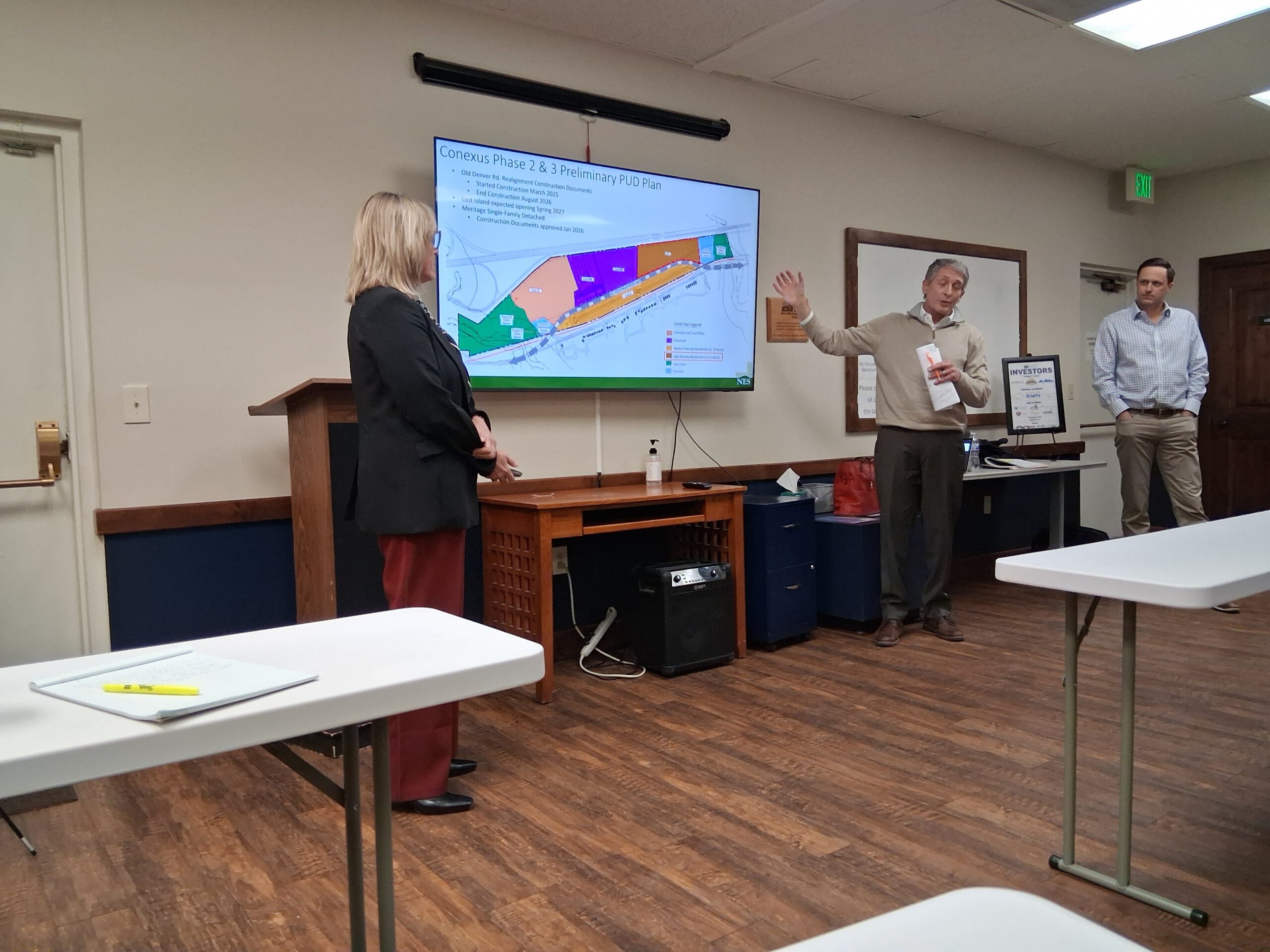
Developers of a swath of land between Old Denver Road and Interstate 25 in Monument have whittled down plans to what they believe is an acceptable compromise with area residents.
The plan, called Conexus Phase 2 and 3, was presented to community members at a meeting on Tuesday night. The crowd was less than 20, a more tepid reception than previously presented plans for the land to be used primarily for industrial purposes. Those plans were withdrawn several years ago after significant public opposition.
The new plan incorporates a mix of uses, some surprising. The section under discussion Tuesday night is a 19-acre parcel where developers want to build a combination of apartments and townhomes -– a total of 354 units. To one side remains a smaller 16-acre area industrial area.
Beyond that, replica dinosaurs tower at the new location of Lost Island Adventure Park, an attraction set to open in spring 2027.
The apartments and townhomes will cater to a demand for “workforce” housing, said Mark Foster, the vice president of development at Hillpointe, a national housing development company spearheading the project.
With a pool, fitness center, and “luxury” touches on things like countertops, he said the units would be in the price range to attract middle-class renters. The construction plans will be going to the town for approval in February, with a hoped-for construction start date in the fourth quarter of 2026.
Meeting attendees who spoke were not enthusiastic about the project, with some expressing concern about emergency egress, traffic and pedestrian safety for the adjacent Santa Fe Regional Trail. Some also said they appreciate developers’ willingness to compromise, considering the land’s existing zoning.
Developers have already redesigned road access to the area, reconfiguring Old Denver Road around a new community of single-family homes, Meritage, which was approved in December.
Melvin Powell, an Air Force veteran whose house has bordered the development zone for 20 years, said the open space behind his house was an initial selling point for him when it was still in agricultural use.
“As a whole, I’m disappointed with the whole thing,” he said.
He said he was waiting to see how the new residential developments might affect the value of his home and the makeup of the area.


The backstory behind the school-funding TABOR ballot initiative | Paula Noonan
Paula Noonan
paula-noonan@coloradopolitics.com
Updated 8 hours ago
Last session, the General Assembly took in a report on K-12 public school funding. The legislature ordered the report because an idea circulated Colorado was among the bottom five states in dollars allocated per student even though it is one...

Colorado’s election audits are built on math, not politics | IN RESPONSE
Colorado Politics
colorado-politics@coloradopolitics.com
Updated 8 hours ago
By Amanda Gonzalez You don’t build a secure election system overnight. You build it over years — layer by layer — reinforcing it with stronger safeguards, better technology and more transparency. In Colorado, one of those safeguards is a little-known...

Colorado auditor finds serious issues with labor agency’s unemployment insurance accounting
Marianne Goodland
marianne.goodland@coloradopolitics.com
Updated 12 hours ago
Colorado’s state auditors found serious issues with the accounting practices of the unemployment insurance division of the Department of Labor and Employment, concluding the agency underestimated and overestimated figures to the tune of billions of dollars. The auditors labeled the...

Colorado’s newest federal judge speaks about techniques for advancing cases
Michael Karlik
michael.karlik@coloradopolitics.com
Updated 12 hours ago
U.S. Magistrate Judge Cyrus Y. Chung described on Wednesday the various tactics he employs to resolve court cases, summing up his role with a laxative-based metaphor. “Someone told a group of us federal magistrate judges that magistrate judges are the...

Inflation held steady last month, but that was before the attack on Iran sent energy costs soaring
Christopher Rugaber
christopher.rugaber@associatedpress.com
Updated 16 hours ago
KANSAS CITY (AP) — Inflation remained stubbornly elevated last month as gas prices rose, but it’s a snapshot of consumer prices before a U.S.-Israeli attack on Iran sent energy costs soaring. Consumer prices rose 2.4% in February compared with a...

Three cargo ships damaged by ‘projectiles’ in Strait of Hormuz
Brady Knox, Washington Examiner
brady.knox.washington.examiner@gazetteedit.wpenginepowered.com
Updated 16 hours ago
Three cargo ships were damaged by unspecified “projectiles” while navigating the Strait of Hormuz, jeopardizing President Donald Trump’s goal of preserving the shipping lane’s safety. The strait was de facto closed the morning hostilities began on Feb. 28, with announcements...

Trump calls on Thune to be a ‘leader’ and get the votes for the SAVE America Act
NAOMI LIM Washington Examiner
naomi-lim-washington-examiner@coloradopolitics.com
Updated 16 hours ago
President Donald Trump increased pressure on Senate Majority Leader John Thune (R-SD) to pass the SAVE America Act, imploring him to be a “leader” after he expressed concerns that there is not enough support for the measure in his chamber....

The ‘talking filibuster,’ explained
Molly Parks, Washington Examiner
molly.parks.washington.examiner@gazetteedit.wpenginepowered.com
Updated 16 hours ago
Senate Republicans have for weeks been debating the use of the “talking filibuster” to guarantee the passage of the SAVE America Act in the upper chamber, after President Donald Trump called the legislation his “No. 1” priority. The bill, which...

Colorado’s Polis joins coalition of governors urging Congress to reject Trump tariffs
Marissa Ventrelli
marissa.ventrelli@coloradopolitics.com
Updated 12 hours ago
Colorado Gov. Jared Polis has joined 18 other governors in writing a letter to members of Congress, urging them to reject President Donald Trump’s efforts to codify tariffs that the U.S. Supreme Court recently invalidated. “Governors across the country are...

Department of Agriculture warns of packages holding potentially invasive seeds
Michael Braithwaite
michael.braithwaite@gazette.com
Updated 11 hours ago
Spring planting is around the corner, and the Colorado Department of Agriculture wants residents to know where their seeds are coming from. Officials with the department warned Tuesday that they received reports of unsolicited packages containing plant seeds mailed internationally...