

Colorado Supreme Court to hear cases on witness retaliation, slip-and-fall

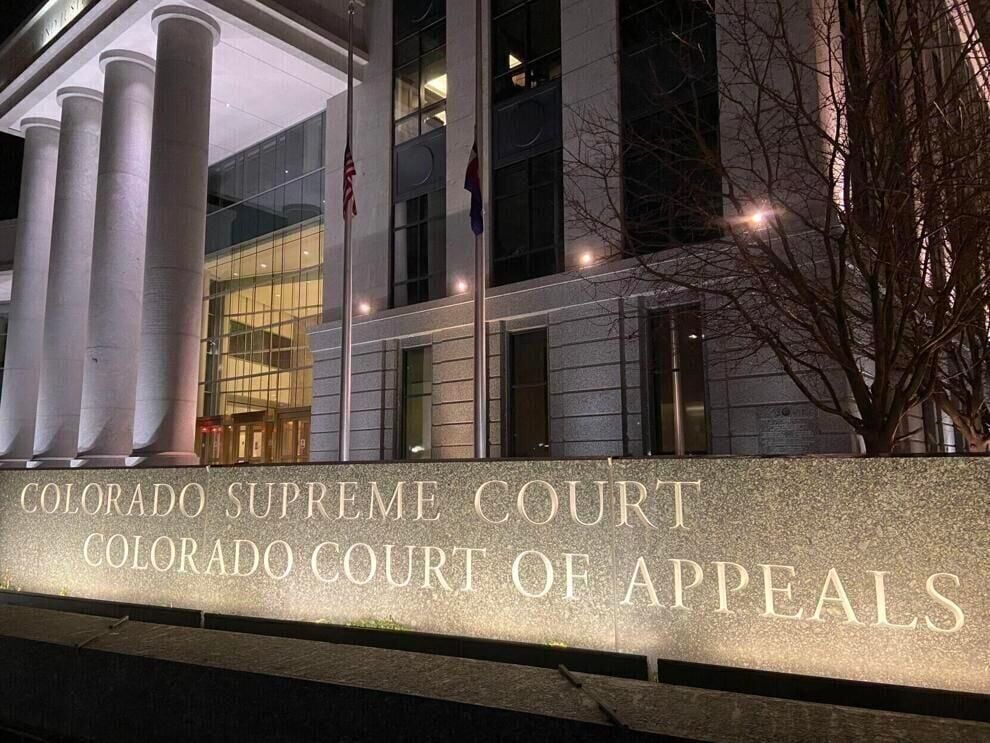
The Colorado Supreme Court announced on Monday that it will decide whether defendants can be convicted of retaliating against a victim or witness when that person has not yet testified and is not scheduled to testify.
At least three of the court’s seven members must agree to hear a case on appeal. There is currently one vacancy to be filled next month.
The justices will also consider when homeowner associations are liable for injuries to guests on their property.
Finally, the court accepted a child-welfare appeal that the state’s Court of Appeals had previously dismissed. Because of the rules governing such cases, neither the Supreme Court nor the Court of Appeals could disclose the underlying filings or decision. Therefore, the circumstances of the appeal are unclear.
Witness retaliation
Erin Amber Trujillo’s son and his ex-girlfriend — who would become the alleged victim in Trujillo’s La Plata County criminal proceedings — were driving together when an argument ensued. The son threw the victim’s cell phone out the window and the victim threw out the son’s wallet. The victim then exited the vehicle at a stoplight.
In response to the victim’s phone call, a sheriff’s deputy stopped Trujillo’s son. The deputy then arrested the son on suspicion of false imprisonment and criminal mischief. Trujillo arrived shortly afterward and told law enforcement her son was “attacked,” “being abused,” and she was “pressing charges against everybody.”
The victim, meanwhile, retrieved her vehicle and met up with her mother at a gas station. The two of them drove to the sheriff’s office, but Trujillo began following closely behind them. Upon arrival, Trujillo pulled nearby and said, “Where is (her son’s) wallet, or I’m going to beat your ass.”
Prosecutors subsequently charged Trujillo with retaliating against a witness or a victim. Jurors convicted her for an attempted offense.
A three-judge Court of Appeals panel reversed her conviction, concluding the jury instruction neglected to accurately describe the elements of the crime.
However, the panel rejected Trujillo’s argument that her conviction should be vacated and a second trial prohibited because the threat or harassment had not occurred after the victim testified, or was even scheduled to testify, against her. Although the panel acknowledged Trujillo was seemingly upset about the wallet, it reasoned that jurors could find Trujillo’s actions were also motivated by the victim’s relationship to her son’s arrest.
Trujillo appealed to the Supreme Court, arguing that the witness retaliation law did not apply when a defendant expresses frustration toward a victim at an early stage.
“The legislature did not intend to cover situations like here, where a criminal case hadn’t even been formally filed let alone testimony scheduled,” wrote public defender Emily Hessler. “If the evidence was sufficient here, retaliation against a victim or witness would become a vast offense committed in a huge number of criminal and civil cases whenever a person involved says something harsh to a party on the opposite side.”
The Supreme Court will examine the issue.
The case is Trujillo v. People.
HOA injury
Tiffani Willis alleged that she lived in the Twin Shores homeowner association in Jefferson County. She described herself as the partner of a unit owner. Although her name was not on the title, she served on the HOA’s board and paid the unit’s dues occasionally.
After she slipped and fell on an icy sidewalk, Willis sued over her injuries. The question then turned to Willis’ legal status.
Under Colorado law, a person injured on another’s property may have an easier or harder time holding the landowner liable, depending on their status. A trespasser can only sue for injuries the landowner “willfully or deliberately caused.” A licensee, in contrast, can sue over hazards the landowner caused and “actually knew about.”
An invitee has the easiest burden to satisfy: They can sue if a landowner did not guard against hazards the landowner “actually knew about or should have known about.”
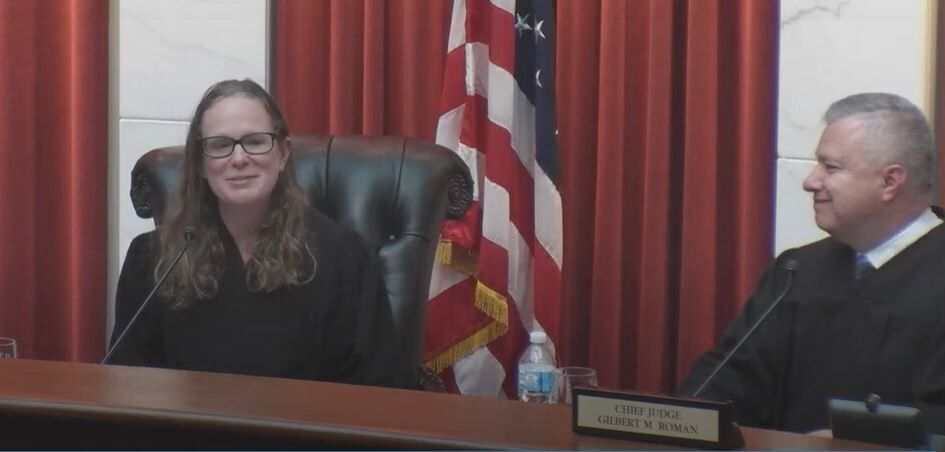
A Court of Appeals panel ultimately did not analyze Willis’ precise relationship to the HOA and to the unit where she lived. Instead, it concluded she was, at a minimum, the guest of a homeowner. That was sufficient to label her an invitee. As such, she only needed to show the HOA should have known about the hazard.
Judge Christina F. Gomez noted Colorado courts treat renters and their guests as invitees, under the theory that the landowner’s business necessarily involves letting others use their common areas in exchange for rent.
Similarly, as “part of the arrangement in a planned community like this one, the association receives periodic dues payments while the unit owners receive the right to invite their guests to use the common elements,” she wrote.
Twin Shores appealed to the Supreme Court, arguing the Court of Appeals unnecessarily broadened the liability of HOAs for injuries on property they own.
“Colorado law was and is sufficient, without revision or judicial expansion, to address the issue presented: Ms. Willis as a matter of law was a licensee, because she was the social guest of a resident at Twin Shores,” the HOA’s lawyers wrote.
The Supreme Court will review the appellate panel’s conclusion.
The case is Twin Shores Master Owner Association, Inc. et al. v. Willis.


Appeals court overturns Douglas County vehicular homicide conviction due to faulty jury instructions
Michael Karlik
michael.karlik@coloradopolitics.com
Updated 21 hours ago
Colorado’s second-highest court overturned a defendant’s vehicular homicide conviction and 12-year prison sentence on Thursday after determining a Douglas County judge omitted key language from the jury instructions that could have resulted in a different outcome. James Paul McDonald was...

Federal judge dismisses malicious prosecution claim against former Denver prosecutor
Michael Karlik
michael.karlik@coloradopolitics.com
Updated 2 days ago
A federal judge concluded on Monday that a former Denver prosecutor could not be sued for allegedly causing the arrests of two plaintiffs after they failed to appear for trial on the scheduled date, even though the trial had been...
Judicial discipline commission reports increased transparency, increased submissions
Michael Karlik
michael.karlik@coloradopolitics.com
Updated 2 days ago
The Colorado Commission on Judicial Discipline received 473 misconduct complaints about judges in 2025, which was nearly 29% higher than in 2024 and substantially greater than any time in the past decade. However, only 31 complaints were referred to the commission...

Colorado Gov. Jared Polis ignites fierce debate after raising clemency questions in Tina Peters case
Marianne Goodland
marianne.goodland@coloradopolitics.com
Updated 2 days ago
Gov. Jared Polis ignited a political firestorm Tuesday night after weighing in on the prison sentences of two former Colorado officials — a Democrat and a Republican — convicted of attempting to influence a public servant. The comments quickly fueled...

Colorado Supreme Court signals intervention in dispute over treatment for trans children
Michael Karlik
michael.karlik@coloradopolitics.com
Updated 3 days ago
The Colorado Supreme Court ordered Children’s Hospital Colorado on Tuesday to explain why it should not direct the organization to resume providing certain types of services to transgender children in compliance with the state’s non-discrimination law. Last month, a Denver...

Judge nixes latest policy requiring 7 days’ notice for Congress members to visit ICE facilities
Michael Kunzelman
michael.kunzelman@associatedpress.com
Updated 3 days ago
WASHINGTON (AP) — A federal judge agreed on Monday to temporarily suspend the latest version of a Trump administration policy that requires members of Congress to provide a week’s notice before they can visit immigration detention facilities. U.S. District Judge...
Judge nixes latest policy requiring 7 days’ notice for Congress members to visit ICE facilities
Michael Kunzelman
michael.kunzelman@associatedpress.com
Updated 3 days ago
WASHINGTON • A federal judge agreed on Monday to temporarily suspend the latest version of a Trump administration policy that requires members of Congress to provide a week’s notice before they can visit immigration detention facilities. U.S. District Judge Jia...
Colorado Supreme Court clarifies restraining order violations can always support burglary charge
Michael Karlik
michael.karlik@coloradopolitics.com
Updated 2 days ago
The Colorado Supreme Court’s majority ruled on Monday that a violation of a restraining order can also serve as a basis for finding a defendant guilty of burglary. Under state law, a person commits second-degree burglary by unlawfully entering or...

10th Circuit judge creates vacancy, district court gets new chief judge | COURT CRAWL
Michael Karlik
michael.karlik@coloradopolitics.com
Updated 3 days ago
Welcome to Court Crawl, Colorado Politics’ roundup of news from the third branch of government. A longtime member of the Denver-based federal appeals court will give the president a vacancy to fill, plus Colorado’s federal trial court will see a...

Morgan County man accused of killing wife, staging her suicide charged with first-degree murder
Kyla Pearce
kyla.pearce@gazette.com
Updated 3 days ago
A grand jury announced the indictment of 52-year-old Ronald Lowry, who is accused of killing his wife in October 2023 and staging the crime scene to look like a suicide. Lowry, who was arrested Friday in Morgan County, was charged...
PREV
PREVIOUS

Polis delivers final state address to Colorado legislature
Gov. Jared Polis delivered his final State of the State address to the Colorado General Assembly this morning and outlined his agenda for this year’s legislative session, with a focus on housing, early childhood development, and the economy. He expectedly touted his accomplishments in the last seven years, as well as spelled out the challenges […]

Gov. Jared Polis' final address draws mixed reaction
Gov. Jared Polis used his final State of the State address to reflect on seven years of policy changes, blending cultural references and nostalgia, and drawing sharply different reactions from people. Lawmakers both past and present — as well as representatives from state agencies, nonprofit organizations and other guests — listened to Polis speak for […]