

Unsolicited advice to both Republicans and Democrats | SONDERMANN
This even-numbered year will be one of political turnover in Colorado with the governor’s chair opening up, along with the other state executive offices (attorney general, state treasurer, and secretary of state), all due to term limits.
A U.S. Senate seat will also be on the ballot. The ultra-competitive 8th district to Denver’s north will be highly targeted by both parties in the pitched battle for control of Congress.
While the November election seems well out in the future, the reality is that these campaigns will soon be at full throttle. Precinct caucuses, that fossilized throwback, are less than two months away.
County meetings will soon follow, leading to the Republican and Democratic state assemblies. All of that is a precursor to the primary elections to be held on the final day of June.
Given Colorado’s relatively new status as something close to a one-party state to go along with the preponderance of safe, non-competitive districts that dot the map, the June primary will be arguably of as much or more consequence than the November general election.
With that by way of setting the table, as an unaffiliated voter for the last quarter century and middle-of-the-road commentator, let me offer some unsolicited advice to both parties, focusing on one hotly contested primary race within each.
First, to Colorado Republicans: The odds of a Republican taking the oath next January as Colorado’s governor range from slim to none. Given the state’s deep blue hue and the extended drift of the local GOP into virtual irrelevance, either Michael Bennet or Phil Weiser will occupy that dais.
In spite of that likelihood bordering on a guarantee, the Republican gubernatorial primary is of utmost importance. It is a pivot point that will say much about whether a formerly venerable, viable party has turned a corner and is again serious about winning and governing or whether that descent into crazyville, reflexive election denialism and political marginalization has yet to hit bottom.
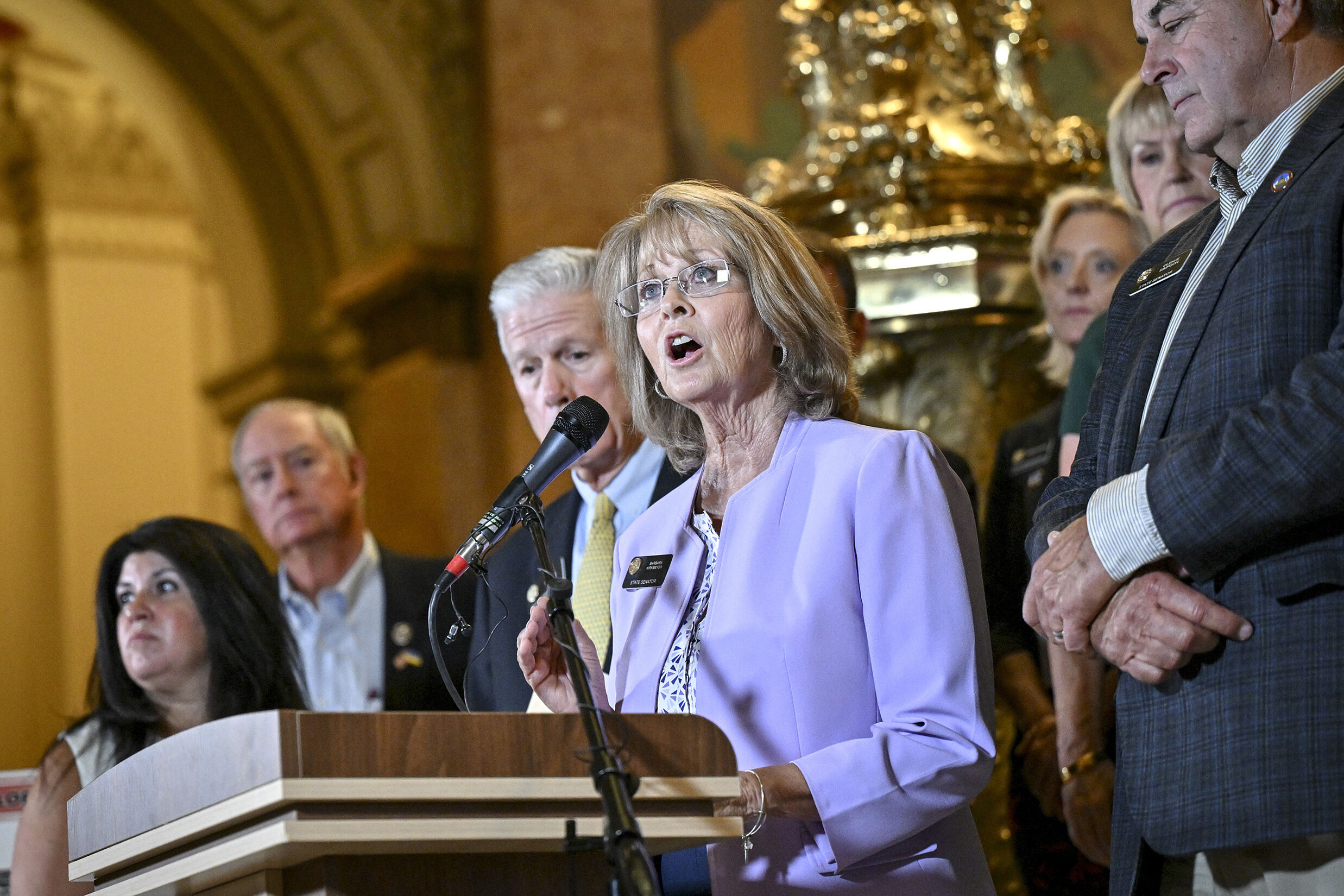
At the most recent count, there are ten declared GOP candidates for the gubernatorial nomination. For ease of processing, I’ll divide the field into two categories. There is Barb Kirkmeyer and then there is everyone else.
Kirkmeyer is a longtime state legislator from southern Weld County who is thoroughly versed in the ins and outs of state government. Where her rivals have platitudes, she has a plan. Hers is a conservatism focused on actual governing, not a collection of soundbites to excite the truest of true believers on the committed right.
Before Republicans can compete and again win in Colorado, they must first get back in the game. Kirkmeyer’s nomination would provide such a start. That is why she boasts endorsements from Bill Owens, the only Republican governor in the last 50 years, and Congressman Gabe Evans, who understands the imperative to appeal beyond the hardcore base.
The Democratic primary is almost sure to determine Colorado’s next governor. However, the Republican primary might be of greater significance for restoring two-party politics.
Let’s now switch to the Democratic side of the aisle and their nomination contest for attorney general to succeed Weiser.
Democrats may chafe at the suggestion, but they could learn a thing or two from the experience of Lauren Boebert. Yes, her.
More precisely, they should take note of the failure of Republicans to deny Boebert the nomination in her newly adopted district. Five Republicans, including several of stature, ran against Boebert in that 2024 primary election.
The result was utterly predictable. Boebert secured the nod with less than 44% of the vote. The multitude of alternative candidates split up the 56% of primary voters who wanted someone other than Boebert. All five of those other candidates produced vote percentages in the low double or high single digits.
Had those five had the wisdom and, yes, self-effacing maturity to come together and rally around a single challenger, it is quite possible that lone alternative could have prevailed.
That lesson is directly applicable to the Democratic contest for attorney general. Jena Griswold is the dominant frontrunner, a la Boebert, notwithstanding her abundant warts and near-total lack of legal experience.
Running against Griswold are former senior Department of Justice attorney Hetal Doshi, Boulder District Attorney Michael Dougherty and consumer advocate David Seligman.
If all, or even just two, remain in the race, they will split the anyone-but-Jena vote, and Griswold will easily triumph. But if Democrats can unite behind one alternate contender, Griswold could be sent packing. Maybe she could sign on somewhere as a junior attorney and learn a bit of the law.
From this vantage point, Doshi may well be the strongest option. Though that is for others to decide. But this is certain: Splinter the vote, as Republicans did against Boebert, and Griswold will waltz into the attorney general’s corner office in her career of failing upwards.
There you go – one pointer for each party. You can thank me later.
Eric Sondermann is a Colorado-based independent political commentator. He writes regularly for ColoradoPolitics and the Gazette newspapers. Reach him at EWS@EricSondermann.com; follow him at @EricSondermann

Should we have recall votes for all Colorado elected officials? | Hal Bidlack
Hal Bidlack
hal-bidlack@coloradopolitics.com
Updated 2 days ago
As I write this on the Sunday before you read it, we’ve just learned of the first American casualties of our, what — war? conflict? attack? — on Iran. The Supreme Leader of Iran, for the past 36 years or...

Could Weiser or Bennet as governor each be an improvement over Polis? | Miller Hudson
Miller Hudson
miller-hudson@coloradopolitics.com
Updated 3 days ago
The weekend before last was a forerunner to numerous forums and debates where U.S. Sen. Michael Bennet and Attorney General Phil Weiser will jostle for position in the Democratic primary for governor. The victor seems certain to be headed to...
Poison, poultry and prostitution — the Colorado legislature marches on | Rachel Gabel
Rachel Gabel
rachel-gabel@coloradopolitics.com
Updated 3 days ago
Many weeks my search history is odd but the past two weeks might worry our county sheriff if he didn’t know me as well as he does. This week has been the week of poison, poultry and prostitution. Not to...
Thoughts on President Trump’s State of the Union address | Cronin & Loevy
Tom Cronin Bob Loevy
tom-cronin-bob-loevy@coloradopolitics.com
Updated 3 days ago
The U.S. Constitution’s Article Two states “He (the president) shall from time to time give to the Congress Information of the State of the Union, and recommend to their Consideration such Measures as he shall judge necessary and expedient….” On...

Are Colorado businesses leaving or evacuating? | Jon Caldara
Jon Caldara
jon-caldara@coloradopolitics.com
Updated 6 days ago
At this point, if you hear beeping downtown, it’s not a construction crew. It’s a company backing out. And look, I get it. Businesses relocate for all sorts of reasons: taxes, regulations, labor costs, office space, crime, commute times, the...
Additional thoughts on State of the Union address/rally | Cronin and Loevy
Tom Cronin Bob Loevy
tom-cronin-bob-loevy@coloradopolitics.com
Updated 4 days ago
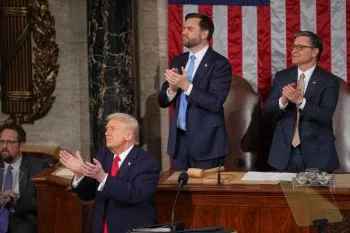
The U.S. Constitution’s Article II states that “He (the president) shall from time to time give to the Congress Information of the State of the Union, and recommend to their Consideration such Measures as he shall judge necessary and expedient...
A cynical import Colorado doesn’t need | SONDERMANN
By Eric Sondermann
by-eric-sondermann@coloradopolitics.com
Updated 4 days ago
“But mommy, he started it.” Every parent, definitely those with more than one kid, has heard this instinctively defensive reaction to the point of exhaustion. It is the ultimate deflection or shifting of the blame. A similar rationale, often about...
Cute puppy overload and an audition of a different kind: Capitol M | Week of Feb. 28, 2026
Marianne Goodland
marianne.goodland@coloradopolitics.com
Updated 6 days ago
The lighter side of the Capitol, and most days, you ought to be really grateful for it. There’s a rumor (jk) floating around that an amendment is coming for the bill to legalize prostitution. The amendment would ban condoms made...
Boulder’s bleak oil-and-gas legal entanglements | Paula Noonan
Paula Noonan
paula-noonan@coloradopolitics.com
Updated 6 days ago
Good neighbor policy in the fossil-fuel-energy industry stops at Boulder’s door. If any other county or municipality decides to rumble with Exxon Mobil and Suncor Energy over their legal exposure to climate lawsuits, those entities will no doubt face “Bleak...
How much liberty do you really believe in? | Hal Bidlack
Hal Bidlack
hal-bidlack@coloradopolitics.com
Updated 1 week ago
I’m guessing my regular readers, if asked which Colorado Politics story I would choose to write about this week, would guess the Out West Roundup, which I admit is a personal favorite. The notion New Mexico would launch a “Truth...
PREV
PREVIOUS
Gov. Jared Polis 'frustrated, surprised' at efforts to revive vetoed union bill
Gov. Jared Polis was surprised that Democratic lawmakers and labor groups are seeking to revive a union-backed legislation less than a year after he vetoed the bill due to worries about its impact on businesses and mandatory dues on workers. Elected officials and labor unions gathered at the Capitol on Thursday to announce the return […]

Vince Bzdek: Coloradans are fed up with the high price of cars
Car buyers in Colorado – and America – are fed up. Cars are too damn expensive. The average price of a new car broke the $50,000 barrier last fall, according to Kelley Blue Book stats. The Wall Street Journal recently noted that the price of cars and trucks in the United States has increased 33% […]