

Colorado campaign debt collection efforts aren’t much of an effort

It was only weeks after the U.S. military in September 2011 repealed its “don’t ask, don’t tell” policy barring openly gay men and women from serving in the armed forces that Army veteran Brian Carroll announced his candidacy for a seat in the Colorado General Assembly.
Carroll, then a member of the state’s National Guard, was believed to be the first openly gay veteran in the nation – he had served seven years that included tours in Afghanistan and Iraq – to run for public office since the policy change. He couldn’t have done so under the previous policy without risking his position.

“Ultimately, what it comes down to, I believe, is standing up and providing opportunity for leadership,” Carroll was quoted at the time by HuffPost.
He never made it to the 2012 Democratic primary election for Lakewood’s House District 28 in March that year, stepping aside when he didn’t qualify for the ballot.
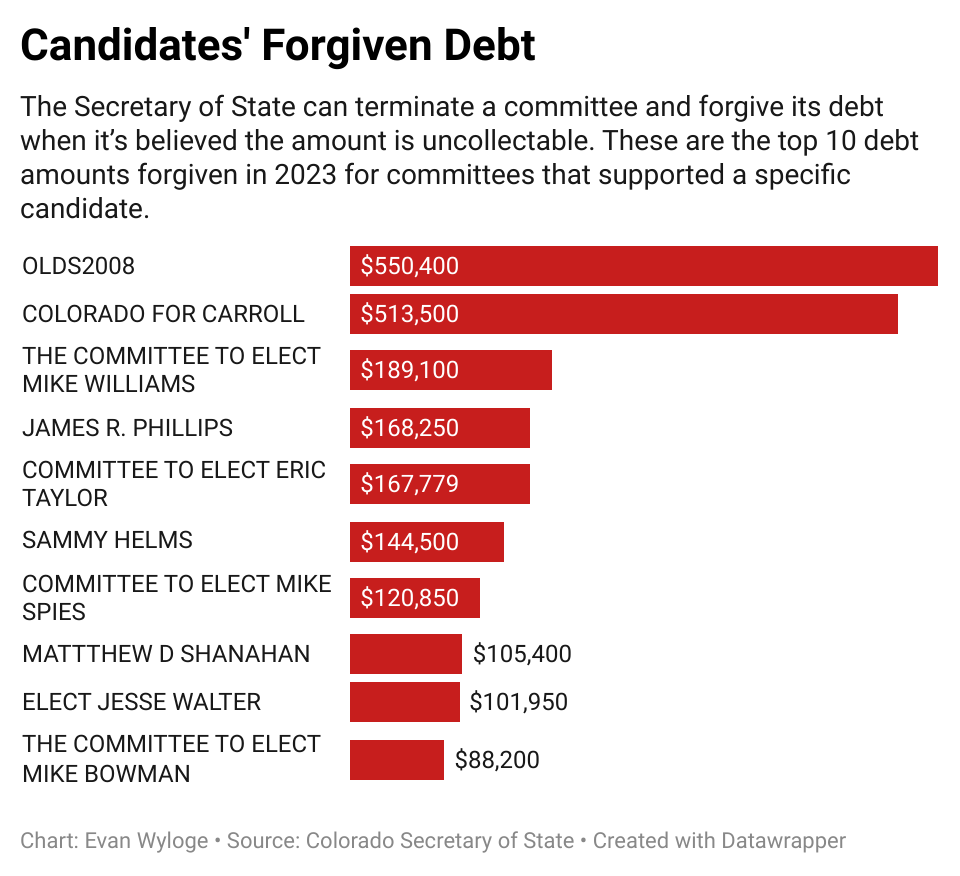
Along the way, Carroll’s campaign committee – Colorado for Carroll – had amassed $513,500 in penalties for missing filing deadlines on the next 22 campaign finance reports that were due because Carroll never closed the committee.
Records show the secretary of state’s office sent delinquency letter after delinquency letter over the course of two years without response. Carroll could not be reached for this report.
Several came back undeliverable.
Finally, in June 2014, the secretary of state’s office formally terminated Carroll’s committee – it’s last report showed it had about $1,900 on hand – and formally imposed the fines.
There were 9 other committees that were terminated that day, records show, when Scott Gessler was secretary of state.
Then, in July 2024, Carroll’s hefty debt was gone.
Just like that.
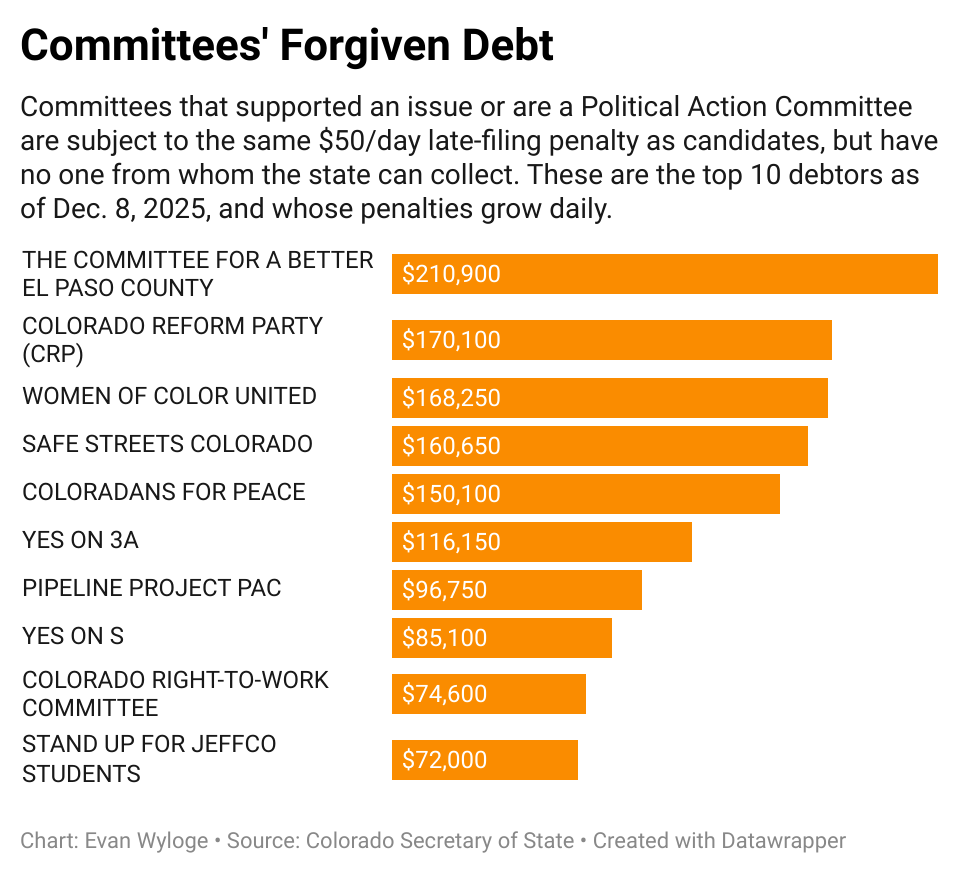
In one swing, 208 campaign committees were absolved of more than $5.1 million of debt they owed the state of Colorado, some dating back more than a decade, a review by The Denver Gazette has found.
The reason: “Collection efforts for all these debts have been unsuccessful.”
The problem, The Denver Gazette found, is that there really wasn’t much of a collection effort in the first place.
Colorado law allows the secretary of state, who is responsible for maintaining all campaign finance filings and overseeing its laws, to terminate an inactive committee after it misses six successive report deadlines.
RELATED: Colorado campaign finance penalties ‘a runaway train without an off-ramp’
Then, if an uncollected debt is older than six years, the state can declare it uncollectable and write it off.
That six-year clock begins when the committee is terminated.
So, for Brian Carroll’s committee, that began in late 2014.
But the state’s collection agency at the time – the state controller’s office in the Department of Personnel Administration was the collector until 2021 – said it hasn’t gotten any such request on campaign finance penalties since at least 2018, the last year for which it still had records. In 2021, the rules changed, and state agencies were instructed to contract their own private collection agencies.
Secretary of State Jena Griswold’s office said it has not hired any collection agency or done any collection efforts – save for the delinquency letters it said it sends.
Yet Griswold’s office in September 2023 twice filed paperwork with the Office of the State Controller requesting the forgiveness of Carroll’s debt and more than 200 others.
The State Controller’s office signed off on the forgiveness request in January, 2024. State Treasurer Dave Young did the same in July that year, records show, officially approving the request.
“According to the secretary of state’s office, Central and Private Collection Agencies had little to no success in collecting the debt,” the paperwork said.
But that effort never happened, The Denver Gazette found.
“It looks like just one big write-off, to get the debts off the books and move on,” said a campaign finance expert who reviewed The Denver Gazette’s findings and would only speak on the condition of anonymity because the expert still works within the system.
Griswold’s office merely said it “has discretion to determine whether it believes the debt is collectible.”
Dozens of committees that make up the list of forgiven debtors supported unsuccessful candidates for office, many of whom simply walked away from the requirement to file any more paperwork, officially close their committee or liquidate what few campaign dollars they had on hand.
Dozens more are Political Action Committees or issue committees that battled through election days and then, like the others, simply stopped and walked away.
In the case of Brian Olds, an unsuccessful American Constitution candidate for state representative in 2008, he racked up dozens of delinquency notices for late or unfiled reports since before that election.
Olds’ committee – Olds2008 – was administratively closed, along with 26 others by the secretary of state in August 2012, records show.
The state said it tried over the next decade to collect the $550,400 it said Olds2008 owed – the most by any committee whose debt was forgiven – but because it couldn’t find Olds or had any address to go on, the state gave up.
Olds’ debt was officially forgiven in July 2024, records show.
The Denver Gazette found Olds in Greenwood Village, just where his voter registration record said he was.
“Well, that’s news to me,” he told The Denver Gazette. “If memory serves, we spent maybe $700 on that whole campaign. The fines are outrageous and it’s not like I’ve been hiding anywhere.”


Colorado Gov. Polis signs bill requiring social media scaled-back social media warrant bill after last year’s veto
Marissa Ventrelli
marissa.ventrelli@coloradopolitics.com
Updated 20 minutes ago
Colorado law enforcement will soon have faster access to digital evidence after Gov. Jared Polis signed a pared‑down bill requiring social media companies to acknowledge and respond to search warrants on a tight timeline, a shift from a broader proposal...
Under fire from legislators and critics, Colorado’s top Medicaid official resigns
Marianne Goodland
marianne.goodland@coloradopolitics.com
Updated 54 minutes ago
Kim Bimestefer resigned Monday as Colorado’s top Medicaid official, stepping down just as a bipartisan bloc of state senators prepared to formally urge Gov. Jared Polis to remove her over what they called years of mismanagement, waste and costly errors...
Power grid shutdowns in Colorado bring protection — and problems
Scott Weiser
scott.weiser@gazette.com
Updated 4 hours ago
A downed power line in Sunshine Canyon in the mountains west of Boulder in December posed an electrocution risk to firefighters and bystanders after Xcel Energy re-energized it without repairing it, despite being notified of the break the day before....
Aurora wildland fire contained at Buckley Space Force Base
Nicholas Fogleman
nicholas.fogleman@denvergazette.com
Updated 4 hours ago
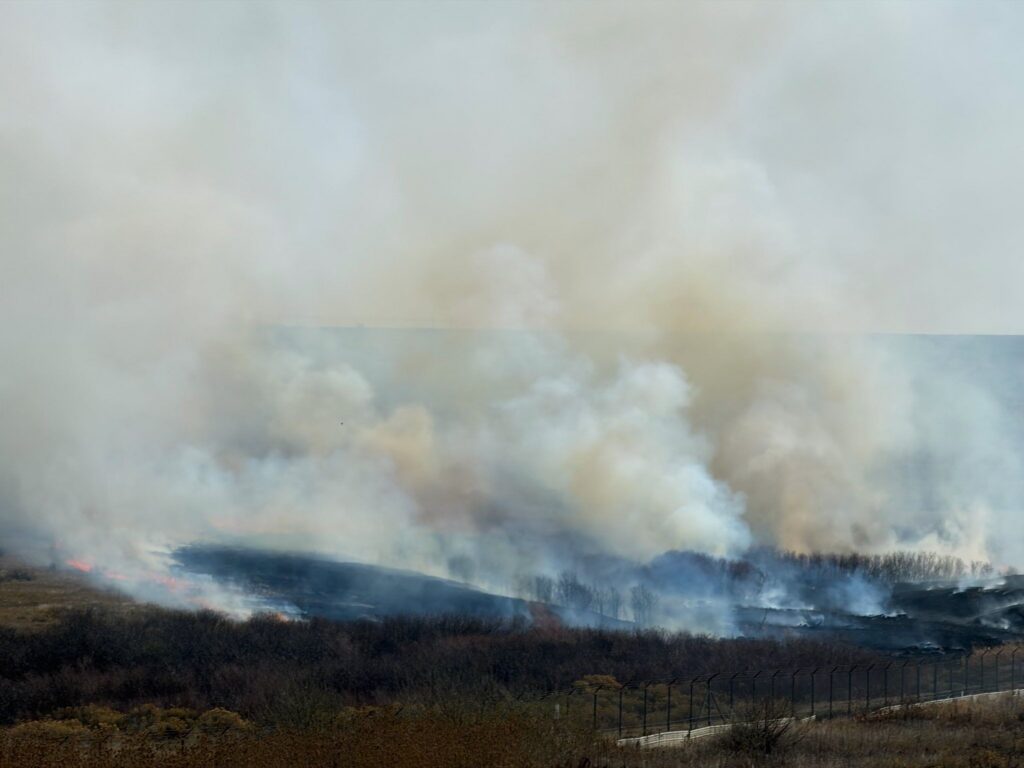
A wildland fire burned Sunday morning on the southwest end of Buckley Space Force Base in Aurora, authorities said. The fire no longer posed a threat and crews were clearing the scene as of 10:53 a.m., according to Aurora Fire...

Unsustainable: How Colorado’s Medicaid spending exploded
Nico Brambila
nico.brambila@denvergazette.com
Updated 5 hours ago
The state’s Medicaid program — which covers about one in four Coloradans — is poised for its largest single-year jump in at least two decades, with officials proposing a $2.3 billion increase, even as lawmakers face a $1.5 billion budget...

Phil Weiser wins top spot in Colorado’s Democratic gubernatorial primary at party’s state assembly
Ernest Luning
ernest.luning@coloradopolitics.com
Updated 2 days ago
Attorney General Phil Weiser’s name will appear first on Colorado’s Democratic gubernatorial primary ballot after his overwhelming win Saturday at the party’s state assembly in Pueblo. Weiser joins U.S. Sen. Michael Bennet in the June 30 primary for the office...
‘No Kings’ protest draws tens of thousands to Colorado state Capitol
Matt Kyle
matt.kyle@denvergazette.com
Updated 2 days ago
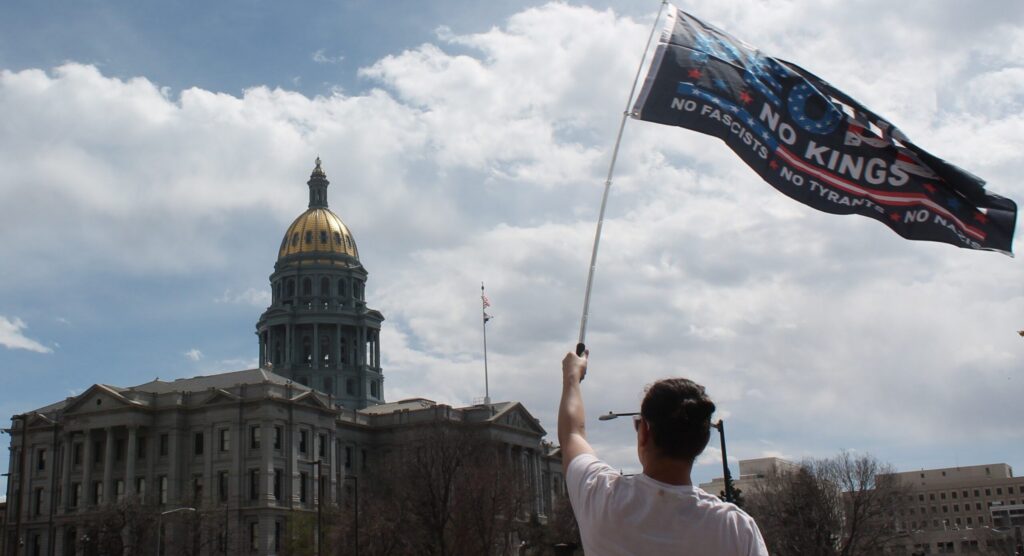
The third round of the national No Kings Day protests hit Denver Saturday, when tens of thousands gathered near the Colorado state Capitol to criticize the Trump administration. Organizers addressing the crowd estimated there were 30,000 present for the Saturday...
Denver Democrat Diana DeGette trails challenger Melat Kiros at assembly as both qualify for primary
Ernest Luning
ernest.luning@coloradopolitics.com
Updated 2 days ago
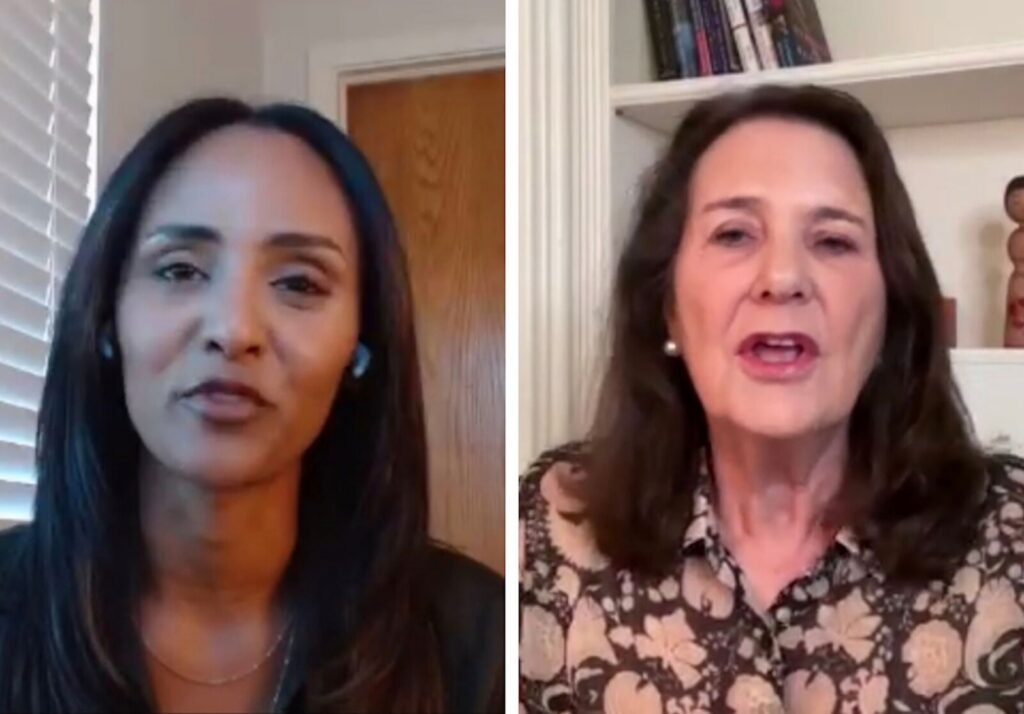
U.S. Rep Diana DeGette, a Denver Democrat, qualified for Colorado’s June primary by the skin of her teeth Friday at the party’s district assembly, where the 15-term incumbent received fewer than half as many delegate votes as her challenger, 28-year-old...
Jeffco adopts updates to wildfire resiliency code
Sage Kelley
sage.kelley@denvergazette.com
Updated 4 hours ago
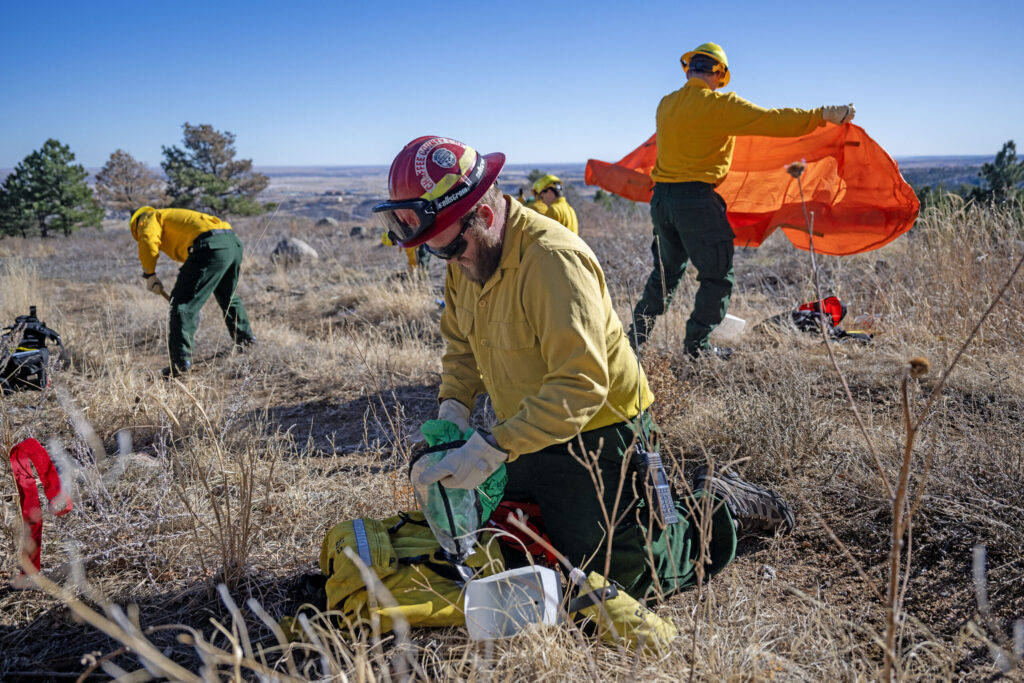
Jefferson County is one of the most at-risk counties for wildfires in the country, and the board of commissioners is attempting to lessen the danger. The Jefferson County commissioners approved updates to the Wildfire Resiliency Code on March 10, including...
Colorado ski resorts announce early closures amid historic snowpack lows, high temperatures
Kyla Pearce
kyla.pearce@gazette.com
Updated 3 days ago
As Colorado’s historically low snowpack year comes to a close and spring conditions take over the mountains, the state’s major ski resorts are announcing closing dates — some of which are weeks before historic closing dates. Most of Colorado’s ski...
PREV
PREVIOUS

Colorado campaign finance penalties 'a runaway train without an off-ramp'
Each day, Mike Stapleton wakes up owing the state of Colorado another $1,550. By the end of each week, Stapleton’s debt for not filing nearly three dozen campaign finance reports dating to April 2018 will have grown by nearly $11,000. As of Dec. 8, Stapleton and his campaign – The Committee to Elect Michael Stapleton […]

Colorado justices splinter over approach to sentencing review
Members of the Colorado Supreme Court were divided on Monday about whether vehicular homicide stemming from intoxicated driving is “grave and serious” in every possible scenario, with two justices suggesting the court reconfigure its approach for determining the proportionality of criminal sentences. The Eighth Amendment’s prohibition on cruel and unusual punishment means sentences cannot be […]