

Colorado’s job growth slows, though economists don’t anticipate a recession
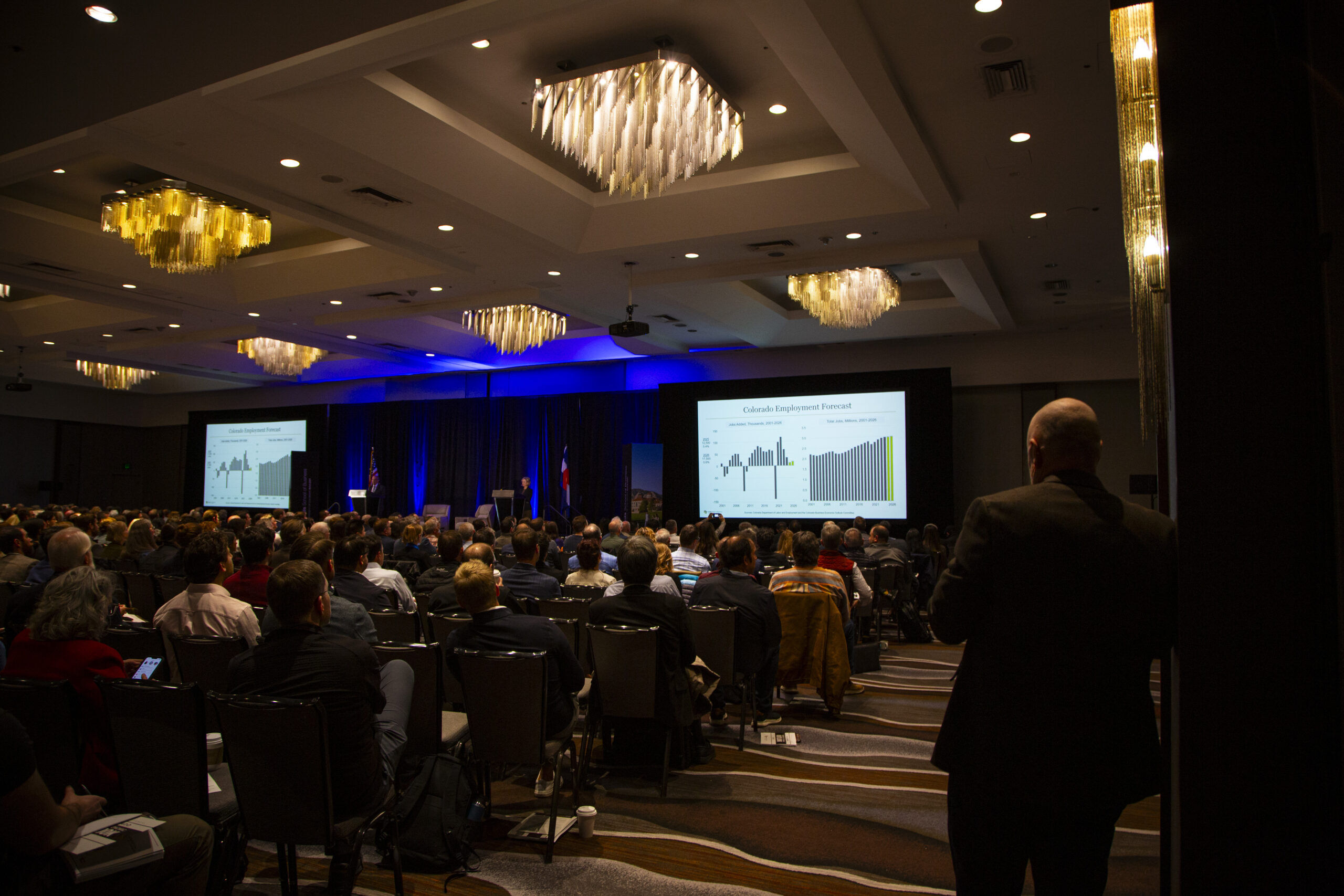
Preliminary estimates show Colorado’s job growth slowed more than expected this year and 2026 could also see slower growth, according to the annual economic outlook from the Business Research Division at the University of Colorado Boulder released Monday.
But sluggish growth doesn’t mean there will be a recession in 2026, economists said.
Employment in the state grew by 1.1% in 2024, the report said. But in 2025, preliminary estimates show it fell to 0.4% growth.
The state could see some improvement next year as the job growth forecast is 0.6%.
The report is the 61st annual outlook on Colorado’s economy, detailing forecasts for job growth and trends impacting industries for 2026 based on analysis from 130 statewide government, business and academic experts.
The 2026 outlook report paints a bleaker picture of job growth across the state compared to last year’s report.
After the Department of Labor revised its data earlier this year, the data showed Colorado had slower job growth than economists originally believed.
For example, researchers corrected the preliminary estimates in 2024 down from 1.6%. And the forecast for job growth in 2025 was first projected to be 1.2% — far above where it’s now expected to be by the end of the year.
“We were really starting from a much lower base when beginning the forecast this year,” said CU Boulder economist Brian Lewandowski. “So, in reality, 2024 was growing much slower than we knew about at the time. And that continued into 2025.”
The slowdown was also exacerbated by business uncertainty under President Donald Trump’s second term, including new policy changes such as federal spending cuts and tariffs, according to analysts.
As estimates go, the projections for 2025 and 2026 aren’t set in stone yet.
There’s a chance Colorado is seeing, or could see, job loss instead of growth.
Lewandowski said “slightly negative” employment is within the margin of error for 0.4% and 0.6% job growth estimates.
“We are sort of really in this flat growth cycle, and it is plausible, but I think unlikely, that we’ll go negative,” Lewandowski said.
RECESSION OR NO?
On the brighter side, Colorado’s gross domestic product grew 2% in 2024 and 2.1% in 2025. The state’s GDP is projected to grow by 2.9% in 2026.
While a lot of economic indicators look muddy, CU Boulder economist Richard Wobbekind said they’re not forecasting a recession.
“Indicators that would measure a recession like GDP are not headed to negative territory,” Wobbekind said at the economic forum.
The economists expect business investment to uptick next year and Trump’s personal income tax cuts could give a short-term stimulus to the economy. The Federal Reserve could continue to cut interest rates, which would also spur more investments.
WHAT INDUSTRIES SAW JOB LOSSES OR GAINS IN 2025?
Most industries in the state saw job losses this year, projections show.
Out of the 11 largest sectors in Colorado, six had job losses in 2025. The largest losses were in the professional and business services sector, which saw employment drop 5.8%.
In addition, job losses also affected retail and transit (-2.6%), information (-2.4%), manufacturing (-1.4%), financial activities (-0.5%) and other services, such as religious and grant nonprofit work (0.3%).
The state is seeing the largest job losses in higher wage jobs and the larger job gains in lower wage jobs, said Wobbekind.
A third straight year of job losses in professional and business services — the sector covering high-level expertise careers in engineering, scientific research, legal, computer design and accounting — is driving a lot of Colorado’s slowdown.
“It’s part of what has shifted the economy from being such a high growth economy in ’21, ’22, ’23 to significant slowdown in ’24, ’25 and continuing into ’26,” Wobbekind said.
The slowdown was hit harder by federal spending cuts that impacted research grants across universities and private companies, the report said, slowing down hiring more.
LOOKING TO 2026
As businesses adjust to Trump’s widespread changes since returning to office, economists expect Colorado’s economy to see slow job growth in 2026 that is slightly faster compared to 2025 — though still relatively flat.
“We think that (business uncertainty) loosens up a little bit next year with more policy uncertainty sort of behind us,” Lewandowski said.
Colorado is projected to add 17,500 jobs in 2026, the report said. The state is estimated to have a total of 12,500 new jobs by the end of this year.
Several industries with job losses this year are expected to bounce back in 2026. Three industries are projected to see job losses: professional and business services (-1.1%), information (-0.2%) and leisure and hospitality (-1%).
The largest job gains were once again in the education and health services sector at 11.2% in 2025. The trend is expected to continue in 2026 at 7.7%, as an aging population drives demand for more hospital, nursing and social assistance workers.
Some of the largest headwinds for labor force participation are slow migration to the state and an aging workforce. Inflation averaged 2.3% in the Denver-Aurora-Lakewood metro area in 2025 and is projected to reaccelerate to 3.5% in 2026, the report said.
Colorado’s economy has been one of the top performing economies in the U.S. over a medium-term timeline, according to the report. But it’s been slipping in state rankings over the shorter term.
“We believe Colorado remains a relatively competitive market as we face slower growth,” Wobbekind said. “But it is a different environment than we’ve had before.”

Site selectors praise Colorado workforce — but flag regulatory hurdles | FISCAL ROCKIES
Hap Fry, Special to the Gazette
hap-fry@gazette.com
Updated 16 hours ago
Editor’s Note: Once among the nation’s fastest-growing economies, Colorado today confronts mounting challenges that threaten its momentum. This series reveals how a state once defined by prosperity is navigating economic cliffs and ridges. We explore the impact that increased regulations, tariffs,...

‘Evolving’ regulatory landscape among Colorado cities is pricey, problematic, small businesses say | FISCAL ROCKIES
Deborah Grigsby
deborah.smith@denvergazette.com
Updated 16 hours ago
Editor’s Note: Once among the nation’s fastest-growing economies, Colorado today confronts mounting challenges that threaten its momentum. This series reveals how a state once defined by prosperity is navigating economic cliffs and ridges. We explore the impact that increased regulations, tariffs,...

Q&A with the Colorado Springs Chamber & Economic Development Corporation | Struggling with workforce shortages, high cost, regulatory uncertainty | FISCAL ROCKIES
Thelma Grimes
thelma.grimes@coloradopolitics.com
Updated 16 hours ago
Editor’s Note: Once among the nation’s fastest-growing economies, Colorado today confronts mounting challenges that threaten its momentum. This series reveals how a state once defined by prosperity is navigating economic cliffs and ridges. We explore the impact that increased regulations, tariffs,...
Regulatory layers turn cost of doing business in Colorado into ‘death by a thousand cuts’ | FISCAL ROCKIES
Marianne Goodland
marianne.goodland@coloradopolitics.com
Updated 17 hours ago
Editor’s Note: Once among the nation’s fastest-growing economies, Colorado today confronts mounting challenges that threaten its momentum. This series reveals how a state once defined by prosperity is navigating economic cliffs and ridges. We explore the impact that increased regulations, tariffs,...
Fiscal Rockies: Small businesses drive the rural Colorado economy — but barriers keep growing
Rachael Wright
rachael.wright@coloradopolitics.com
Updated 16 hours ago
Editor’s Note: Once among the nation’s fastest-growing economies, Colorado today confronts mounting challenges that threaten its momentum. This series reveals how a state once defined by prosperity is navigating economic cliffs and ridges. We explore the impact of increased regulations, tariffs,...

Douglas County businesses to pay fines for unreported thefts under proposed ordinance
Noah Festenstein
noah.festenstein@denvergazette.com
Updated 23 hours ago
Douglas County commissioners on Tuesday advanced an ordinance aimed at curbing retail theft by penalizing businesses that refuse to report shoplifters to law enforcement. The proposal is notable in that it shifts the onus of responsibility to businesses. Officials said...

Humane Colorado bids fond farewell to its CEO at Celebration of Compassionate Leadership | NONPROFIT REGISTER
Joanne Davidson Special to Colorado Politics
joanne-davidson-special-to-colorado-politics@coloradopolitics.com
Updated 2 days ago
HUMANE COLORADO Denver News: Veterinarian Apryl Steele is not one to toot her own horn, so the general public might have no idea of the depth and scope of the role she has played in elevating the standard of care for companion animals and for expanding the socially...
New housing needs assessment for Colorado Springs and El Paso County: ‘No market segment is adequately served’
DEBBIE KELLEY
debbie-kelley@coloradopolitics.com
Updated 2 days ago
For decades, Colorado Springs and El Paso County leapt rooftops ahead of housing demand and now fall so short that it’s uncertain whether catching up to the growing need is feasible, a new Regional Housing Needs Assessment shows. While the...

Trump administration announces $12 billion soybean aid package
RACHAEL WRIGHT Special to The Gazette
rachael-wright-special-to-the-gazette@coloradopolitics.com
Updated 3 days ago
President Donald Trump and Secretary of Agriculture Brooke Rollins announced Monday that the administration was planning to disburse a $12 billion dollar aid package as part of the Farmer Bridge Assistance (FBA) Program, to make targeted, one-time payments to crop...
Audit finds major gaps in Colorado’s oil and gas reporting, enforcement
Marissa Ventrelli
marissa.ventrelli@coloradopolitics.com
Updated 3 days ago
The agencies responsible for regulating Colorado’s oil and gas industry are underperforming when it comes to reporting and enforcement and they also failed to collect payments amounting to hundreds of thousands of dollars in lost revenue, according to a state...
PREV
PREVIOUS

Colorado justices lay down framework for analyzing defamation lawsuits involving 'public interest' issues
The Colorado Supreme Court clarified on Monday how judges should evaluate whether lawsuits arising from a person’s speech — in particular, online consumer reviews — are connected to an “issue of public interest” and merit protection from legal liability. As part of the framework, the justices concluded a person’s motive in speaking is irrelevant to […]

Denver explores moving city to biennial budget
The Denver City Council is considering moving the city to a two-year budget cycle, with the option to revert to a one-year cycle during “economic uncertainty.” The proposed measure, put forth during Monday’s Budget and Policy Committee meeting, aims to simplify the budget process timeline, increase transparency and financial reporting, free up financial staff, and […]