

Federal judge deems Jeffco’s appeal ‘frivolous’ in jail death case
A federal judge declared Jefferson County’s appeal of his evidentiary decision “frivolous” on Thursday, which enables him to continue handling the civil rights litigation even as an appellate court separately addresses the appeal.
The order from U.S. District Court Judge S. Kato Crews came three days after a hearing in which the plaintiffs’ attorney warned that allowing Jeffco to immediately appeal a routine pretrial decision would afford government defendants another avenue for delaying cases.
In the underlying lawsuit, the surviving family of James Purdy sued the county, its elected sheriff, several jail personnel and the jail’s medical contractor. The family alleges Purdy, 76, died in custody after numerous falls that jail staff knew about, yet failed to prevent. The claims include violations of Purdy’s constitutional right to adequate medical care, the Americans with Disabilities Act, and Colorado’s constitution and laws.
The Jeffco sheriff’s defendants moved in April to dismiss the claims against them. For the federal constitutional claim specifically, they invoked qualified immunity, a judicially created concept that shields government employees from civil lawsuits unless they violate a person’s clearly established rights.
Government defendants can assert qualified immunity early on with a motion to dismiss, and they can later raise it in a motion for summary judgment after the discovery of evidence has run its course. Notably, unlike most orders that can only be appealed at the conclusion of a case, a defendant can appeal a trial judge’s order denying qualified immunity immediately. As a consequence, there can be a delay for months or years while the appeal is decided.
Shortly after the Jeffco defendants filed their motion to dismiss, they also asked the court to stay, or pause, the case until Crews could determine whether the individual employees were entitled to immunity. U.S. Magistrate Judge Timothy P. O’Hara declined to do so, and allowed for depositions of the defendants. Crews later upheld O’Hara’s order as reasonable.
The county then appealed to the U.S. Court of Appeals for the 10th Circuit, transferring control of the case from Crews to the circuit. Despite the fact that his order fell outside the category of immediately appealable decisions, the county deployed a creative argument.
A key purpose of qualified immunity is to protect government employees from “the ordinary burdens of litigation,” Jeffco reasoned. If defendants have to sit for depositions, they are experiencing the burdens of litigation and, effectively, have been denied qualified immunity. Therefore, defendants are entitled to appeal immediately.
“Qualified immunity was not any part of the analysis or anything I ruled upon,” countered Crews at the Dec. 1 hearing. “As I understand your argument, this would apply in any cases where qualified immunity is raised. That once a motion to dismiss is filed, an automatic stay of discovery should enter as to those defendants. Is that your view?”
And if denying the stay was equivalent to denying qualified immunity, he continued, what was the purpose of the motion to dismiss?
“There’s utterly no precedent for what they are doing here,” Darold W. Killmer, the plaintiffs’ attorney, told Crews.
In a Dec. 4 order, Crews agreed the 10th Circuit does not allow for immediate appeals of pretrial evidentiary decisions.
“To be sure, the Court’s determination of the Sheriff Defendants’ entitlement to qualified immunity will be reviewable on appeal once the Court rules on their motion to dismiss. That motion has been fully briefed as of June 2025, and the Court will rule on it in due course,” he wrote.
Crews added that the discovery of evidence against the government is not automatically halted “simply at a defendant’s mention of qualified immunity.”
The case is Estate of Purdy et al. v. Jefferson County, Colorado et al.


Federal judge green-lights excessive force trial against Fort Collins officers
Michael Karlik
michael.karlik@coloradopolitics.com
Updated 2 days ago
A federal judge concluded last week that a jury will need to resolve whether two Fort Collins police officers violated a man’s constitutional rights by using excessive force after he refused to accept a citation. In a Jan. 21 order,...
Federal judge declines to dismiss strike-breaking nurses’ lawsuit over wage violations
Michael Karlik
michael.karlik@coloradopolitics.com
Updated 2 days ago
A federal judge last week declined to dismiss 39 nursing employees’ claims for compensation against a Greenwood Village-based company for its alleged violations of state and federal law. U.S. Nursing Corporation employs health care professionals to cross the picket lines...
Appeals judge argues prior decision on defendant’s ‘3-strikes’ sentence was wrong
Michael Karlik
michael.karlik@coloradopolitics.com
Updated 2 days ago
A member of Colorado’s second-highest court argued on Thursday that a defendant stands wrongfully sentenced under the state’s “three-strikes” law, and an earlier appellate decision saying otherwise was incorrect. A three-judge Court of Appeals panel agreed that Kiki Lamount Douglas’...

DA touts accomplishments from first year in office but she also faced backlash
Kyla Pearce
kyla.pearce@gazette.com
Updated 2 days ago
District Attorney Amy Padden celebrated one year in office this week by touting her accomplishments, major convictions and “increased accountability” in a news release. Padden, who was elected in 2024 and took the helm of the 18th Judicial District office...

Appeals court overturns convictions after Douglas County judge let biased juror serve
Michael Karlik
michael.karlik@coloradopolitics.com
Updated 3 days ago
Colorado’s second-highest court reversed a defendant’s robbery-related convictions and 18-year prison sentence on Thursday because a Douglas County judge allowed a biased juror to serve. During Ahmarion Kaliel Shead’s trial in January 2023, one juror, identified as “J.H.,” indicated on...

Federal judge blocks USDA ‘pilot project’ affecting Colorado food assistance
Michael Karlik
michael.karlik@coloradopolitics.com
Updated 4 days ago
A federal judge blocked the U.S. Department of Agriculture on Wednesday from proceeding further with a “pilot project” that would require five Colorado counties to rapidly recertify more than 100,000 households for food assistance. In a brief ruling from the...
Colorado lawmakers hear about increased judicial discipline complaints, fallout from Missy Woods misconduct
Michael Karlik
michael.karlik@coloradopolitics.com
Updated 4 days ago
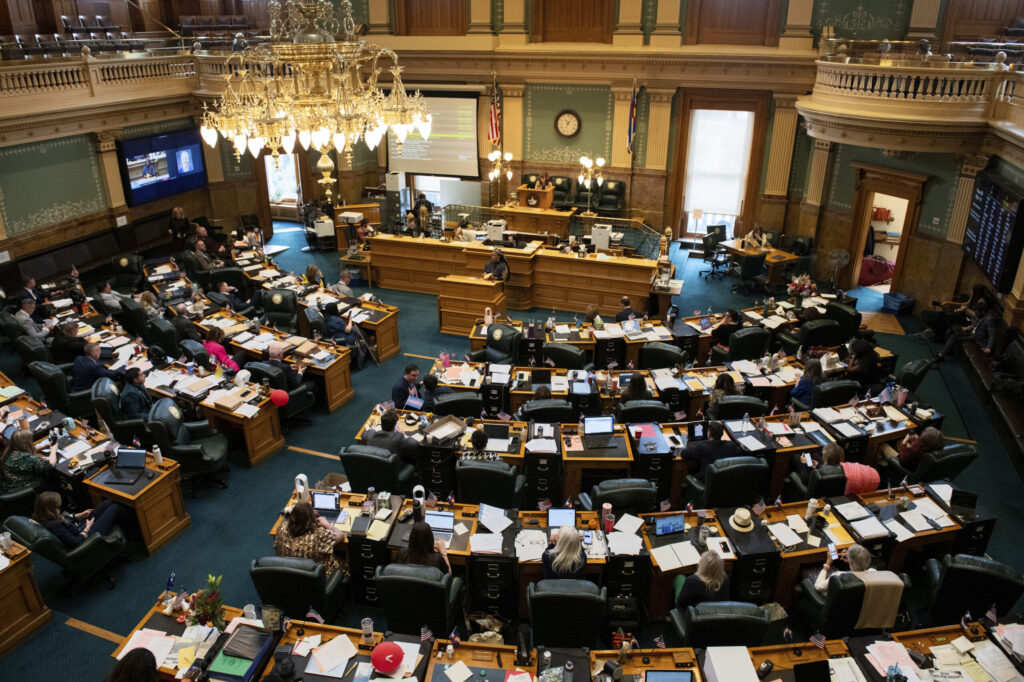
Members of the Colorado legislature’s judiciary committees heard about a large increase in complaints against judges and additional forensic misconduct that has come to light, during three days of oversight hearings last week. Leaders of several judicial-related agencies appeared between...
Federal judge warns DOJ against raising repeatedly rejected arguments in immigration detention cases
Michael Karlik
michael.karlik@coloradopolitics.com
Updated 23 hours ago
A federal judge in Colorado warned the U.S. Department of Justice on Monday against raising arguments that she and other judges have repeatedly rejected in cases challenging the lawfulness of immigration detentions. In a Jan. 26 order finding the government...

Colorado Supreme Court to address child’s CCTV testimony
Michael Karlik
michael.karlik@coloradopolitics.com
Updated 5 days ago
The Colorado Supreme Court announced on Monday that it will review the impact of a victim’s closed-circuit testimony on the prosecution of a juvenile defendant. At least three of the court’s seven members must agree to hear an appeal. There...

10th Circuit to hold all-judges hearing, judicial committee turns down ‘civility code’ | COURT CRAWL
Michael Karlik
michael.karlik@coloradopolitics.com
Updated 6 days ago
Welcome to Court Crawl, Colorado Politics’ roundup of news from the third branch of government. The Denver-based federal appeals court agreed to hold a rare all-judges hearing in a criminal case, plus a state Supreme Court committee overwhelmingly rejected a...
PREV
PREVIOUS

Proposed development sparks rally to 'save' trail, open space south of Denver
For the past 25 years around Denver’s south metro area, Mike Smith has watched homes, offices and commercial centers rise in open spaces he once viewed from the seat of his bike. But then there’s what he calls “the heart of Lone Tree.” To catch the sun rise or set or to ease the stress […]
Federal judge recommends sanctions on plaintiffs for faulty case citations
A federal judge recommended that a pair of self-represented plaintiffs be subject to a range of sanctions for including flawed and non-existent case citations in their filings, potentially by using artificial intelligence. “A federal court is not a workshop for fictional writing. It is a forum that exists to uphold the law, administer justice, and […]