

The advantage of Medicare Advantage | HUDSON

During the initial 50 years of my working life, I was a net contributor to American health care. I reached 70 having spent only a single day in a hospital following an appendectomy at 17. Today that would have been a day surgery. Virtually all my adult life, I paid for medical insurance, with just a few short breaks when I ran “bare” while transitioning from one job to another. Whenever possible, I enrolled with Kaiser medical programs. Once Medicare eligible, I signed up for their Medicare Advantage plan.
Initially, Kaiser’s Colorado Advantage program was unique as the plan applied for an exception to the federal rules permitting them to operate on a “capitated” basis. Fiscally, Kaiser received a flat annual payment for each Medicare Advantage enrollee and, in turn, committed to providing all required health care for its patients. More than 500,000 Colorado seniors participate in Medicare Advantage programs, all of which offer some form of managed (HMO) care. For those who prize a lifetime relationship with and confidence in a specific physician or medical practice, their coverage is pretty much limited to signing up with the Advantage plan their provider contracts with.
During the early 1990s I traveled constantly by air, often taking four to six business flights a week. This experience introduced me to what was seemingly an entirely irrational pricing scheme which familiarized me with the word algorithm long before it became popular as an internet descriptor. Airlines adjust the cost of a ticket depending on how far away a flight date may be, the day of the week (even the time of day) a passenger is purchasing a ticket, how full the flight is at the time of your reservation together with factors unknown. The result is unless a couple purchases their tickets together, no two people seated in your row paid the same price for their trip. Health care costs can appear equally irrational.
During the 45 years since I served in the legislature, health care costs have exploded from less than 10% of national GDP to nearly 20%. Together with the financialization of the American economy by hedge funds and private equity, which has followed a similar trajectory, half our discretionary dollars now pass to either bankers or health care providers. Unlike airlines, where cutthroat competition tamps prices down, medical costs escape market forces for two reasons: first, costs are rarely transparent and, second, the entire sector is chock-a-block with middlemen of varying descriptions whose presence are opaque. As I would argue with Republican colleagues at the legislature in 1980, when health care costs were already a problem, medical care rarely behaves like a commodity.
When I recently faced cardiac bypass surgery, I wasn’t interested in identifying the low-cost provider, nor did I wish to serve as a novice surgeon’s first patient, although every young doctor has to have one. Call me selfish. Call me nervous. I wanted a cardiac practice with a sterling success record (99-plus-percent). Or, at a time when we still used yellow page directories, I would challenge market zealots, “If you break your leg and the bone is protruding through the skin will you take the time to call through and locate the cheapest orthopedist to set your leg?” Of course not. The nearest emergency room will do. And then, pray for no “out-of-network” surprise billings.
Writing in “The Big Newsletter”, Matt Stoller identifies much of the rising costs in American health care as “corporate sludge” — the source for why we pay twice as much as other advanced economies for often mediocre medical care. Medicare Advantage appeared in the mid 1990s as a work around for patients who had neither the time nor persistence to navigate Medicare’s approval hurdles. Eight years ago, my bilateral knee replacements cost me just $900 out of pocket, primarily for three nights at the hospital. This past July, my hip replacement, which is now a day surgery, cost $92 for miscellaneous expenses. I received far more than my money’s worth from 15 years of Kaiser’s Medicare Advantage plan, as the unbilled price of each surgery exceeded $125,000. That, of course, as with so much of current medical practice, is a somewhat fictitious number. Kaiser has negotiated reduced rates with its providers.

Despite their popularity, Advantage plans have been under attack for nearly their entire 30-year history. On the left, many critics are irritated by the fact insurance carriers have discovered a way to extract a few extra dollars from the Medicare program, while legislators on the right in Congress are now searching for opportunities to eliminate every possible dollar from the federal government’s health care budgets. Some wags have joked the U. S. government has become an insurance company with an Army. Nearly 70% of the federal budget is dedicated to Social Security, pensions and health care. Just as Willie Sutton, the Depression-era bank robber, is rumored to have explained he robbed banks because, “…that’s where the money is”, Congressional budget hawks turn to Medicaid and Medicare costs for appropriation savings.
As is predictable in Washington, a lobbying organization has emerged, a non-partisan, non-profit advocacy voice for the insured: the Medicare Advantage Majority, or MAM, dedicated to protecting and strengthening Medicare Advantage coverage. Among the 34 million Americans relying on these programs for managing their care, including many with chronic conditions requiring continuing care, their Advantage programs often pick up most, if not all, of drug costs. They also can cover benefits traditional Medicare has never offered, including vision, dental and transportation to appointments. “Medicare Advantage doesn’t just serve seniors, it supports the entire ecosystem of caregivers who treat them,” explains MAM spokesperson Darren Grubb. Ninety-two percent of providers and caregivers express their support for the role Advantage plans undertake in shepherding patients through their medical challenges.
Nonetheless, U.S. Sens. Bill Cassidy (R-Louisiana) and Jeff Merkley (D-Oregon) have reintroduced their failed 2023 bill that forbids “upcoding” of an initial diagnosis assigned to a Medicare client. This is a common and to be expected result of the progression in most chronic illnesses as well as many diseases. Most inexplicable is the bill’s slashing of funding for in-home care, which would drive-up eventual costs. The legislation is proffered as a remedy for the myth of medical waste, fraud and abuse. How is this supposed to occur? Let’s face it, patient fraud is virtually non-existent. Provider fraud is another matter, and a legion of investigators earn their keep by searching for it. My own hip surgery resulted from an upcoding of assumed sciatica to arthritic deterioration in the joint.
The Boston Globe has covered changes coming for Medicare Advantage plans in New England more than most other media, reporting on Oct. 19, “Tens of thousands of senior Massachusetts residents may find that (their) Medicare Advantage plans are charging higher premiums, shrinking provider networks, covering fewer drugs, and offering fewer perks (including transportation to appointments) as Medicare’s open enrollment period gets underway.” It’s not just Medicaid taking hits from Trump’s “Big, Beautiful Bill.” We should expect premium increases in 2026 for Colorado enrollees. Nonetheless, as MAM’s spokesman Darren Grubb observes, “Medicare Advantage saves caregivers time and money.” In my experience that can be a win-win solution.
Miller Hudson is a public affairs consultant and a former Colorado legislator.

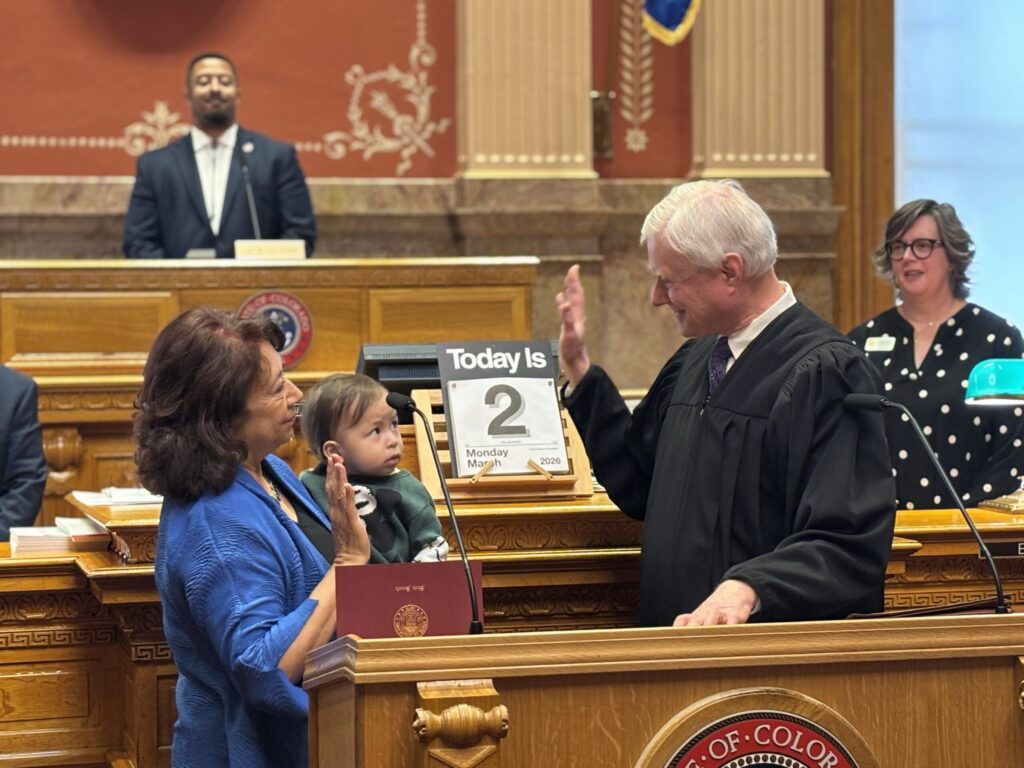
Colorado Senate swears in Adrienne Benavidez after SD 21 vacancy win
Marianne Goodland
marianne.goodland@coloradopolitics.com
Updated 43 minutes ago
Sen. Adrienne Benavidez, D-Adams County, was sworn in Monday to the Colorado Senate, just four days after winning a vacancy election in District 21. She was sworn in by Colorado Court of Appeals Justice Lino S. Lipinsky de Orlov. Usually,...

Rural legislators, Colorado farmers defeat pollinator bill backed by Gov. Polis
Marianne Goodland
marianne.goodland@coloradopolitics.com
Updated 33 minutes ago
A proposal to limit the use of neonicotinoid-coated crop seeds collapsed in the Senate Agriculture and Natural Resources Committee last week, as rural lawmakers, including two Democrats, joined Republicans to reject what they called an expensive, impractical mandate on farmers....

Competing overtime bills for agriculture workers split Colorado Democrats
Marianne Goodland
marianne.goodland@coloradopolitics.com
Updated 4 hours ago
Competing bills setting the overtime threshold for farmworkers have split legislators at the Colorado state Capitol, with one group saying a law passed in 2021 has harmed, rather than helped, farming operations and workers alike, while the other side insists...

Could Weiser or Bennet as governor each be an improvement over Polis? | Miller Hudson
Miller Hudson
miller-hudson@coloradopolitics.com
Updated 24 hours ago
The weekend before last was a forerunner to numerous forums and debates where U.S. Sen. Michael Bennet and Attorney General Phil Weiser will jostle for position in the Democratic primary for governor. The victor seems certain to be headed to...

Poison, poultry and prostitution — the Colorado legislature marches on | Rachel Gabel
Rachel Gabel
rachel-gabel@coloradopolitics.com
Updated 24 hours ago
Many weeks my search history is odd but the past two weeks might worry our county sheriff if he didn’t know me as well as he does. This week has been the week of poison, poultry and prostitution. Not to...

Thoughts on President Trump’s State of the Union address | Cronin & Loevy
Tom Cronin Bob Loevy
tom-cronin-bob-loevy@coloradopolitics.com
Updated 24 hours ago
The U.S. Constitution’s Article Two states “He (the president) shall from time to time give to the Congress Information of the State of the Union, and recommend to their Consideration such Measures as he shall judge necessary and expedient….” On...

Male wolf dies after capture attempt in Colorado
Marianne Goodland
marianne.goodland@coloradopolitics.com
Updated 23 hours ago
One of the original wolves brought to Colorado from Colorado has died after an attempt to capture it, the’s state wildlife agency said. The Colorado Parks and Wildlife identified the wolf as No. 2305 — meaning it was one of...

Are Colorado businesses leaving or evacuating? | Jon Caldara
Jon Caldara
jon-caldara@coloradopolitics.com
Updated 4 days ago
At this point, if you hear beeping downtown, it’s not a construction crew. It’s a company backing out. And look, I get it. Businesses relocate for all sorts of reasons: taxes, regulations, labor costs, office space, crime, commute times, the...

Democrat Michael Bennet turns in petitions for Colorado’s gubernatorial primary, plans to skip caucuses
Ernest Luning
ernest.luning@coloradopolitics.com
Updated 1 day ago
U.S. Sen. Michael Bennet, a Democratic candidate for governor, submitted nominating petitions for Colorado’s June primary ballot on Friday, his campaign and the Colorado Secretary of State’s Office said. Bennet plans to rely on his petitions to get on the...

Colorado Republicans, Democrats clash over Iran military operation
Thelma Grimes
thelma.grimes@coloradopolitics.com
Updated 2 days ago
Colorado’s congressional delegation split sharply along party lines Saturday after the U.S. and Israel attacked Iran, triggering a fresh debate in America over presidential war powers. Trump announced early Saturday morning that U.S and Israeli forces had begun “Operation Epic...
PREV
PREVIOUS

The significance of the State Land Board siding with the San Luis Valley | GABEL
Some members of the State Land Board don’t like the Trump administration and the decisions made about conservation, which they voiced in the monthly public meeting Nov. 13. The board could have made the mistake of making an exceptionally partisan statement, something that is certainly not in the best interest of conservation or kids. The […]

Bennet won’t blame Polis for Medicaid cuts | WADHAMS
Gov. Jared Polis, with the acquiescence of U.S. Sen. Michael Bennet who is the presumptive Democratic frontrunner for governor in 2026, is proposing deep Medicaid cuts that will hurt Colorado’s most vulnerable families and endanger the state’s entire health care system. Meanwhile, Polis and Bennet rail against Medicaid reforms at the federal level that would […]