

All Lakewood City Council incumbents re-elected, still focusing on affordable housing

The Lakewood City Council looks mostly the same following the Nov. 4 elections.
With that, the council’s goals remain the same: affordable housing for the missing middle — or families that don’t qualify as low-income but don’t earn enough to obtain a mortgage on a single-family home.
The city had four incumbents running for re-election on Tuesday. Ken Cruz, Bill Furman, Paula Nystrom and Jeslin Shahrezaei were all reelected, with the latter being uncontested.
Liz Black, a new candidate, also faced no competition in Ward 2.
Cruz beat Bonnie Nguyen and Pedro Roybal in Ward 3 with 50.95% of the vote. Nystrom beat Karen Gordey in Ward 5 with 67.59%. Furman won decisively over Ariel Manzanares-Scisney and Desirée González in Ward 4 with 73.13% of the vote.
Both Cruz and Furman were initially voted in during a special election in the spring, while Shahrezaei has held the seat since 2021 and Nystrom since 2024.
Cruz said the re-elections show “that Lakewood residents appreciate steady, collaborative leadership. They’ve seen that this council can disagree respectfully, make tough decisions, and still move the city forward. Voters are saying, ‘Keep working together, keep listening and keep making progress.’ That continuity matters.”
“I think that the re-election is an indication that while not every vote aligns with every constituent’s presence, they recognize that the council is focused on the best outcome for the people of Lakewood,” Furman told The Denver Gazette.
Residents seem grateful to have the full party returning, especially after big moves earlier this year to update the city’s zoning code to allow for more inclusionary housing on what were once single-family zoning lots.
“Their proven commitment to thoughtful planning, responsible stewardship and our community’s long-term vision gives us a strong foundation to continue building a vibrant, thriving city,” Malisa Eakins, a resident and local Realtor, told The Denver Gazette regarding the re-elections.
“Nice to see that candidates that were for changing the zoning in Lakewood all are winning,” a Reddit user, Adventnebula, said on the city’s forum during the elections.
“NIMBYs think we elect a city council that doesn’t represent us, reality proves otherwise,” another user said.
“Residents might not always have the same opinion about how to run things, but these are people with a passion and a heart to do good work in the City of Lakewood. That I am certain of,” newcomer Black said.
Still, some residents have been outspoken about the council, especially during the four-part zoning ordinance votes that occurred throughout the last few months.
“(The council) surely are not paying attention to those that appear before them at city council meetings or at ward meetings. They are evasive, dismissive, disingenuous, even arrogant when addressing their constituents,” a resident named Ludmila commented on the city’s website back in September.
“Unfortunately, the current council is not being held accountable by Lakewood voters and the resulting echo chamber has become complacent in their positions,” Steve Farthing, a founder of the Save Belmar Park group, said. “This needs to change for the betterment of Lakewood and for the protection of wildlife and open space.”
He claimed that former councilmembers faced “inhospitable” treatment from the council, leading to other qualified candidates being uneager to run.
All five of the Lakewood elected representatives, including Black, are listed on the Jefferson County Democratic Party website as Democrats.
Robert Preuhs, a political science professor and department chair at Metropolitan State University of Denver, said Democratic voting was a theme throughout the state this year.
He noted that backing affordable housing efforts in Lakewood generally aligns more with Democratic priorities than Republican ones.
“The voters were a bit more discerning in terms of who they wanted to throw out,” he said.
AFFORDABLE HOUSING STILL THE FOCUS
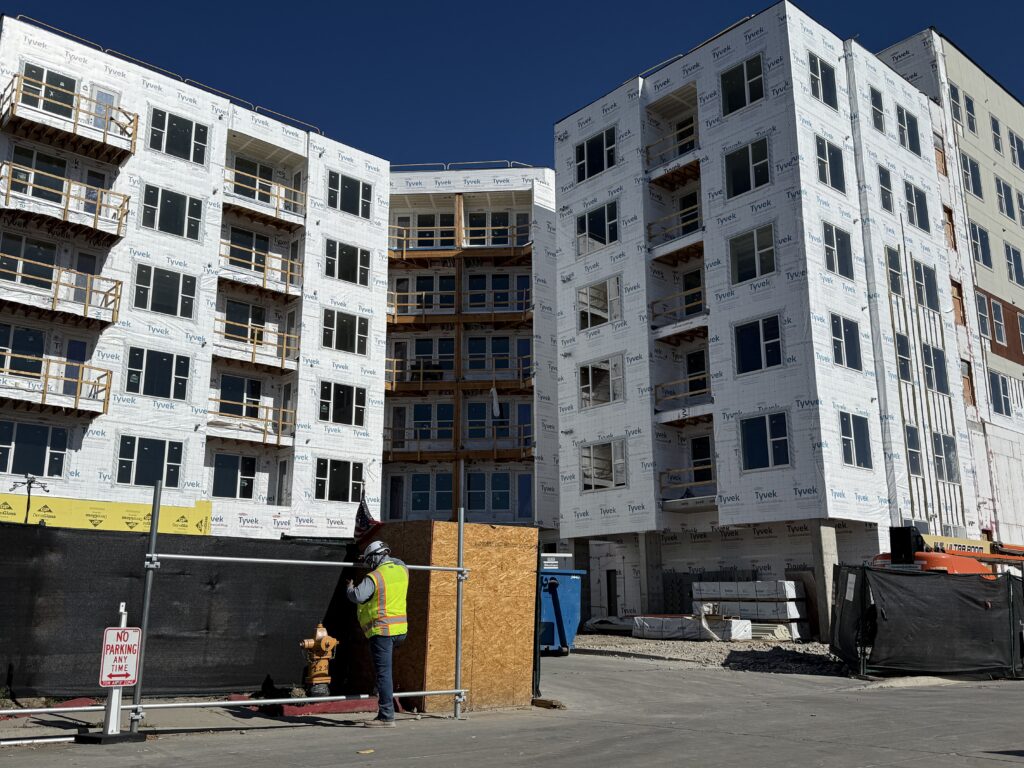
Between August and November, the council approved all four parts of a new zoning code that will go into place next year, the biggest change since 2012. It was the focus of the council’s year, with members stating multiple times that they wanted to get the voting finished before the election.
The most discussed part of the 400-page proposal was the erasure of the term “single-family housing,” though the city never had direct single-family- only zoning in the past.
New residential districts are broken up into low-form residential and mid-form residential classifications.
Low-form residential will include single-family homes and small-scale attached and detached housing to “support compact, walkable neighborhoods with a range of housing options,” according to the proposal.
Mid-form will include medium-density housing and multi-family buildings.
The updates include combining nine residential uses into three: residential dwellings, accessory dwellings and temporary dwellings, according to city spokesperson Stacie Oulton.
With the re-election of the council, bringing in more affordable homes — like duplexes and townhomes — remains a top priority.
“We are focused on the issues of affordable housing by pushing for inclusionary zoning,” Furman said. “There are strong advocates on this council that have and continue to be focused on the emergency sheltering issues. There is an effort to advance sustainability initiatives, currently in the ad hoc committee.”
Black said her first goal is to get in and learn more about the affordable housing initiatives “so that I can begin to think about policies that will begin to tackle these issues.”
Cruz said the priorities remain clear: affordable housing in a “balanced and responsible way,” supporting small businesses, building resources for the community and strengthening community outreach.
Nystrom added that greenhouse gas emission reduction requirements, tree canopy and other environmental goals that can “directly impact our health and quality of life” are on her priority list, as well.
“Having a cohesive council means we can maintain momentum on major initiatives without having to start over,” Cruz said. “There’s already a shared understanding of our priorities and how to get things done. It allows us to focus on implementation, on turning conversations and policy frameworks into visible results for residents.”
Staff writer Nico Brambila contributed to this report.


As Aurora police worry about court ruling’s impact on crime, council sees opening to revisit penalties
Kyla Pearce
kyla.pearce@gazette.com
Updated 2 days ago
Aurora’s top police official is worried about the impact of a Colorado Supreme Court decision about penalties on the city’s crime rate, while progressive councilmembers see an opening to reverse decisions made by previous city councils. The court ruled on...

Tension surrounding the Space Force? Congress weighs in on staffing
Mary Shinn
mary-shinn@coloradopolitics.com
Updated 3 days ago
The large annual defense act steps into staffing issues within the Space Force, requiring roughly equal staffing between operational and acquisition positions. The National Defense Authorization Act also requires the Secretary of the Air Force to examine the Space Force’s...

Investigation finds Colorado Sen. Faith Winter was at fault in fatal crash
Marianne Goodland
marianne.goodland@coloradopolitics.com
Updated 6 days ago
Legislator’s alcohol level was more than twice the legal limit County authorities have concluded their investigation into the I-25 crash that killed Colorado Sen. Faith Winter, determining the Colorado legislator was at fault in the two-vehicle collision. An autopsy found...

Forecast shows slowing growth in Colorado
Marianne Goodland
marianne.goodland@coloradopolitics.com
Updated 7 days ago
Missing federal data complicates state forecast Colorado’s economy is holding steady, though growing warnings, particularly in consumer demand and spending, are emerging, according to state economists’ latest forecast. The December forecast presented on Friday was not as complete, given the...

Women’s soccer stadium package up for final Denver City Council vote
Deborah Grigsby
deborah.smith@denvergazette.com
Updated 4 days ago
Monday is shaping up to be a big night for the Denver Summit FC, as the Denver City Council is set to vote on the construction of a women’s soccer stadium. Council Bill 25-1541, which proposes changing the land’s zoning...
Colorado officials stall progressive income tax ballot initiative again by declaring it to have multiple subjects
Ed Sealover
ed-sealover@coloradopolitics.com
Updated 6 days ago
In a saga offering more twists than a soap opera, Colorado Title Board members reversed course on Wednesday and determined an initiative to establish a progressive income tax doesn’t qualify for the 2026 ballot because it doesn’t have a single...

Trump touts victories at border, in economy in prime-time address to the nation
The Associated Press
the-associated-press@coloradopolitics.com
Updated 1 week ago
WASHINGTON — In a rare evening address from the White House, President Donald Trump boasted on Wednesday of his accomplishments and blamed his Democratic predecessor for soaring consumer prices as his party braces for a tough midterm election next year....

US House passes Colorado Rep. Lauren Boebert’s bill to remove gray wolves from endangered species list
Marianne Goodland
marianne.goodland@coloradopolitics.com
Updated 7 days ago
A bill sponsored by U.S. Rep. Lauren Boebert of Colorado to delist the gray wolf from federal protections for endangered species cleared the U.S. House late on Thursday, setting up a fight in the U.S. Senate over a measure supporters...

Colorado campaign debt collection efforts aren’t much of an effort
David Migoya
david.migoya@gazette.com
Updated 1 week ago
It was only weeks after the U.S. military in September 2011 repealed its “don’t ask, don’t tell” policy barring openly gay men and women from serving in the armed forces that Army veteran Brian Carroll announced his candidacy for a...

Colorado campaign finance penalties ‘a runaway train without an off-ramp’
David Migoya
david.migoya@gazette.com
Updated 1 week ago
Each day, Mike Stapleton wakes up owing the state of Colorado another $1,550. By the end of each week, Stapleton’s debt for not filing nearly three dozen campaign finance reports dating to April 2018 will have grown by nearly $11,000....
PREV
PREVIOUS

Another translocated wolf dies in Colorado, bringing total to 12
Wildlife officials on Friday morning announced that another British Columbia wolf, a female with the tag 2506, died in southwest Colorado. Officials said necropsy will be performed by U.S. Fish & Wildlife. The Colorado Parks and Wildlife did not identify the wolf’s exact location, but southwestern Colorado is home to both the Ute Mountain Ute […]

Trump accuses foreign-owned meat packers of inflating US beef prices and calls for investigation
WASHINGTON (AP) — President Donald Trump on Friday accused foreign-owned meat packers of driving up the price of beef in the U.S. and asked the Department of Justice to open an investigation. The Republican president announced the move on social media days after his party suffered losses in key elections in which the winning Democratic candidates focused relentlessly on the […]