

Appeals court tosses man’s convictions after Denver judge relied on expired pandemic-era law to violate speedy trial deadline
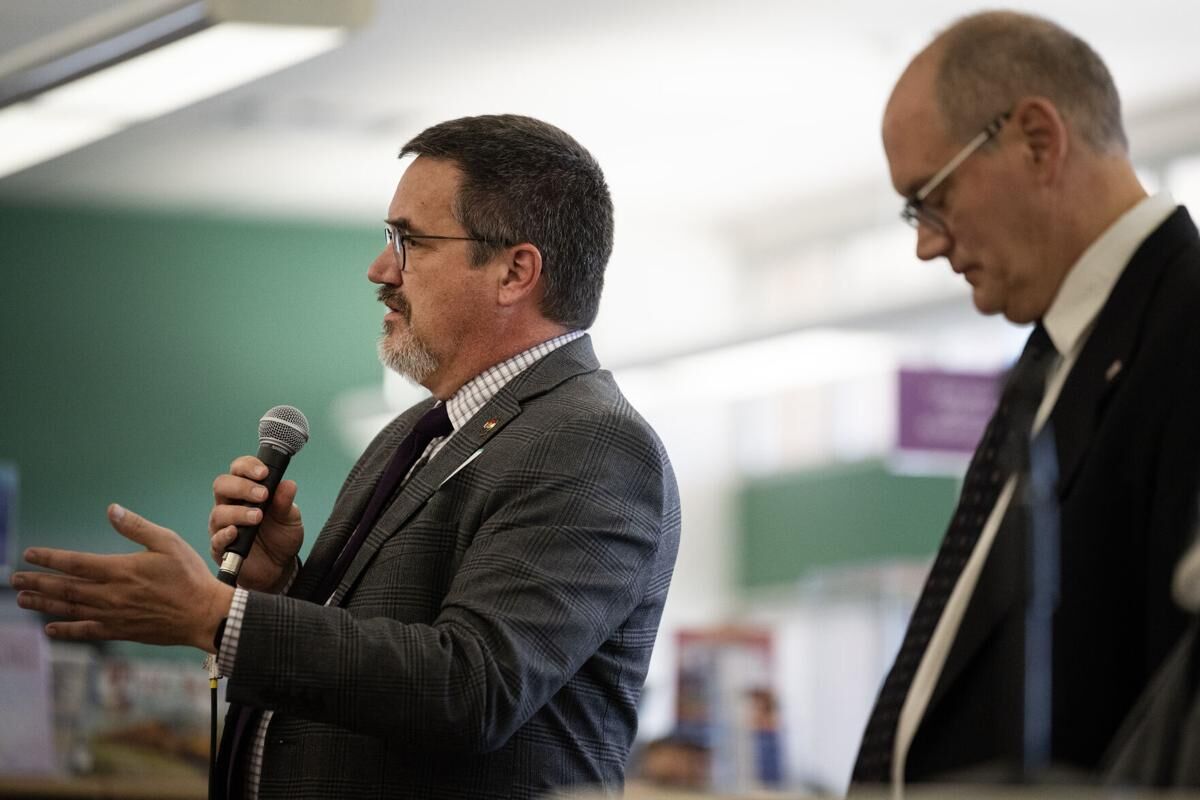
A Denver judge mistakenly used an expired provision of state law to extend a defendant’s speedy trial deadline, Colorado’s second-highest court ruled on Thursday in overturning the man’s convictions and 34-years-to-life prison sentence.
As part of the constitutional guarantee of a speedy trial, Colorado law generally requires the government to bring a defendant to trial within six months of their not-guilty plea. Lawmakers have established one consequence for a violation: dismissal of the charges and a bar on further prosecution.
Prosecutors charged Anastacio Mares with multiple offenses for sexual assault on a child. Jurors found him guilty and he received an indefinite sentence of at least 34 years.
Mares entered his not-guilty plea in April 2022, meaning his speedy trial deadline fell in October. In mid-June, Mares’ lawyer suggested Mares was not competent to proceed, prompting District Court Judge Eric M. Johnson to order a competency evaluation.
Following the evaluation, Johnson found Mares to be competent after all and recalculated the speedy trial deadline to account for the time to perform the evaluation — now in mid-December.
Johnson tried to set a trial for September, but Mares’ lawyer had a conflict for late September and believed early September would be too soon. The prosecutor also called an early September trial infeasible.
After further dates were problematic for the defense or prosecution, Johnson observed the COVID-19 pandemic had created a backlog for trials. He cited a provision of Colorado law permitting judges to extend the speedy trial deadline by three or six months under certain circumstances due to pandemic congestion.
“I have worked very hard to avoid that,” he said. But “I’m going to trigger that because of the COVID pandemic.”
Johnson and the attorneys apparently did not realize that lawmakers included a clause automatically terminating judges’ authority to extend trial deadlines due to pandemic backlogs. The termination took effect in April 2022, four months earlier.
Johnson set the trial for January 2023. When the defense moved to dismiss the charges, Johnson said he “did everything I could” to bring Mares to trial within the speedy trial deadline. However, the request for a competency evaluation was a delay “that could be attributable to the defense.”
Mares appealed his convictions, citing a violation of his speedy trial rights. The government countered that even if Johnson was wrong to rely on the temporary COVID-19 provision, the defense’s delay tactics forced his hand.
“The trial court was presented an impossible situation. The statutory six months in which a trial is to be prepared and presented to a jury had been stalled by the defense’s request for a competency determination,” wrote Senior Assistant Attorney General Frank R. Lawson. Afterward, the “prosecution and court endeavored to make themselves available for multiple dates within the existing timeline, but the defense could not reciprocate.”
Case: People v. Mares
Decided: August 21, 2025
Jurisdiction: Denver
Ruling: 3-0
Judges: Ted C. Tow III (author)
David H. Yun
Grant T. Sullivan
A three-judge Court of Appeals panel disagreed with Lawson’s interpretation of events.
Judge Ted C. Tow III wrote in the panel’s Aug. 21 opinion that Mares’ lawyer was not stonewalling Johnson’s efforts to set a trial. Moreover, it was unfair to cite the competency evaluation as grounds to violate Mares’ speedy trial rights.
“Indeed, this reading of the statute would place a defense attorney whose client presents competency concerns in an untenable position: insist on the possibly incompetent client’s speedy trial or raise competency and risk being held responsible for extensions beyond the time it takes to have the client evaluated,” wrote Tow.
As for Johnson’s use of the since-repealed authority to extend the speedy trial deadline, the “General Assembly’s words unequivocally state that the provision is not to be invoked after a specific date,” Tow concluded.
The panel overturned Mares’ convictions and, as required by state law, directed the charges to be permanently dismissed.
The case is People v. Mares.


Colorado Supreme Court to address child’s CCTV testimony
Michael Karlik
michael.karlik@coloradopolitics.com
Updated 10 hours ago
The Colorado Supreme Court announced on Monday that it will review the impact of a victim’s closed-circuit testimony on the prosecution of a juvenile defendant. At least three of the court’s seven members must agree to hear an appeal. There...

10th Circuit to hold all-judges hearing, judicial committee turns down ‘civility code’ | COURT CRAWL
Michael Karlik
michael.karlik@coloradopolitics.com
Updated 1 day ago
Welcome to Court Crawl, Colorado Politics’ roundup of news from the third branch of government. The Denver-based federal appeals court agreed to hold a rare all-judges hearing in a criminal case, plus a state Supreme Court committee overwhelmingly rejected a...
Divided Colorado Supreme Court curtails use of laced-substances defense
Michael Karlik
michael.karlik@coloradopolitics.com
Updated 1 day ago
The Colorado Supreme Court on Monday walked back the ability of criminal defendants to claim their conduct was the result of consuming an intoxicating substance that secretly contained another behavior-altering substance. Under state law, “involuntary intoxication” is an affirmative defense,...
Colorado justices say utilities commission overreached by immunizing Xcel in rate document
Michael Karlik
michael.karlik@coloradopolitics.com
Updated 1 day ago
Xcel Energy cannot rely upon a rate-setting document to broadly immunize itself from liability against electrocutions, the Colorado Supreme Court ruled on Monday. The justices originally heard the electrocution-related lawsuit from Francisco Cuevas to decide whether Xcel’s tariff, which sets...
Colorado Supreme Court committee rejects civility proposal amid fears of weaponization by judges, ‘jerks’
Michael Karlik
michael.karlik@coloradopolitics.com
Updated 1 day ago
The Colorado Supreme Court’s Civil Rules Committee overwhelmingly rejected a proposal last week to create an enforceable “civility code” for lawyers and legal paraprofessionals, which would allow judges to quickly impose corrective action without a formal complaint and investigation by...
10th Circuit to address resentencing of probation violators in rare all-judges hearing
Michael Karlik
michael.karlik@coloradopolitics.com
Updated 3 days ago
The Denver-based federal appeals court agreed on Thursday to hold a rare all-judges hearing to determine the proper procedure for resentencing a criminal defendant who has violated the terms of his probation. In the federal appellate courts, the vast majority...
Appeals court overturns Adams County sex offense convictions due to prosecutor’s misconduct
Michael Karlik
michael.karlik@coloradopolitics.com
Updated 2 days ago
Colorado’s second-highest court reversed multiple child sex assault convictions on Thursday after concluding an Adams County prosecutor committed misconduct while cross-examining the defendant. A three-judge Court of Appeals panel observed the charges against Daniel Michael Boerner depended on the jury...

Fort Carson soldier’s wife could be deported
Carol McKinley
carol-mckinley@coloradopolitics.com
Updated 5 days ago
As the country’s largest immigration enforcement crackdown continues in Minnesota’s Twin Cities, a Fort Carson sergeant is fighting a personal immigration crisis — one that may implode his family. Sgt. Tyler Garza’s wife, Jennifer Maradiaga Baca, is not a legal...
Elizabeth School District dismisses challenge to book-ban injunction on eve of appellate arguments
Michael Karlik
michael.karlik@coloradopolitics.com
Updated 5 days ago
An Elbert County school district has dismissed its challenge to a judge’s injunction ordering it to return banned books to library shelves, days before the Denver-based federal appeals court was set to hear oral arguments this week. Although a three-judge...
Colorado Supreme Court to hear cases on insurance coverage for COVID, witness credibility
Michael Karlik
michael.karlik@coloradopolitics.com
Updated 6 days ago
The Colorado Supreme Court announced on Tuesday that it will decide the degree to which a virus or other hazard must affect a commercial property before it can trigger loss-or-damage coverage under an insurance policy. At least three of the...
PREV
PREVIOUS

Colorado state Rep. Ryan Armagost resigns, avoids censure resolution
State Rep. Ryan Armagost announced on Thursday afternoon that he is resigning his House seat immediately. That resignation takes out the possibility of a censure that was expected to be brought up against him either on Thursday or Friday. Only a member of the Colorado General Assembly can be censured, according to House rules. Armagost […]

Artificial intelligence bill clears first Senate special session committee
The proposed Senate Democrats’ fix to the first-in-the-nation artificial intelligence regulation dealing with “algorithmic discrimination” won approval from its first committee on the first day of the 2025 special session. Senate Bill 4 — sponsored by Senate Majority Leader Robert Rodriguez, D-Denver, who is also the author of the 2024 law that Gov. Jared Polis […]