

Colorado’s Congressional delegation talks bipartisanship, tariffs and health care at chamber luncheon

The eight members of Colorado’s delegation to the U.S. House often agreed more times than is often portrayed — on major issues affecting the state.
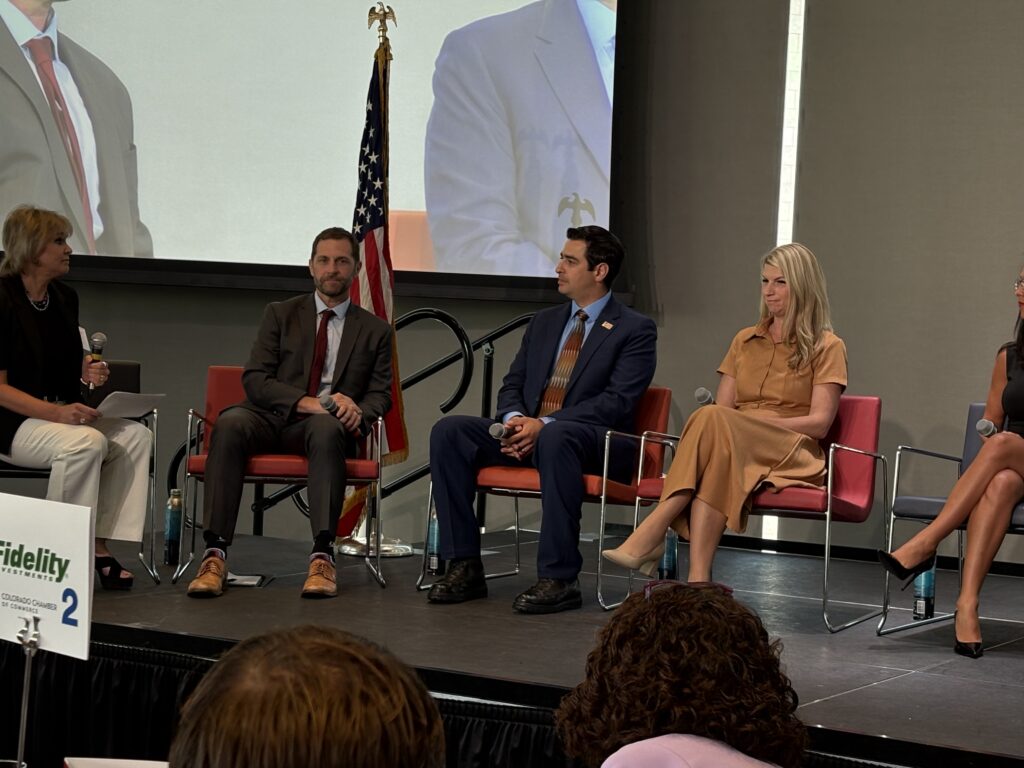
All eight members appeared together, for the first time publicly ever, to attend the Colorado Chamber of Commerce’s seventh biennial congressional delegation luncheon, where they discussed issues in front of a packed audience of several hundred at the Denver Art Museum.
Moderator Shaun Boyd of CBS4 led off with a question on bipartisanship and how well the members work with each other.
U.S. Rep. Jason Crow, D-Aurora, of the 6th Congressional District, pointed to efforts with U.S. Rep. Lauren Boebert, R-Windsor, of the 4th CD, on a Space Force National Guard reserve.
Crow and U.S. Rep. Jeff Crank from the 5th CD, are carrying a bill on traumatic brain injuries. Crow has also worked with Rep. Gabe Evans of the 8th CD on space issues.
Evans noted his district has the largest space national guard unit in the country. He added that one of his first meetings in Congress was with the entire delegation to figure out how to protect Colorado’s Space Command.
Rep. Brittany Pettersen, D-Lakewood, who represents the 7th CD, said it’s difficult to build relationships across the aisle in Congress, unlike her days at state Capitol. She joked that she lost months of her life listening to the “loquacious” U.S. Sen. Bob Gardner, R-Colorado Springs.
Congress is set up to be more partisan than it should be, Pettersen said.
But members of the delegation, indeed, connect on the House floor, and she pointed to a bill she’ s carrying with Boebert on new zip codes.
“We keep each other posted,” Pettersen said.
Boebert noted meetings by the entire Colorado delegation, which, when conducted over Zoom, would also allow Gov. Jared Polis to join in.
Rep. Joe Neguse, D-Lafayette, of the 2nd CD, noted a bill he’s working on with Rep. Jeff Hurd, R-Grand Junction, of the 3rd CD, on snow modeling forecasts.
Hurd added that while disagreements exist, so does collaboration, pointing to a behind-the-scenes effort by the delegation to get a public lands sale out of the most recent congressional budget.
Hurd also noted legislation he’s working on with Crow, such as the Ski Hill Resources for Economic Development Act, and a measure on economic development.
“We all care about working together for the issues that impact our state,” such as wildfire and infrastructure, said U.S. Rep. Diana DeGette, D-Denver, of the 1st CD, is the senior member of the delegation. “We don’t agree on a lot of political items, but we do agree on Colorado and helping Colorado.”
“It never makes the news when you work together, but when there’s conflict, that’s what sells,” Crank added. “But we work together a lot.”
He noted collaborations with Neguse to get C130s for fighting fires on the Western Slope.
Affordable housing is also an issue that unites the delegation, the members said.
Neguse noted an omnibus, bipartisan bill from the U.S. Senate on housing affordability, calling it a harbinger of things to come.
A bipartisan bill with 100 co-sponsors on affordable housing tax credits is in the works, Evans noted. He’s also part of a “problem-solvers” caucus, which includes Pettersen and which is working on permitting and regulatory changes in housing.
The fissures showed up on the subject of tariffs.
Crank initially said that, as a supporter of free trade, he didn’t favor long-term tariffs, but he backed President Donald Trump’s efforts because tariffs are necessary for encouraging manufacturing and to close the trade deficit.
“This president has very effectively used tariffs to get to the negotiating table,” Crank said.
He noted the trade deal with the European Union, which he said would bring hundreds of millions of dollars in investments. If one is, indeed, using tariffs, then that person cannot publicly admit to only doing it to get a better deal, he said.
That prompted DeGette to thank him, somewhat tongue in cheek, for explaining the President’s thought process. “Most of us have no idea what he’s doing with imposing tariffs,” then taking them back and renegotiating. It’s causing great consternation and instability, she said.
DeGette noted she co-chairs a Japan study group, and when they met with the Japanese prime minster and his senior advisors, they were absolutely furious at the US, because the tariffs didn’t take into account business investment, including a big steel deal.
Boebert and Pettersen took on the issue of childcare. Boebert defended the OBBA, noting it’s “very pro-child and pro-parent” as it extended a child tax credit from the 2017 Tax Cuts and Jobs Act.
But “the American dream isn’t just about affording childcare,” Boebert said. “It’s about allowing moms to stay home and raise children…and not being forced into the work field.”
Pettersen has first-hand experience with the childcare issue, noting she put her baby on a wait list for childcare while she was still pregnant and that lasted a year.
She’s not alone; Pettersen noted 10,000 people in Colorado are unable to work because of a lack of childcare.
A question about the upcoming General Assembly special session prompted Crow to point out the impact of the OBBA on Colorado. He said 300,000 people will lose their healthcare, and tens of thousands of Colorado children will go hungry. Seven hospitals, mostly rural, are at risk of closing from the measure, with three that could close in the next year.
Crank took the opposite view, pointing to out of control spending by Democrats at the state Capitol for years. The state has a choice about taxing overtime or seniors. “That’s probably what they’re planning to do,” he said.
Without the OBBA, 73,000 small businesses in his district would have seen a 43% tax increase, and working families would be hit with a 21% tax increase due to the expiration of the Tax Cuts and Jobs Act.
“We’ve heard the sky is falling from my colleagues” over healthcare, he added, but the only people who will be thrown off are those who refuse to work 20 hours a week.
Colorado should look at cutting spending instead of burdening everyone with more taxes, he said.
Artificial intelligence is also on the special session agenda. Hurd and Pettersen took on the role of the federal government in regulating AI. Both agreed that a federal solution is preferable to a patchwork of regulations from the states.
Regulations do not stop at a state’s border, and too many states with their own regulation could be a national security issue, Hurd said. “Please push us and hold us to getting it done” at the federal level, he added.0
There’s potential for agreement on the issue of premium tax credits that are due to expire at the end of the year.
DeGette countered Crank’s comments on healthcare. “They’re not all sitting around watching TV in their parents’ basements,” she said, noting 93% of those who get those tax credits are either working or exempt.
This will be a terrible hit on all Coloradans, because it will drive up the cost of health care.
Hurd disagreed with the assertion that rural hospitals will close because of the OBBA, and said anyone can satisfy the requirements for Medicaid by volunteering or going to work., requirements that he said don’t go into effect until April 2027.
“There’s time for us to get it right,” he said, such as through a temporary extension.
On the issue of Colorado’s competitiveness, Crow said the state has reached a tipping point and no longer holds a competitive advantage against other states, because of the high cost of living and a chronically-underfunded public education system.
A question on energy prompted Boebert to claim that the energy industry has been under attack for the last four years. “We have a mandate of ‘drill, baby, drill,’” she said.
Neguse said the OBBA will have a negative impact on domestic energy production, particularly in renewables. He noted that Sen. Chuck Grassley, R-Iowa, has put a hold on Trump nominees because of the administration’s effort to get rid of solar and wind tax credits.
“I don’t think we’re achieving any sort of balance at the federal level, and regulatory uncertainty has been injected into the business environment,” he added.
There’s always been an “all of the above” approach to energy, added DeGette, but the OBBA eliminates that in favor of just one industry, oil.
Boebert countered that they are creating more of a balance, and the government won’t be choosing winners and losers.
“Yes, it is,” shot back DeGette.
“This is what our committee proceedings look like,” added Neguse, to laughter from the audience.
The final question, on regulatory reform, drew competing views on whether to use a scalpel or axe, with DeGette favoring the scalpel and Boebert the axe.






Denver to mull $6.9M East Colfax BRT extension, police union deal
Deborah Grigsby
deborah.smith@denvergazette.com
Updated 23 hours ago
Denver’s councilmembers will consider several items during Monday’s regular meeting, but the most notable is a resolution to overhaul contract review rules, requiring draft agreements to be shared with the Council before being heard at committee meetings. Council Resolution 26-0329...

Colorado justices confirm lawyers may ‘borrow’ allegations from elsewhere
Michael Karlik
michael.karlik@coloradopolitics.com
Updated 12 hours ago
The Colorado Supreme Court ruled on Monday that plaintiffs’ lawyers can use allegations made elsewhere to bolster their own clients’ claims, so long as the attorney first performs some degree of investigation into the “borrowed” assertions. Under Colorado’s rules for...

Colorado legislators propose $46.8 billion budget, driven by Medicaid costs
Marianne Goodland
marianne.goodland@coloradopolitics.com
Updated 14 hours ago
The six-member panel of legislators in charge of crafting the state budget has now turned over its plan to the Colorado legislature, proposing to spend $1.5 billion more for the Medicaid program. The increase is driven by Medicaid costs, which...

Governor signs bill expanding who can petition for weapons restrictions
Marissa Ventrelli
marissa.ventrelli@coloradopolitics.com
Updated 15 hours ago
Gov. Jared Polis on Monday signed a bill into law expanding who can ask a judge to temporarily restrict a person’s access to firearms. Established in 2019, 0Colorado’s extreme risk protection law (ERPO) initially allowed a family member or law...

Colorado justices restore RTD subcontractor’s award, reject ‘drastic’ view of public works law
Michael Karlik
michael.karlik@coloradopolitics.com
Updated 16 hours ago
The Colorado Supreme Court on Monday restored a $5.7 million award to a company that helped build a commuter rail line and, in doing so, rejected a view of state law that would nullify a subcontractor’s entitlement to any compensation...
As Colorado passes 6 million residents, housing initiatives take center stage
Marianne Goodland
marianne.goodland@coloradopolitics.com
Updated 15 hours ago
New Census data confirming Colorado’s population has topped six million is fueling renewed debate over Gov. Jared Polis’ housing agenda, as he tied the population increases to home construction. The governor said the counties experiencing the largest increases in new...

Congress urged to open antitrust investigation into Apple and OpenAI over ‘left-leaning bias’
Kaelan Deese, Washington Examiner
kaelan.deese.washington.examiner@gazetteedit.wpenginepowered.com
Updated 18 hours ago
A conservative legal group founded by senior White House adviser Stephen Miller is urging Congress to investigate a partnership between Apple and OpenAI, arguing the companies have effectively locked millions of people into a single, politically biased artificial intelligence system....

Trump threatens jail time over downed US fighter jet ‘leak’
Christian Datoc and Mabinty Quarshie, Washington Examiner
christian.datoc.and.mabinty.quarshie.washington.examiner@gazetteedit.wpenginepowered.com
Updated 18 hours ago
President Donald Trump threatened jail time Monday for the journalist who first reported that an airman was still missing after a fighter jet went down in Iran last week. The high-risk and eventually successful attempt to rescue the weapons officer...

Bill to accelerate police access to online data clears Colorado committee
Marissa Ventrelli
marissa.ventrelli@coloradopolitics.com
Updated 14 hours ago
A proposal to speed up law enforcement’s access to social media data is advancing in the Colorado Legislature, drawing testimony from the residents of Evergreen, where a school shooting took place, and questions from opponents worried about privacy and constitutional...
El Paso County defendant’s speedy trial rights violated, Colorado justices find in overturning convictions
Michael Karlik
michael.karlik@coloradopolitics.com
Updated 11 hours ago
The Colorado Supreme Court concluded on Monday that an El Paso County prosecutor made an unjustified decision to file a mid-case appeal, pushing the trial beyond the legal deadline and requiring that the defendant’s convictions be overturned. In Colorado, the...
PREV
PREVIOUS

Appeals court says Trump can cut $2 billion in foreign aid
A federal appeals court on Wednesday ruled that President Donald Trump can withhold nearly $2 billion in previously approved foreign aid payments, delivering a significant legal win to his administration’s effort to scale back the U.S. Agency for International Development. The U.S. Court of Appeals for the District of Columbia voted 2-1 to overturn a lower court’s order requiring the administration to pay out […]

'Fundamentally unjust': Colorado federal judge's commentaries on fairness stand out
Two years ago, a federal judge in Colorado dismissed a lawsuit from a man who alleged federal prison guards enlisted another inmate to assault him. His assailant even submitted a statement saying as much. Yet, the plaintiff, who would have had “very strong claims” were he in a state facility, could not sue because of […]