

Boulder attack suspect’s federal indictment could change following woman’s death
Dressed in beige, with his hands and ankles bound by handcuffs and a smile on his face, the Boulder attack suspect appeared Thursday in federal court, where next steps in what could be a drawn-out case were discussed following the death of a 82-year-old woman who suffered injuries from the Molotov cocktails used in the attack.
Mohamed Soliman could face additional charges stemming from the woman’s death if the prosecution decides to file a motion for a superseding indictment, which is used to include different charges, new charges or add new defendants to the original indictment.
The Colorado Springs-area resident recently pleaded not guilty to the 12 federal hate crime charges on June 27 for his alleged involvement in the attack. He is accused of throwing Molotov cocktails at a group of people in Boulder on June 1 protesting for the release of Israeli hostages still held by Hamas. Prosecutors listed 29 victims in the attack, including 13 who were physically injured.
The prosecution, represented Thursday by Assistant U.S. Attorney Laura Cramer-Babyez, would need to file the indictment through the federal courthouse in Denver if they decide to add or change charges following the woman’s death. The prosecution did not indicate which direction it would take, only telling federal Judge John Kane they will coordinate with the defense if they file a motion.
The room at the Alfred A. Arraj United States Courthouse was mostly silent as most of the 30-minute hearing was spent scheduling future proceedings that are tentative because the indictment and other motions could push them back.
Kane told Soliman he has the right to a jury trial or to enter a plea deal with the prosecution, emphasizing his presumption of innocence will remain throughout as the case unfolds.
If a trial were to happen, Kane said he expects it to take more than 15 days. He said he’d prefer it to be four days a week because the jury, which would likely be composed of people from across Colorado, will have to travel to Denver each court day.
While the court set a tentative trial date for Sept. 2, Kane said this will likely change.
“I can’t imagine this case will be trialed within 70 days, especially if there’s a superseding indictment,” Kane said.
If there’s an amended indictment, the court will go through scheduling all over again, making Kane question if Thursday’s hearing was essentially a “academic exercise.” Despite this, the prosecution wished to proceed.
Kane also brought up a potential conflict of interest, notifying the court that Cramer-Babycz had represented him once in a very limited, technical filing on a case many years ago when she worked for the large firm Perkins Coie.
“I’m notifying counsel in an excess of caution,” Kane said. He encouraged attorneys to determine if they believed that conflict required his recusal. If so, this would also require proceedings to be rescheduled.
A single federal hate crime charge carries a possible sentence of 10 years in prison and a $250,000 fine. In addition to the 12 federal charges, Soliman also faces 118 charges, including attempted first-degree murder, from the 20th Judicial District Attorney’s office in the related state case.
Soliman is expected to appear in court again on Tuesday for a preliminary hearing for his state charges.
Colorado Politics Must-Reads:
-
Johnston’s permitting policy gives power to the people of Denver | HUDSON
-
The twists and turns of Aurora dentist’s road to murder trial
-
Fewer people — by tens of thousands — are moving to metro Denver, study says
-
Republican Janak Joshi files to challenge John Hickenlooper in Colorado’s 2026 US Senate race

Colorado Supreme Court to address child’s CCTV testimony
Michael Karlik
michael.karlik@coloradopolitics.com
Updated 14 hours ago
The Colorado Supreme Court announced on Monday that it will review the impact of a victim’s closed-circuit testimony on the prosecution of a juvenile defendant. At least three of the court’s seven members must agree to hear an appeal. There...

10th Circuit to hold all-judges hearing, judicial committee turns down ‘civility code’ | COURT CRAWL
Michael Karlik
michael.karlik@coloradopolitics.com
Updated 1 day ago
Welcome to Court Crawl, Colorado Politics’ roundup of news from the third branch of government. The Denver-based federal appeals court agreed to hold a rare all-judges hearing in a criminal case, plus a state Supreme Court committee overwhelmingly rejected a...
Divided Colorado Supreme Court curtails use of laced-substances defense
Michael Karlik
michael.karlik@coloradopolitics.com
Updated 1 day ago
The Colorado Supreme Court on Monday walked back the ability of criminal defendants to claim their conduct was the result of consuming an intoxicating substance that secretly contained another behavior-altering substance. Under state law, “involuntary intoxication” is an affirmative defense,...
Colorado justices say utilities commission overreached by immunizing Xcel in rate document
Michael Karlik
michael.karlik@coloradopolitics.com
Updated 1 day ago
Xcel Energy cannot rely upon a rate-setting document to broadly immunize itself from liability against electrocutions, the Colorado Supreme Court ruled on Monday. The justices originally heard the electrocution-related lawsuit from Francisco Cuevas to decide whether Xcel’s tariff, which sets...
Colorado Supreme Court committee rejects civility proposal amid fears of weaponization by judges, ‘jerks’
Michael Karlik
michael.karlik@coloradopolitics.com
Updated 2 days ago
The Colorado Supreme Court’s Civil Rules Committee overwhelmingly rejected a proposal last week to create an enforceable “civility code” for lawyers and legal paraprofessionals, which would allow judges to quickly impose corrective action without a formal complaint and investigation by...
10th Circuit to address resentencing of probation violators in rare all-judges hearing
Michael Karlik
michael.karlik@coloradopolitics.com
Updated 3 days ago
The Denver-based federal appeals court agreed on Thursday to hold a rare all-judges hearing to determine the proper procedure for resentencing a criminal defendant who has violated the terms of his probation. In the federal appellate courts, the vast majority...
Appeals court overturns Adams County sex offense convictions due to prosecutor’s misconduct
Michael Karlik
michael.karlik@coloradopolitics.com
Updated 2 days ago
Colorado’s second-highest court reversed multiple child sex assault convictions on Thursday after concluding an Adams County prosecutor committed misconduct while cross-examining the defendant. A three-judge Court of Appeals panel observed the charges against Daniel Michael Boerner depended on the jury...
Fort Carson soldier’s wife could be deported
Carol McKinley
carol-mckinley@coloradopolitics.com
Updated 5 days ago
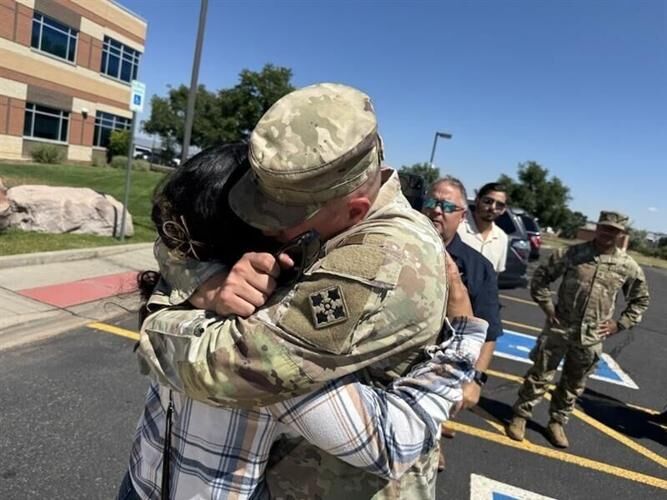
As the country’s largest immigration enforcement crackdown continues in Minnesota’s Twin Cities, a Fort Carson sergeant is fighting a personal immigration crisis — one that may implode his family. Sgt. Tyler Garza’s wife, Jennifer Maradiaga Baca, is not a legal...

Elizabeth School District dismisses challenge to book-ban injunction on eve of appellate arguments
Michael Karlik
michael.karlik@coloradopolitics.com
Updated 5 days ago
An Elbert County school district has dismissed its challenge to a judge’s injunction ordering it to return banned books to library shelves, days before the Denver-based federal appeals court was set to hear oral arguments this week. Although a three-judge...
Colorado Supreme Court to hear cases on insurance coverage for COVID, witness credibility
Michael Karlik
michael.karlik@coloradopolitics.com
Updated 6 days ago
The Colorado Supreme Court announced on Tuesday that it will decide the degree to which a virus or other hazard must affect a commercial property before it can trigger loss-or-damage coverage under an insurance policy. At least three of the...