

Despite tough talk, Colorado justices punch holes in 2021 crime victim restitution ruling
In a package of five opinions released on Tuesday, the Colorado Supreme Court stood by its general interpretation of the state’s crime victim restitution law from four years ago, while it simultaneously agreed that some judges’ violations of the law are not subject to challenge.
The marathon set of oral arguments last fall made clear to prosecutors that the Supreme Court had no interest in overturning its 2021 decision in People v. Weeks, which explicitly instructed judges and prosecutors on complying with the law for awarding financial restitution to crime victims. Nor did the justices backtrack on the solution they identified for violations: vacate the faulty restitution order entirely.
However, the Supreme Court did narrow the ability to challenge noncompliant restitution decisions in cases where substantial time has passed after a trial judge’s violation, and in instances where the defense either asks for — or does not object to — a trial judge’s consideration of restitution beyond the legal deadline.
‘No reason to reverse course’
In Colorado, as part of sentencing, judges must consider whether defendants owe financial restitution to their victims. If so, prosecutors generally need to provide the requested amount by the time of sentencing or within 91 days of sentencing. Judges must also impose the restitution amount within 91 days of sentencing. If judges need to extend either deadline, they must find extenuating circumstances or good cause.
In Weeks, the Supreme Court ruled in November 2021 that judges’ historical process of awarding compensation to crime victims did not comply with Colorado law. The justices noted a lackadaisical approach had taken hold in the trial courts that neglected the clear deadlines and procedural requirements. Consequently, if trial judges fail to follow the law, they lose authority to issue a restitution order.

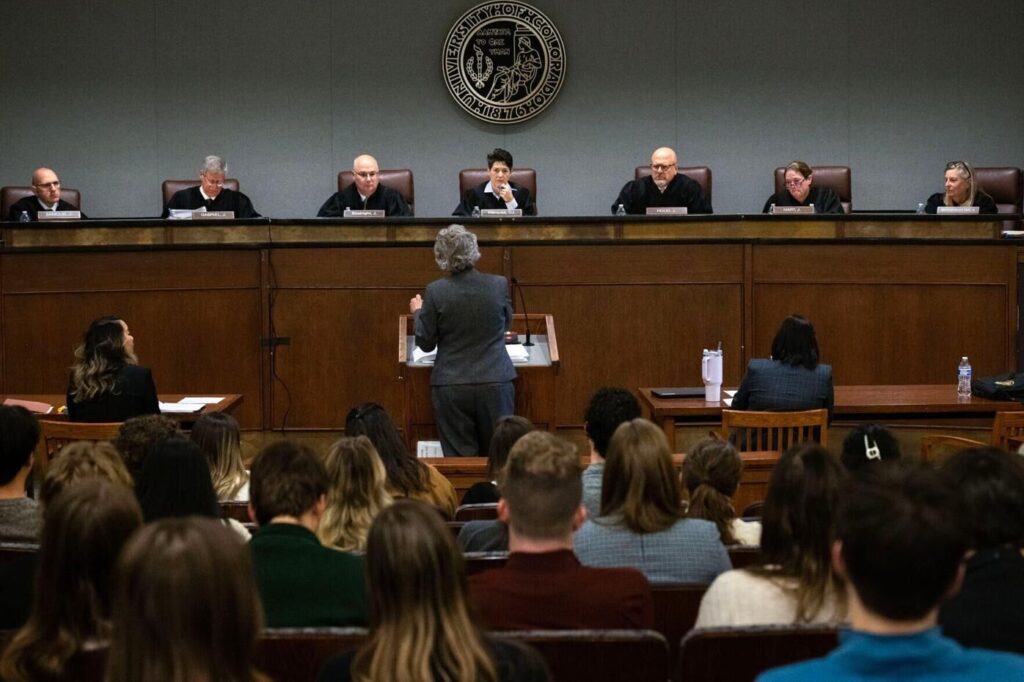
Following several Court of Appeals decisions overturning restitution awards to crime victims, the Colorado Attorney General’s Office petitioned the Supreme Court to narrow — or even walk back — the Weeks ruling. The request did not go over well when the Supreme Court heard oral arguments in the five restitution appeals last November.
“We didn’t just pull it out of thin air. What was the reason we did that? Why did we adopt such a rigid scheme in Weeks?” pressed Justice Carlos A. Samour Jr., who authored Weeks.
“Because you had great intentions,” responded Assistant Attorney General Frank R. Lawson.
“You know the reason. We said it in Weeks. You may not like it, but you know it,” retorted Samour. “Because prosecutors were not following the law.”
In one of the opinions released on May 27, Samour stood by his court’s original reading of the restitution law.
“The legislature could not have been clearer,” he wrote. Despite the decades-old requirements of the restitution law, “litigants and trial courts were still engaging in the ‘longstanding practice’ that failed to adhere to those amendments. That’s precisely what animated our decision in Weeks: We sought to buck the stubborn trend. Despite the prosecution’s fervent pleas to backtrack now, we see no reason to reverse course.”

Despite Samour’s strong language, the Supreme Court nonetheless added several asterisks to its original directive. Broadly, the justices addressed what happens if a defendant’s action or inaction causes a judge to issue an order beyond the 91st day, and when defendants are able to challenge years-old restitution orders that were issued in a noncompliant fashion.
Defense objections
Three cases focused on the defendants’ own actions. Zachary Eugene Babcock’s attorney objected to the prosecution’s restitution amount on the 90th day after sentencing, seeking a hearing beyond the deadline. Jessica Jo Roberson’s lawyer asked for a series of extensions while prosecutors revised their request, eventually pushing the restitution decision beyond 91 days. The prosecution provided its restitution request in the case of Darryl Cornelious Johnson on the 91st day, but Johnson’s objection prompted a hearing outside of the deadline.

The various trial judges did not explicitly find good cause existed to extend the deadline prior to the 91st day.
In each instance, the Supreme Court upheld the untimely restitution orders. The justices reasoned a defendant can surrender their right to have restitution decided within 91 days and in those instances, judges will not lose their authority to eventually issue an order.
“Roberson’s failure to object to a hearing outside the statutory deadline and subsequent repeated requests for continuances — all without any mention of the ninety-one-day deadline despite numerous opportunities to do so — reflects ‘conduct that manifests an intent to relinquish a right or privilege,'” wrote Justice Melissa Hart in Roberson’s case.

If the court were to strictly hold judges to the 91-day deadline, crime victims “could receive no compensation due solely to a trial court’s failure to meet the deadline. Such a result is antithetical to the statute’s purposes,” added Justice William W. Hood III in Babcock’s case.
His observation, however, ran contrary to the original Weeks decision, where Samour wrote that excusing a violation of the deadline “would be tantamount to disregarding the legislature’s intent.” None of the other opinions referenced that statement, either.

In each instance, Justice Richard L. Gabriel wrote separately, joined by Chief Justice Monica M. Márquez. They would not have concluded the defendants surrendered their right to timely restitution. Rather, they would have held that the defense’s objections amounted to good cause to exceed the deadline.
Gabriel admitted he “would modify our statement in Weeks” that judges have to expressly find good cause. Instead, he would have simply allowed appellate courts to find good cause exists by looking at the case record.
Illegal sentence? Or procedural flaw?
The Supreme Court also examined what should happen to noncompliant restitution orders that were issued years before Weeks. Previously, the Court of Appeals held such challenges addressed only the “illegal manner” in which a judge imposed restitution. That “procedural deficiency” did not render the sentence itself illegal. The distinction made all the difference: illegal sentences can be corrected anytime, while illegal manner challenges must be brought within 126 days.
In the two cases on the subject, the Supreme Court focused on what the law requires at or before sentencing. Either trial judges must order the specific dollar figure the defendant must pay, or they must enter an order saying whether or not the defendant owes restitution, with an amount to be determined later.
In the case of Shaun Jeff Snow, his trial judge neither ordered restitution within 91 days nor did he say at sentencing whether Snow would be liable for restitution. Samour, who wrote the opinion in Snow’s appeal, noted the trial judge’s actions were fully noncompliant with the law, rendering his sentence illegal and subject to correction anytime.

“We should not be understood as suggesting that the district court is the lone culprit in this case,” wrote Samour. The prosecution “didn’t request restitution, or even so much as inform the court and Snow that it intended to seek restitution, until it submitted the restitution information some two-and-a-half months after the sentencing hearing.”
The Supreme Court agreed Snow’s obligation to pay restitution must be erased as a result.
In contrast, the context of Audrey Lee Tennyson’s sentencing made clear he would have to pay restitution. His trial judge instead issued the order beyond 91 days and without good cause. Tennyson challenged his restitution obligation 10 years later.
This time, Samour wrote for the Supreme Court’s majority that Tennyson’s trial judge lawfully found he should pay restitution, but committed a procedural violation by exceeding the deadline. Unlike Snow, Tennyson’s challenge was to the illegal manner of sentencing, not an illegal sentence. Therefore, he had 126 days to seek review, not unlimited time.

Gabriel dissented, arguing the majority’s decision “dramatically undercuts” Weeks and ensured trial judges and prosecutors “will bear no consequences” for violating the law. He would have permitted Tennyson to challenge the belated restitution order as an illegal sentence.
“The upshot of the majority’s opinion today is that many defendants will be deprived of their day in court,” Gabriel wrote, “rendering the statutory language meaningless in a large number of cases.”
Although the Supreme Court initially agreed to evaluate whether vacating restitution orders was the only consequence for a violation, the justices stopped short of answering that question. Samour did, in Snow’s case, emphasize that the 91-day deadine would be unenforceable if there were no “ramifications for a trial court’s failure to comply.”
The cases are Tennyson v. People, Snow v. People, Johnson v. People, Babcock v. People and People v. Roberson.
Editor’s note: This article has been updated.
Colorado Politics Must-Reads:

10th Circuit orders lawyer to pay $1,000 for faulty AI citations
Michael Karlik
michael.karlik@coloradopolitics.com
Updated 4 hours ago
The Denver-based federal appeals court ordered a lawyer on Monday to pay $1,000 to the opposing side for submitting a legal filing with fake case citations generated by artificial intelligence. A three-judge panel of the U.S. Court of Appeals for...

Supreme Court finalists selected, federal judges slash backlogs | COURT CRAWL
Michael Karlik
michael.karlik@coloradopolitics.com
Updated 11 hours ago
Welcome to Court Crawl, Colorado Politics’ roundup of news from the third branch of government. Coloradans learned who the three finalists are for a state Supreme Court vacancy, and new data show that Colorado’s federal trial judges reduced their backlog...
Federal judge blasts government for violating court order, confiscating man’s property
Michael Karlik
michael.karlik@coloradopolitics.com
Updated 1 day ago
A federal judge gave the government three hours on Friday to return the property of a man released from immigration detention, which it allegedly retained in violation of her previous order. “At its most benign, this failure is an unforced...
DA’s withdrawal from veterans treatment court not judge’s problem, ethics panel says
Michael Karlik
michael.karlik@coloradopolitics.com
Updated 3 days ago
There are no ethical concerns from a judge continuing to participate in a specialty veterans treatment court if the district attorney’s office has withdrawn from the program, the Colorado Supreme Court’s ethics committee advised on Wednesday. Colorado law permits chief...
Divided appeals court orders insurance company to pay $35,600 for delayed disclosure of policy
Michael Karlik
michael.karlik@coloradopolitics.com
Updated 3 days ago
Colorado’s second-highest court concluded on Thursday that an insurance company violated state law when it refused to disclose an automobile policy to an injured motorist for nearly one year after she requested it. By 2-1, a three-judge Court of Appeals...
Judge expected to decide Monday whether to accept latest plea agreements for Hallfords
Mackenzie Bodell
mackenzie-bodell@coloradopolitics.com
Updated 3 days ago
An El Paso County judge is expected to decide Monday whether to accept new negotiations that would extend the prison sentence for Jon and Carie Hallford, coming on the heels of the court rejecting the original plea agreements for the...
Who are the 3 finalists for the Colorado Supreme Court?
Michael Karlik
michael.karlik@coloradopolitics.com
Updated 5 days ago
A citizen-led nominating commission has chosen the finalists for a vacancy on the Colorado Supreme Court, the first opening in five years on the seven-member court. The vacancy arose after the unexpected resignation of Justice Melissa Hart, who formally departed...
Christopher Zenisek, trial judge experienced with high-profile cases | SUPREME COURT FINALISTS
Michael Karlik
michael.karlik@coloradopolitics.com
Updated 5 days ago
After the Marshall fire burned through Boulder County in the final days of 2021 and wound up destroying more than 1,000 homes, the sprawling 4,000-plaintiff litigation was assigned to District Court Judge Christopher Zenisek of Jefferson County. Zenisek would go...
Andrea Wang, water and energy expert | SUPREME COURT FINALISTS
Michael Karlik
michael.karlik@coloradopolitics.com
Updated 5 days ago
When the late Chief Justice Mary Mullarkey authored a 2002 opinion in the complex and long-running Taylor Ranch case involving landowners’ claims to access a 77,000-acre tract in the San Luis Valley, she worked with her law clerk, Andrea S....
Susan Blanco, innovator in the judiciary | SUPREME COURT FINALISTS
Michael Karlik
michael.karlik@coloradopolitics.com
Updated 5 days ago
Less than 24 hours after her selection as a finalist for a Colorado Supreme Court vacancy, Chief Judge Susan Blanco was back on the bench in Fort Collins, moving methodically through the variety of complications she encountered. “Your goatee might...