

Colorado justices, 5-2, rule jury may consider victim’s suicidality in fentanyl distribution case
The Colorado Supreme Court ruled on Monday that a 2022 state law allows jurors to hear about a victim’s suicidal intentions when determining if a defendant is guilty of selling fentanyl and causing the victim’s death.
The justices interpreted for the first time a relatively new law imposing harsher penalties for those who distribute the synthetic opioid fentanyl. The year the measure passed, 920 people in Colorado died due to fentanyl overdoses. As a result, a defendant can now be sentenced to eight to 32 years in prison if distributing fentanyl was “the proximate cause” of a victim’s death.
However, in the El Paso County prosecution of Patrick L. Beverly II, it was unclear whether jurors in his case would be allowed to hear evidence that the man to whom he sold fentanyl seemed intent on dying by suicide — calling into question whether the sale of drugs was, in fact, what legally caused the death.
By 5-2, the Supreme Court decided the victim’s suicidality was something jurors may consider.
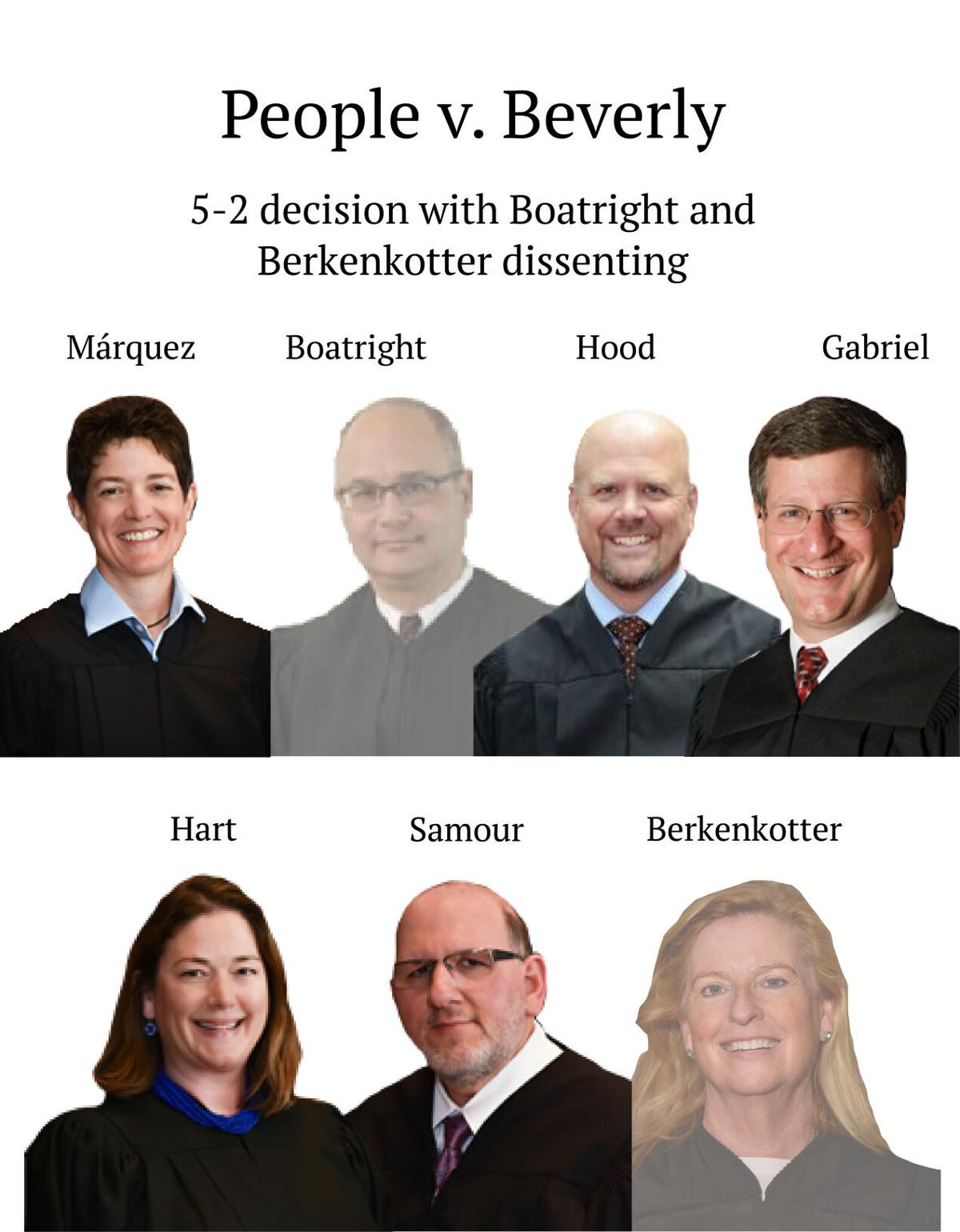

“Had the General Assembly intended to trigger an enhanced penalty anytime a fentanyl distribution ‘results in’ a user’s death, it could have said so,” wrote Chief Justice Monica M. Márquez in the May 5 opinion. “Though a fentanyl distributor should foresee that distributing fentanyl may result in death by accidental overdose, the distributor should not necessarily be expected to foresee, in every case, that a purchaser will make the ‘abnormal’ decision to intentionally die by way of ingesting ‘extraordinary’ amounts of fentanyl.”
Justice Brian D. Boatright disagreed. Writing for himself and Justice Maria E. Berkenkotter, he believed the inherent lethality of fentanyl necessarily makes a buyer’s death foreseeable. If selling fentanyl starts the “chain of events” leading to a victim’s death, that is enough for a conviction.
“Whether the person intended to end their life is irrelevant,” wrote Boatright.

Justice Brian D. Boatright and Chief Justice Monica M. Márquez attend Gov. Jared Polis' 2025 State of the State address on Thursday January 9, 2025 at the Colorado State Capitol. Special to Colorado Politics/John Leyba
John Leyba

Colorado Springs police found Matthew Bowen dead from a fentanyl overdose one night in August 2023. Evidence suggested Beverly sold Bowen dozens of fentanyl pills hours earlier. Prosecutors charged Beverly with fentanyl distribution resulting in death.
Prior to trial, the district attorney’s office sought to withhold a key detail from the jury: that Bowen was seemingly suicidal at the time Beverly provided him with fentanyl. The county coroner noted signs of Bowen’s suicidality and testified that Bowen’s levels of the powerful drug were “extraordinarily high.”
“I think the jury’s just going to get confused because it doesn’t matter if it’s a suicide,” Deputy District Attorney Lance Johnston said in arguing for the exclusion. “I don’t want the jurors to come across and say, ‘Well, he got exactly what he wanted. Why should we hold anyone responsible?'”
But that is the risk, countered District Court Judge Marcus Henson, of prosecuting distribution resulting in death, instead of just distribution.
“Because it almost begs the question: If there is the death, then the jury should have some opportunity to consider not only whether or not it was the defendant’s actions that maybe resulted in the death, but whether or not there’s something else contributing to the death,” he said.
Henson determined the jury should hear the evidence about Bowen’s suicidality when deciding if Beverly’s actions caused the death.
The district attorney’s office appealed immediately to the Supreme Court, arguing the victim’s intent in taking the drugs did not matter.
“In this regard, distributing fentanyl to a drug abuser who may or may not be suicidal is comparable to giving a firearm to a child. In either case, it is reasonably foreseeable that the someone could be gravely injured or killed as a result of the act of distribution,” wrote Senior Deputy District Attorney Doyle Baker.

FILE PHOTO
DENVER GAZETTE FILE PHOTO

The Colorado Attorney General’s Office, writing in defense of Henson’s ruling, noted there were two ways to read the 2022 law: Either it did not distinguish between accidental and intentional overdoses — meaning Beverly could be guilty simply for selling the drugs that caused Bowen’s death — or the mention of “proximate cause” required a look into whether there was anything else that triggered death after the sale.
“Judge Henson requests this Court’s guidance as to which reading of the statute is correct,” wrote Assistant Solicitor General Joseph G. Michaels.
Márquez, in the majority opinion, explained proximate cause means there is a connection between the defendant’s conduct and the victim’s injury. It is possible, though, for certain events to break that connection if they are unforeseen. She wrote that jurors should be able to weigh whether Bowen’s suicidality was an unforeseen, intervening cause of his death.
Márquez cautioned that evidence of a victim’s mindset might not work to the defendant’s advantage in every case.
“What if evidence showed the purchaser was unaware that the purchased drugs contained fentanyl?” she wrote. “In that scenario, a reasonable jury might conclude that the defendant effectively participated in the purchaser’s suicide by distributing drugs the defendant knew were more potent than the purchaser believed.”
Márquez added that if a defendant knew about a person’s suicidality and sold them fentanyl anyway, a jury could decide to hold the defendant liable.
Boatright, in dissent, maintained the lethal nature of unprescribed fentanyl made Bowen’s death “practically expected.”
“Selling fentanyl obtained on the black market is the equivalent of selling someone a gun and bullets, knowing that the purchaser plans to repeatedly play Russian Roulette,” Boatright argued. “Death of the person buying the gun and bullets, under those circumstances, is not only foreseeable, but virtually inevitable.”
The case is People v. Beverly.

Misconduct complaints from ex-Colorado judicial discipline director dismissed against federal judges
Michael Karlik
michael.karlik@coloradopolitics.com
Updated 13 hours ago
The administrative body for the Denver-based federal appeals court upheld a finding last week that misconduct complaints against Colorado’s chief federal trial judge and the chief appeals judge warranted dismissal and appeared to be a “litigation tactic” by the complaining...

First-ever Red Rocks naturalization ceremony draws most diverse group of new citizens
Michael Karlik
michael.karlik@coloradopolitics.com
Updated 15 hours ago
Colorado’s federal trial court held its first-ever naturalization ceremony for nearly 300 new citizens on Thursday at Red Rocks Park and Amphitheater. “We’re doing it to commemorate the 250th anniversary of the Declaration of Independence and the United States. Red...
10th Circuit finds no fair housing violation by Littleton landlord for worker’s alleged rape of tenant
Michael Karlik
michael.karlik@coloradopolitics.com
Updated 2 days ago
The Denver-based federal appeals court concluded on Monday that Littleton’s housing authority could not be held liable for a maintenance worker’s alleged rape of a tenant, as the worker’s employment did not provide any special access to the victim. A...

Jeffco Public Schools sues Trump administration to protect funding after alleged transgender policies violation
Matt Kyle
matt.kyle@denvergazette.com
Updated 24 hours ago
In the wake of several threats by the Trump administration to revoke federal funding, Jeffco Public Schools filed a lawsuit against the Department of Education seeking to protect that badly needed money. Jeffco has been under investigation by the DOE’s...
Denver detox center did not violate man’s rights with 10-hour hold, 10th Circuit says
Michael Karlik
michael.karlik@coloradopolitics.com
Updated 3 days ago
The Colorado-based federal appeals court concluded on Tuesday that Denver’s detoxification facility did not violate a man’s rights by holding him against his will for 10 hours until his blood alcohol content was projected to reach zero. Unusually, Brian Garrett’s...

Federal judge clarifies ex-GOP treasurer candidate’s burden to prove defamation claims
Michael Karlik
michael.karlik@coloradopolitics.com
Updated 3 days ago
A federal judge clarified last week that businessman and former Republican statewide candidate Brian Watson will need to surmount a higher hurdle in proving his claim that a party guest’s alleged description of him as a “criminal” amounted to defamation....
Colorado board permits state to appeal injunction against arthritis drug price cap
Marissa Ventrelli
marissa.ventrelli@coloradopolitics.com
Updated 3 days ago
A Colorado board voted Friday to allow the Attorney General’s Office to fight an injunction against a price cap on a drug that treats arthritis. A U.S. district court judge had granted the company Amgen a preliminary injunction, temporarily blocking...
Federal judge rejects constitutional claims, ‘expressions of hatred’ by Club Q defendant
Michael Karlik
michael.karlik@coloradopolitics.com
Updated 4 days ago
A federal judge rejected a defendant’s claims that he received constitutionally ineffective assistance of counsel while facing federal hate crime and firearms charges for murdering five people at a Colorado Springs LGBTQ nightclub in 2022. Anderson Lee Aldrich is serving...

Divided 10th Circuit upholds Colorado congestion fee on car rentals
Michael Karlik
michael.karlik@coloradopolitics.com
Updated 3 days ago
The Denver-based federal appeals court concluded on Monday that a 2024 “congestion impact fee” that lawmakers imposed on short-term vehicle rentals did not conflict with a federal prohibition on certain airport-related charges. Beginning in the 1970s, Congress began limiting the...
10th Circuit dismisses woman’s lawsuit following 10-year attempt to undo restraining order
Michael Karlik
michael.karlik@coloradopolitics.com
Updated 7 days ago
The Denver-based federal appeals court rejected a woman’s challenge on Friday to a restraining order imposed on her more than a decade ago, finding that she cannot credibly claim she will be prosecuted for violating the restraining order through her...