

Colorado ethics panel: Judge cannot drive car advertising wife’s law firm, may ‘occasionally’ ride in it
A judge whose wife works at a law firm may not drive a car that has the firm’s logo affixed to the side, nor may he park the vehicle in front of his home, the state’s judicial ethics panel advised last week.
The judge may, however, ride as a passenger “occasionally,” the panel added.
The Colorado Judicial Ethics Advisory Board, which consists of judges, lawyers and a non-attorney, cited multiple reasons why the judge’s affiliation with the promotional vehicle would be problematic, including the perception that the specific law firm is in a position to influence the judge.
“Thus, although a judge may minimize the risk of showing any actual partiality in favor of his spouse’s employer by recusing from all cases that involve the firm, the judge driving a vehicle prominently displaying advertising for the law firm could, in the mind of a reasonable person, create an appearance of partiality,” the panel wrote in its April 17 opinion.
An unidentified judge asked the advisory board for guidance about the implications of a potential vehicle purchase. His wife’s employer pays a stipend for automobile expenses if she drives a black car, under five years old, that displays the law firm’s logo on the side. The judge and his wife are considering buying a car that meets those criteria, but he wanted to know if the Code of Judicial Conduct permits him to drive the car, park it in front of his home or even ride as a passenger.
The ethics panel advised that even if the judge were not handling cases litigated by his wife’s law firm, a judge may not “convey or permit others to convey” the impression that someone is in a position of influence over them.
“Even if the risk is subtle, a judge should avoid giving such an impression,” the advisory board wrote.

It cited a 2005 opinion that held a judge could not even drive a car with a bumper sticker for their spouse’s political campaign. While slightly different than the promotional vehicle scenario, the underlying principle is “judges cannot use the prestige of their office to promote the economic interests of themselves or others,” the panel wrote.
In that same 2005 opinion, the advisory board also gave the thumbs-down to a judge placing a campaign sign for their spouse on “jointly owned” property.
“In our view, allowing a vehicle to be parked in front of the judge’s home when the vehicle is prominently marked with the logo of a law firm is akin to allowing a spouse to post a political yard sign on property jointly owned by the judge,” the panel wrote in its latest opinion. “Such an action risks the perception that the judge is improperly using the prestige of the judicial office to benefit another entity and creates an appearance of partiality and a possible perception that the law firm is in a position to influence the judge.”
As for whether the judge could ride as a passenger in the promotional car, the ethics panel noted judges are allowed to accept benefits “incidental” to a family member’s job, like attending a work conference as their spouse’s guest. A judge riding in a promotional vehicle for their spouse’s employer would fall into that category, the ethics board concluded, so long as it happened “occasionally.”
“We caution that a judge should be careful, however, to avoid regularly riding in such a vehicle as that would risk the same appearance of partiality already discussed,” the board wrote.

Colorado justices skeptical of appellate court’s limitation on prosecution’s appeal
Michael Karlik
michael.karlik@coloradopolitics.com
Updated 2 days ago
The Colorado Supreme Court seemed skeptical on Tuesday that Denver prosecutors should be barred from appealing a trial judge’s permanent dismissal of a criminal case, based upon the sequence of events after the original ruling. Prosecutors charged Quinn M. Jebe...

Federal judge: Government violated order shielding man from deportation in ‘one-off mistake’
Michael Karlik
michael.karlik@coloradopolitics.com
Updated 2 days ago
A federal judge acknowledged on Thursday that the government violated his order by deporting a man in immigration detention during his pending court case, but it “serves nobody’s interests” to require the government to return him. On Feb. 18, Tesfami...
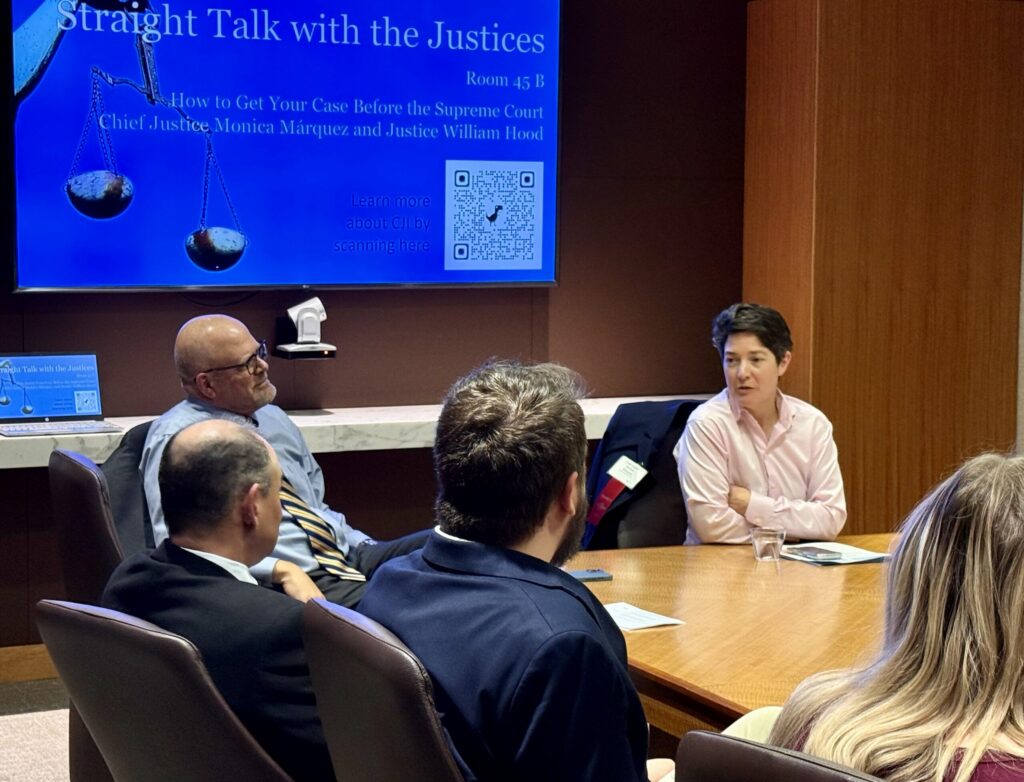
Colorado Supreme Court lifts curtain on decision-making at legal event
Michael Karlik
michael.karlik@coloradopolitics.com
Updated 2 days ago
Members of the Colorado Supreme Court sat down with lawyers on Wednesday to answer questions about behind-the-scenes topics, including what happens immediately after an appeal is argued, why they might intervene in an ongoing case, and the consequence of a...
Colorado’s newest federal judge speaks about techniques for advancing cases
Michael Karlik
michael.karlik@coloradopolitics.com
Updated 3 days ago
U.S. Magistrate Judge Cyrus Y. Chung described on Wednesday the various tactics he employs to resolve court cases, summing up his role with a laxative-based metaphor. “Someone told a group of us federal magistrate judges that magistrate judges are the...

Federal judge hears ICE agents’ confusion about law, injunction on warrantless arrests
Michael Karlik
michael.karlik@coloradopolitics.com
Updated 4 days ago
A federal judge heard testimony on Tuesday from U.S. Customs and Immigration Enforcement agents in Colorado, who had trouble describing the requirements of his recent injunction and the training they received on making warrantless arrests pursuant to the law. On...

10th Circuit dismisses challenge to Colorado legislature’s decorum rules
Michael Karlik
michael.karlik@coloradopolitics.com
Updated 1 hour ago
The Denver-based federal appeals court concluded on Tuesday that Colorado lawmakers cannot be sued for creating and enforcing rules of decorum that circumscribe the public commentary allowed at legislative committee hearings. A three-judge panel of the U.S. Court of Appeals...
Colorado Supreme Court blocks ballot initiative defining ‘fees’
Michael Karlik
michael.karlik@coloradopolitics.com
Updated 5 days ago
The Colorado Supreme Court blocked a proposed ballot initiative on Monday that would have required voter approval for new fees above a certain threshold, while also enshrining a definition of “fee” into the state constitution for the first time. Chief...

Colorado justices, by 5-2, say Longmont detective did not violate suspect’s Miranda rights
Michael Karlik
michael.karlik@coloradopolitics.com
Updated 22 hours ago
The Colorado Supreme Court’s majority ruled on Monday that a Longmont detective did not coerce a suspect into talking by making references to how a judge would look at his character, and by suggesting he may get out of prison...
Colorado justices find Fort Collins police lacked probable cause to arrest suspect in park
Michael Karlik
michael.karlik@coloradopolitics.com
Updated 5 days ago
The Colorado Supreme Court agreed on Monday that Fort Collins police lacked probable cause to arrest a man for a child sex offense based on his presence in a public park around the time they intended to meet with their...

Supreme Court to hold oral arguments, discipline commission releases report | COURT CRAWL
Michael Karlik
michael.karlik@coloradopolitics.com
Updated 5 days ago
Welcome to Court Crawl, Colorado Politics’ roundup of news from the third branch of government. The state Supreme Court is holding oral arguments this week, plus Colorado’s judicial discipline commission released its annual report. Colorado Supreme Court news • The Supreme...
PREV
PREVIOUS
Colorado Supreme Court approves new rules for child welfare cases, with tweaks to jury trial right
The Colorado Supreme Court adopted on Monday a package of revisions to the rules governing child welfare cases, while modifying one section that governs when a parent surrenders their right to have a jury decide if their child is neglected. Earlier this month, the justices held a hearing to evaluate the long-running group effort to […]

Appeals court finds Denver judge relied on unsupported facts to restrict man's parenting time
Colorado’s second-highest court concluded last week that a Denver judge made “clearly erroneous” findings about a father’s sobriety and his request for parenting time when she imposed strict conditions on visitations with his children. Following a virtual April 2024 hearing in which both parents were without a lawyer, then-District Court Judge Jennifer Torrington issued an […]