

Political paradoxes at the start of President Trump’s second term | SLOAN

Chief Justice John Roberts made headlines this week — in a refreshingly nuanced and low-keyed manner increasingly antithetical to the way we have become accustomed to headlines being made in Washington D.C. — with a statement obliquely in response to calls by President Donald Trump to impeach federal Judge James Boasberg, who issued a temporary restraining order Saturday to block the administration from deporting 250 Venezuelans it identified as members of the Tren de Aragua gang under the Alien Enemies Act of 1798. Said Justice Roberts: “impeachment is not an appropriate response to disagreement concerning a judicial decision. The normal appellate review process exists for that purpose.”
Now, Justice Roberts is absolutely correct in his assessment; however righteous, popular and necessary the administration’s order deporting these thugs is (and it is all three), at the very least it is bumping up against new legal ground, and this administration ought to be held to as strict an adherence to the Constitution and the system it provides for as its supporters had clamored for the previous administration to be held to. Granted, as much of an admirer as I am of Justice Roberts, his proclamation would have been better received had it also included a line or two admonishing with equal fervor the judicial adventurism exhibited by D.C. federal district Judge Amir Ali in the USAID case.
Stay up to speed: Sign up for daily opinion in your inbox Monday-Friday
It periodically strikes me I could devote every one of my columns to reflection on the phenomenon of political paradox — less charitably called hypocrisy. It seems even the longest-held principles can be unceremoniously abandoned if embraced by the other side.
The most obvious current examples are the relatively new positions adopted by Republicans on free trade and foreign policy. Of course, if you reach back far enough, both isolationism and protectionism have been more associated with the right — both Smoot and Hawley were Republicans. But conservatism is never (supposed to be) shackled inflexibly to ideology, but beholden rather to the guidance of Edmund Burke, who instructed gradual change was necessary for any society to survive, but also that rash, radical change is the ultimate enemy of order and good governance.
Republican evolution on these issues was of the gradual, measured sort that learned from mistakes — like Smoot-Hawley. Their reversal has been as rash and knee-jerk as the upheavals of the French Revolution that so repulsed Burke.
Of course, the corollary to this is it applies true in reverse — that the Democrats have responded with an equal and opposite reaction. I once wrote perhaps President Trump’s greatest achievement will go down as getting liberal Democrats to think nasty things about Russia. Honestly, if Trump tomorrow proclaimed his unequivocal support for partial-birth abortion, I would bet a healthy amount a good chunk of the MAGA world would instantly take to social media to praise the president’s hard-nosed pragmatism. And just as many erstwhile feminist Democrats would all of a sudden sound like Jerry Falwell on the issue.
This illustrates what may be the greatest frustration for Democrats in Washington these days. On one hand, they want desperately to push back on President Trump and his agenda. On the other hand, they run into a difficulty in that so many of the things they ostensibly oppose are issues or practices until yesterday they championed. This leaves them with not much of a polemical argument to make, aside from “Trump.” Vermont U.S. Sen. Bernie Sanders, for instance, said in an interview back in 2019 “of course” he would use tariffs — just, er, “differently” than Trump. Because, reasons.
Democrats are absolutely appalled by the ambitious use of executive power — unless it is power wielded by a Democrat in pursuit of the welfare state. They call it a constitutional crisis, official treachery on the order of blowing up Mount Rushmore for the president to circumvent the courts in pursuit of his agenda. They forget (or do they?) how regularly President Joe Biden did the same (student loan forgiveness, as one example), or New York U.S. Rep. Alexandria Ocasio-Cortez’s repeated calls for the Biden administration to defy federal court rulings. In a Twitter/X post following a ruling in which Justice Samuel Alito explicitly expressed “doubts (the Biden administration) would even obey an unfavorable order in these cases, much less that it would choose to take enforcement actions to which it has strong objections” AOC replied, in part, “The court is a political entity currently engaged in overreach and abuse of power. In our system of checks and balances, SCOTUS’s reckless behavior warrants a check from the leg + executive branches. This is not unprecedented, it’s how our system is designed to avert tyranny.” Sounds not dissimilar from what President Trump is now saying, and just as wrong-headed.
The Democrats are in an increasingly uncomfortable position on many issues, not just now having to support hawkish foreign policy, defend “Big Pharma” from President Trump’s HHS Secretary, and oppose labor on tariffs, but also to defend institutions they decried less than a year ago. Senate Minority Leader Chuck Schumer, who made one of the only good decisions in his 25 years in the Senate last week by accepting the Republican CR to keep the government open, ignited an internecine war within his party, with several Democrats castigating him for not using the filibuster — the abolition of which was a Democratic priority six months ago. Among those were none other than AOC, whose name is being bandied about for a party leadership position.
The paradoxes pile up.
Kelly Sloan is a political and public affairs consultant and a recovering journalist based in Denver.


Crow’s stunt wasn’t seditious — but was dangerous | BRAUCHLER
George Brauchler
george-brauchler@gazette.com
Updated 8 hours ago
This Thanksgiving, when millions of military members sat down with their families to eat turkey, they likely discussed Crow. Colorado U.S. Rep. Jason Crow’s media lust led him to create an unprecedented video designed to instill doubt in our military...

Polis’ silence deafening on Peters’ prison transfer | WADHAMS
Dick Wadhams
dick-wadhams@coloradopolitics.com
Updated 8 hours ago
What is Gov. Jared Polis thinking? As President Donald Trump tries to bully Colorado into releasing convicted and imprisoned Tina Peters to federal custody, a silent Polis appears to have dived under his desk. The U.S. Bureau of Prisons has...

Trump’s menacing military moves wearing thin with voters | HUDSON
Miller Hudson
miller-hudson@coloradopolitics.com
Updated 8 hours ago
When I reported to my initial assignment following Naval Officer Candidate School, my commanding officer asked me somewhat jovially, “You know why the Navy sends me Ensigns don’t you Mr. Hudson?” Puzzled, I replied, “No, Sir.” Still grinning, he explained,...

Beef industry takes another blow with Nebraska plant closure | GABEL
Rachel Gabel
rachel-gabel@coloradopolitics.com
Updated 8 hours ago
Black Swan is apparently on the menu this holiday season for people across the cattle and beef value chains. Last week, Tyson announced the closure of a processing plant in Lexington, Nebraska. This plant processes about 5,000 head of cattle...

Gambling is better than polling in predicting elections | CALDARA
Jon Caldara
jon-caldara@coloradopolitics.com
Updated 3 days ago
You’ve heard the term, “click bait.” It’s those wonderful, tempting links all over websites like “The top-10 sexiest actors,” or “You’ll never believe what she looks like now.” For political junkies, our click bait is the latest poll numbers. We...

Rural Colorado health care receives the attention it deserves | PODIUM
Colorado Politics
colorado-politics@coloradopolitics.com
Updated 5 days ago
By Marc Catlin A $50 billion investment to fund rural health care was in jeopardy in mid-October, when members of the U.S. Senate attempted to strip out the Rural Health Transformation (RHT) program in exchange for opening the U.S. government....
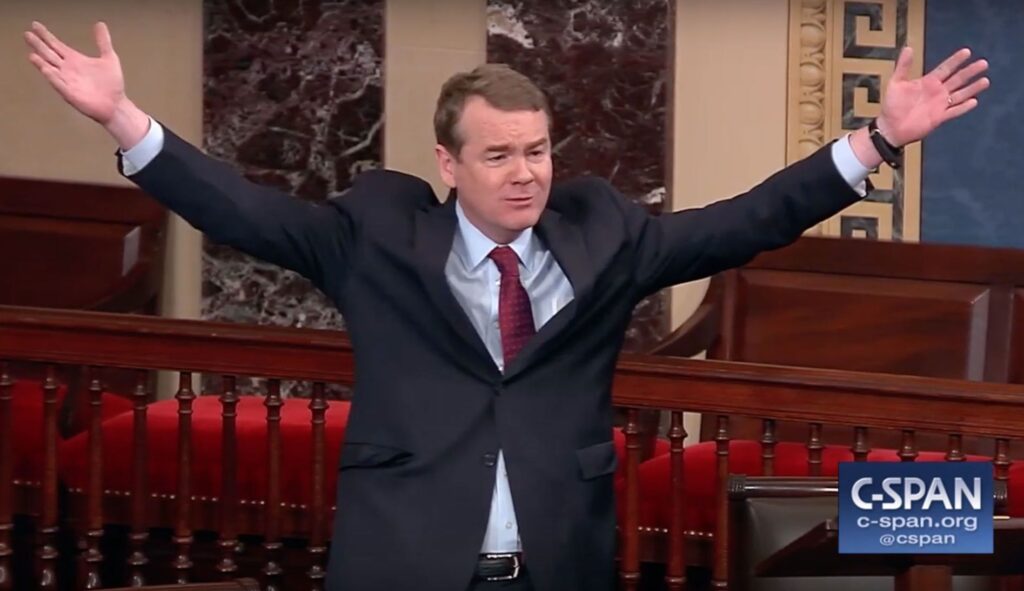
Colorado’s Michael Bennet rode outrage over last government shutdown to presidential bid | TRAIL MIX
Ernest Luning
ernest.luning@coloradopolitics.com
Updated 5 days ago
Only weeks after the longest federal government shutdown in U.S. history ended with congressional Democrats’ demands to restore health care funding previously cut by Republicans left dangling, the high-stakes standoff that dominated political news for 43 days has already receded...

Giving thanks for the long-overdue Epstein reckoning | NOONAN
Paula Noonan
paula-noonan@coloradopolitics.com
Updated 5 days ago
Thanksgiving is the best holiday. No gifts required. Just family and friends around a table enjoying each other’s company, expressing gratitude for the good things in their lives. Some good things arrived recently in the form of the Epstein emails....

Illegal means illegal | BIDLACK
Hal Bidlack
hal-bidlack@coloradopolitics.com
Updated 7 days ago
Before I get to the core of today’s column, my outrage at a president calling for the execution of sitting members of Congress, I’d like to tell you a little bit about how we go about launching intercontinental ballistic missiles,...