

Colorado General Assembly is back in session today | Here are 5 things you need to know
The Colorado General Assembly will kick off its 2025 session today.
Here are five things you need to know.
Ceremonies begin at 10 a.m.
The House and Senate will convene at 10 a.m. The lawmakers will be sworn in by the chief justice of the Colorado Supreme Court. In the House, everyone will be sworn in; in the Senate, the new senators will take their oath. The state Capitol typically takes on a festive atmosphere on opening day, with lawmakers bringing in their families, including babies and young children. Once everyone has taken their oath of office, the Senate President, Speaker of the House and leaders of the minority parties will give speeches.
New members, new chemistry
Lawmakers will need to figure out a way to govern with new leaders — and dozens of new members. The Colorado House will welcome 21 new members, plus one more to replace a member who will be joining the Senate. Democrats will hold 43 seats in the House, three fewer than last year. Republicans will have 22 members. Meanwhile, 11 new members will join the state Senate, with eight coming over from the House and three new members. The chamber will consist of 23 Democrats and 12 Republicans, the same as the 2023 and 2024 sessions.
Over the last few days, Democrats picked legislators to represent vacant seats. In Senate District 31, the party chose Matthew Ball, a policy director for the city of Denver, to replace Sen. Chris Hansen. In Senate District 29, Democrats chose Rep. Iman Jodeh of Aurora to succeed state Sen. Janet Buckner.
Earlier, Republicans picked former University of Colorado regent John Carson to succeed former Sen. Kevin Van Winkle, who resigned in December to accept an appointment to the Douglas County Board of County Commissioners.
Big fights ahead
Businesses and unions will clash over a proposal that will eliminate the requirement for a second election under union laws in order to require non-union members to pay a union fee. While other states only require a single election among workers to decide whether or not to begin discussions on “union security” agreements, Colorado requires two: the first requires a simple majority to unionize; the second must receive a 75% favorable vote to pass. Businesses argue that the Labor Peace Act sets Colorado apart from the rest of the country in a good way, providing a competitive economic environment that draws new businesses to the state. Unions, meanwhile, contend that the second election requirement is a significant barrier to unionization, which they say positively affects both workers and the state’s economy.
Meanwhile, another proposal will likely spark heated debate about local control. The proposal would prohibit local courts from imposing more severe sentences than state courts for the same crimes. If there is no comparable state offense, the maximum punishment for city offenses would default to the state’s petty offense sentencing guidelines of up to 10 days in jail and/or a $300 fine. In addition, the bill says municipal court defendants have the same right to counsel as defendants going before a state court. Local governments and organizations like the Colorado Municipal League and Colorado Counties, Inc., are likely to oppose the legislation. Notably, Aurora officials, who have passed tougher penalties for retail theft, car theft and “dine and dash” offenses, have long maintained that a tougher approach is needed to curb crime. The Aurora police said car theft in the city dropped 22% since the ordinance went into effect, a downward trajectory seen statewide.
Finally, the fight over a proposal to allow online gaming, such as casino-style games, is beginning to take shape. Two tribal casinos in southwestern Colorado could be affected. Sen. Dylan Roberts, D-Summit County, whose district includes Gilpin County, said the bill, which would require voter approval, would decimate the economies of Blackhawk and Central City, which are 90% reliant on tourism and casino revenue. It is not immediately clear how the proposal would affect the community colleges, which have received gaming tax revenue since voters approved casinos in 1990. That tax revenue generates about $13 million annually for the community colleges. The most recent change in state gambling law took place in 2019, when voters approved a measure referred to them by the General Assembly allowing sports betting, with tax revenue paying for state water plan projects.

Figuring out the state budget will be a big task in 2025 with the general fund expected to be down by an estimated $1 billion.
Spotlight on Colorado’s competitiveness
The Denver Metro Chamber of Commerce recently published a report showing that Colorado has substantially slipped in its business competitiveness, and yesterday, legislative leaders delved into the subject. Incoming Senate President James Coleman said he’s looking for an assessment and evaluation of regulations and how to incentivize businesses in the 2025 session. House Speaker Julie McCluskie said, “(While) I appreciate the focus on competitiveness, at the same time, I want to see balance. Are we falling in the rankings, but what are we doing to improve livability?”
House Minority Rose Pugliese said the “livability” issue is tied to the fees the General Assembly has levied on Coloradans in the last few years, such as the grocery bag fee and the retail delivery fee, which she called “nickel and diming” Coloradans. It isn’t just about rolling back regulations, she said. The legislature needs to roll back fees so people can afford to live in Colorado.
Pugliese said she will sponsor a bill to repeal the grocery bag fee.
A budget headache
The biggest headache for lawmakers in the 2025 session is crafting the state budget, which under the constitution must be balanced. In September, members of the legislature’s Joint Budget Committee were told by state economists that they face a $1 billion shortfall in general fund dollars, which is the discretionary money lawmakers use to start new programs and fund existing obligations, from K-12 education to corrections to paying state employees. That number got just a little smaller, briefly, with the December revenue forecast, but a voter-approved ballot measure on public safety added another $350 million obligation, although without a set timeframe for funding it.

Rep. Bob Marshall speaks to media before Gov. Jared Polis signs Senate Bills 23-303 and 23-304 on Wednesday, May 24, 2023, at the home of Joe Lloyd Medina in Commerce City, Colo. (Timothy Hurst/Denver Gazette)

Primary rival sues to prevent Democrat Eileen Laubacher from going through assembly in Colorado’s 4th CD
Ernest Luning
ernest.luning@coloradopolitics.com
Updated 5 hours ago
Democratic congressional candidate Trish Calvarese on Monday asked a judge to prevent one of her primary rivals, Eileen Laubacher, from participating in the caucus and assembly process to seek the nomination to challenge Republican U.S. Rep. Lauren Boebert in Colorado’s...
Colorado lawmakers tackle legislation on sexual assault
Jenny Deam
jenny-deam@coloradopolitics.com
Updated 4 hours ago
A panel of Colorado lawmakers on Monday unanimously approved a bill that supporters say will offer protections and support to victims of domestic violence, stalking, sex trafficking and sexual assault, including mandatory training for law enforcement on trauma. The measure,...
Colorado Supreme Court clarifies restraining order violations can always support burglary charge
Michael Karlik
michael.karlik@coloradopolitics.com
Updated 8 hours ago
The Colorado Supreme Court’s majority ruled on Monday that a violation of a restraining order can also serve as a basis for finding a defendant guilty of burglary. Under state law, a person commits second-degree burglary by unlawfully entering or...

Big week ahead for major legislation to address housing affordability woes
Zach Halaschak, Washington Examiner
zach.halaschak.washington.examiner@gazetteedit.wpenginepowered.com
Updated 10 hours ago
The Senate is pushing ahead with a bipartisan bill to improve housing affordability, teeing up a critical week for housing on Capitol Hill and raising major questions about what provisions will be included. Senate Majority Leader John Thune (R-SD) filed cloture on legislation from the...

Macron goes nuclear with increases to French warhead arsenal
Timothy Nerozzi, Washington Examiner
timothy.nerozzi.washington.examiner@gazetteedit.wpenginepowered.com
Updated 10 hours ago
French President Emmanuel Macron is channeling the atomic spirit of his predecessor Charles de Gaulle with orders for the French military to “increase the number of nuclear warheads” in the nation’s arsenal. Macron announced the seismic shift in France’s defensive...

Who has been killed so far during US-Israel mission in Iran?
David Zimmermann and Keely Bastow, Washington Examiner
david.zimmermann.and.keely.bastow.washington.examiner@gazetteedit.wpenginepowered.com
Updated 10 hours ago
There have been numerous casualties on all sides since the joint U.S.-Israel strikes against Iran commenced over the weekend, with more lives expected to be lost as the campaign continues. The Islamic regime’s leadership is currently bearing the brunt of...
Colorado Senate swears in Adrienne Benavidez after district vacancy win
Marianne Goodland
marianne.goodland@coloradopolitics.com
Updated 10 hours ago
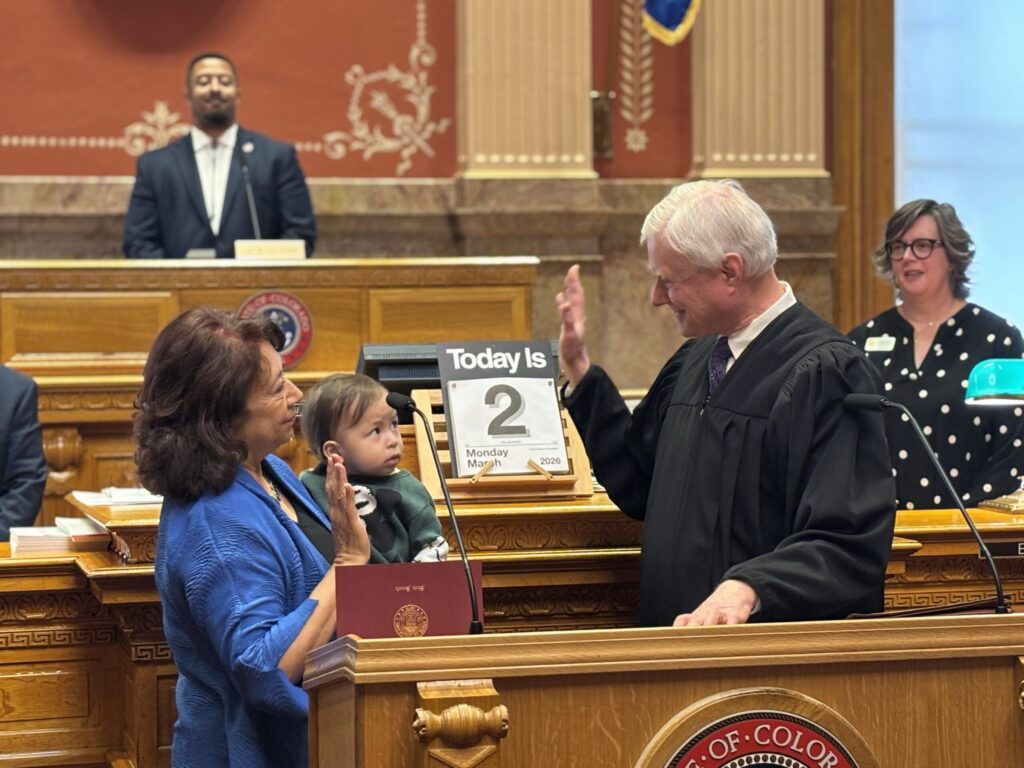
Sen. Adrienne Benavidez, a Democrat from Adams County, was sworn in Monday to the Colorado Senate, just four days after winning a vacancy election in District 21. She was sworn in by Colorado Court of Appeals Justice Lino S. Lipinsky...

10th Circuit judge creates vacancy, district court gets new chief judge | COURT CRAWL
Michael Karlik
michael.karlik@coloradopolitics.com
Updated 12 hours ago
Welcome to Court Crawl, Colorado Politics’ roundup of news from the third branch of government. A longtime member of the Denver-based federal appeals court will give the president a vacancy to fill, plus Colorado’s federal trial court will see a...

Denver mayor says his commute time tripled following ‘road diet’ change
Mark Samuelson Special to The Denver Gazette
mark.samuelson@denvergazette.com
Updated 10 hours ago
Mayor Mike Johnston is pushing back sharply against the claim by Denver councilmembers and bike activists that the city succumbed to lobbying pressure in revising a “road diet” plan for East Alameda Avenue, while noting that his own commute time...

Rural legislators, Colorado farmers defeat pollinator bill backed by Gov. Polis
Marianne Goodland
marianne.goodland@coloradopolitics.com
Updated 11 hours ago
A proposal to limit the use of neonicotinoid-coated crop seeds collapsed in the Senate Agriculture and Natural Resources Committee last week, as rural lawmakers, including two Democrats, joined Republicans to reject what they called an expensive, impractical mandate on farmers....