

Romer and Benson spar over debates, labor support | A LOOK BACK
Thirty Years Ago This Week: In a hotly contested gubernatorial race Gov. Roy Romer and opponent Bruce Benson were exchanging sharp barbs in the media and at speaking engagements.
At a speech before the Committee on Political Education, the political arm of the Colorado AFL-CIO, Romer told the over 100 committee members in attendance, “This is a very important election. It will decide how we choose leaders in this state.”
Romer addressed Benson’s nearly $2 million television ad buy during the primary, “I am not a poor man, but I never chose to use dollars to buy an office. We’ve got a democracy 200 years old. Thomas Jefferson put it together where everybody was equal. I don’t think we can get into a circumstance where only the wealthy can run for office.”
Romer said that Benson was afraid to be seen with him and that the Benson campaign was now pulling out of a previously agreed upon debate tour of Colorado’s biggest cities, 30 in total.
“I’m saying to Mr. Benson: this state needs to see us both. I want to do it 30 times, if you want only 25, OK, but let’s get to it. I think we ought to get back on the street, let people see what kinds of leaders we are.”
When The Colorado Statesman called the campaign for a response, Benson’s press secretary, Greg Sparrow, said that his campaign had proposed 11 engagements to the governor based on invitations received from both news media and community organizers.
Romer, according to Sparrow, didn’t like the informal format that Benson and his team suggested.
“We propose an informal setting, in easy chairs, with a moderator setting the stage and then letting the two talk back and forth,” Sparrow said. “This kind of talk can be useful to give voters a better understanding of issues and differences between them.”
Sparrow also reminded The Statesman that Romer was a multi-millionaire and “outspent his previous GOP rivals six-to-one. This is the first time he won’t be able to outspend an opponent.”
The large television ad buy, Sparrow clarified, was done so that Benson could communicate his ideas to voters.
And to the Benson campaign, it was of no concern that Romer had been endorsed by so many labor organizations.
“It’s not surprising that managers of the AFL-CIO endorse Romer,” said Sparrow, “but the rank-and-file of labor may be tired of career politicians and feel differently — be ready for a change.”
Twenty Years Ago: Several presidents of Colorado’s state universities testified before a joint session of the House and Senate Education Committees on how they were protecting the academic freedoms of their students and “intellectual and political diversity.”
Senate Joint Resolution 04-033 commended the institutions who had signed a memorandum of understanding stipulating that “no student should be penalized because of political opinions that differ from a professor’s.”
Senate President John Andrews, R-Centennial, one of the resolution’s co-sponsors, said that, “Just this month we’ve heard about a Marxist instructor at CSU berating a young woman veteran, a law professor at CU saying Republican students are racists and Nazis, and a Metro faculty member telling her class that conservative students can’t think.”
Andrews, who taught on occasion at the Colorado School of Mines, used the names of both students and professors during his speech at the joint session and said, “Without specifics and case studies, we’re not going to get anywhere today.”
After the joint resolution CSU, CU, Metro State addressed how student grievances were handled and updated their student handbook to address political diversity.
Rachael Wright is the author of the Captain Savva Mystery series, with degrees in Political Science and History from Colorado Mesa University, and is a contributing writer to Colorado Politics and The Colorado Springs Gazette.

Divided appeals court nullifies defendant’s $37,000 restitution obligation due to faulty order
Michael Karlik
michael.karlik@coloradopolitics.com
Updated 2 hours ago
Colorado’s second-highest court concluded on Thursday that a defendant has no obligation to pay nearly $37,000 in crime victim restitution due to a faulty order that even the trial judge acknowledged was contrary to the law. In Colorado, as part...
Investigation finds Colorado Sen. Faith Winter was at fault in fatal crash
Marianne Goodland
marianne.goodland@coloradopolitics.com
Updated 3 hours ago
Legislator’s alcohol level was more than twice the legal limit County authorities have concluded their investigation into the I-25 crash that killed Colorado Sen. Faith Winter, determining the Colorado legislator was at fault in the two-vehicle collision. An autopsy found...
Forecast shows slowing growth in Colorado
Marianne Goodland
marianne.goodland@coloradopolitics.com
Updated 3 hours ago
Missing federal data complicates state forecast Colorado’s economy is holding steady, though growing warnings, particularly in consumer demand and spending, are emerging, according to state economists’ latest forecast. The December forecast presented on Friday was not as complete, given the...

Federal court issues injunction on Colorado gas stove labels law
Marissa Ventrelli
marissa.ventrelli@coloradopolitics.com
Updated 4 hours ago
A federal judge in Denver has issued an injunction blocking enforcement of a newly enacted state law that would have required retailers to place labels on gas-fueled stoves with warnings about their potential effects on air quality. The law, House...
Colorado officials stall progressive income tax ballot initiative again by declaring it to have multiple subjects
Ed Sealover
ed-sealover@coloradopolitics.com
Updated 6 hours ago
In a saga offering more twists than a soap opera, Colorado Title Board members reversed course on Wednesday and determined an initiative to establish a progressive income tax doesn’t qualify for the 2026 ballot because it doesn’t have a single...

Justice Melissa Hart to step down from Colorado Supreme Court
Michael Karlik
michael.karlik@coloradopolitics.com
Updated 2 hours ago
Justice Melissa Hart will step down from the Colorado Supreme Court effective Jan. 5, the Judicial Department announced unexpectedly on Friday. Hart has been on an unexplained and unusual leave of absence from the court since Oct. 28. She told Colorado Politics...

These members of Congress will leave their jobs (mostly) voluntarily
David Mark, Washington Examiner
david.mark.washington.examiner@gazetteedit.wpenginepowered.com
Updated 7 hours ago
Former House Speaker Nancy Pelosi (D-CA) and President Donald Trump do not agree on much. In fact, they hate each other. But Pelosi, 85, and Trump, 79, do share one professional characteristic. They each regained jobs at the pinnacles of...

GOP alternative to Obamacare subsidy extension could cut health insurance prices by 11%
Tiana Lowe Doescher Washington Examiner
tianalowedoescherwashingtonexaminer@wpstage.coloradopolitics.com
Updated 7 hours ago
After 15 years of Republican railing against the Affordable Care Act, GOP lawmakers have it on the ropes. But four House Republicans are trying to help prop it up. The Republican quartet joined Democrats Dec. 17 to force a House...

Lower prices sound great, but deflation would spur economic headaches
Jay Caruso, Washington Examiner
jay.caruso.washington.examiner@gazetteedit.wpenginepowered.com
Updated 7 hours ago
Republicans have good reason to worry about their prospects in the 2026 midterm elections after a string of recent defeats. GOP losses in the recent New Jersey and Virginia gubernatorial races, Miami’s mayoral election, and the contest for a previously...
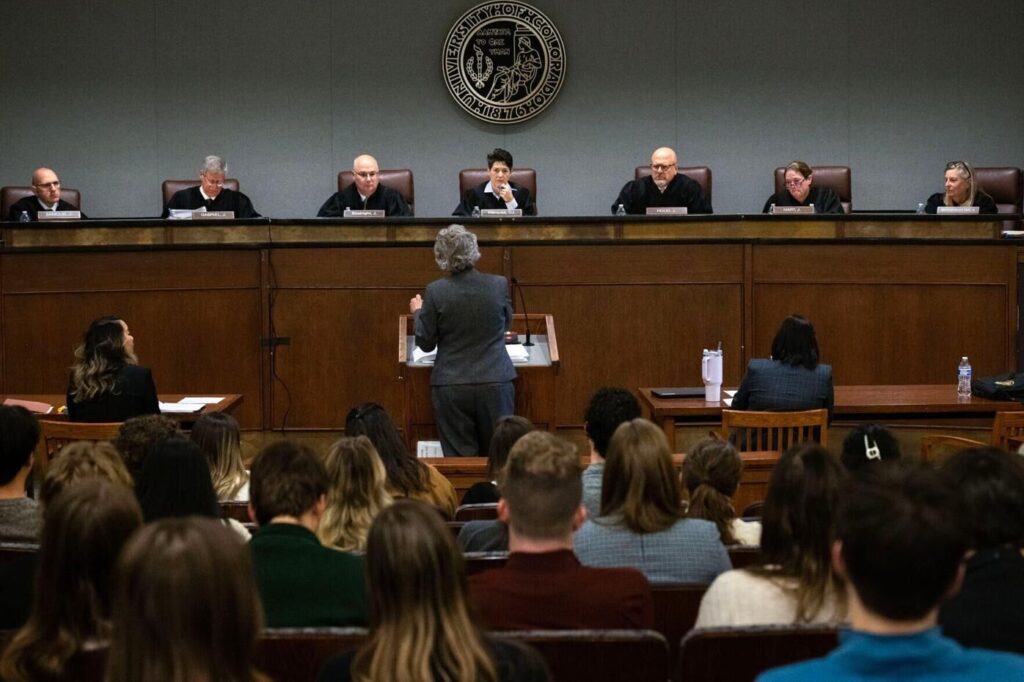
Colorado Supreme Court may address ‘new form of representation’ in criminal case
Michael Karlik
michael.karlik@coloradopolitics.com
Updated 8 hours ago
The Colorado Supreme Court signaled last week that it may get involved in an ongoing Denver criminal proceeding in which the prosecution alleges a trial judge sidestepped the clear rules for appointing defense counsel. At least four of the court’s...
PREV
PREVIOUS
Colorado Gov. Jared Polis signs bill to permanently exempt ag equipment and greenhouses from property tax
Gov. Jared Polis on Friday signed the last bill to come out of last week’s special session. While the four-day session focused on property taxes, per the governor’s instructions in his call to bring lawmakers back to the Capitol, House Bill 24B-1003 wasn’t exactly seen by some lawmakers as a property tax issue. The measure […]

Unintended consequences: New law on accessibility leads to removal of public records from websites
A 2021 law intended to improve accessibility to government documents for individuals with hearing and vision impairments has had unintended consequences — it prompted some agencies to completely remove public records from websites altogether in order to avoid non-compliance with the legislation. House Bill 21-1110 required all state and local agencies to implement accessibility plans for […]