

Boulder DA reveals extent of King Soopers shooting suspect’s planning for first time
Ahmad Alissa researched bomb-making materials, guns, previous mass shootings and how to clear a hallway two months before he allegedly killed 10 people in a Boulder King Soopers.
That’s according to Boulder District Attorney Michael Dougherty, who revealed for the first time the extent of Alissa’s planning and preparation during opening statements of the murder trail in Boulder County Thursday morning.
“He lives and works in Arvada and ‘Boulder’ shows up on his phone more and more and more. He pulled into the first big place that he comes across on March 22,” Dougherty said.
Alissa drove from his home in Arvada, which was captured on a neighbor’s doorbell camera, turned on to Highway 93 and then took a left at the Table Mesa Shopping Center. He first drove by the Chase Bank and King Soopers grocery store to the nearby neighborhood and then turned his black Mercedes around, according to Dougherty.
The prosecutor used the urgency apparent in slain Boulder Police Ofc. Eric Talley’s dash cam, photos of all 10 victims, projector screen and a color-coded animated screen showing Alissa’s movements from when he walked through the store’s east doors, to the victims who faced possible death and those who didn’t make it.
He shot three people in the parking lot in just 38 seconds, and then spent the next 68 seconds hunting and killing seven more, the prosecutor said.
Defense attorneys plan to argue that Alissa was suffering from mental illness, thus not capable of telling right from wrong.
“This happened because Mr. Alissa had untreated schizophrenia and screaming voices told him to commit a mass shooting,” Samuel Dunn, of the Colorado Public Defender’s Office, told jurors Thursday morning during opening statement.
Alissa in a striped button-down shirt, full beard and glasses listened to Dougherty’s nearly two-hour opening statements while sipping from a Starbucks cup. He appeared uncomfortable, often toying with his beard. He twisted and shifted in his seat, looking to see a screen shot himself aiming at victims on a large monitor directly to his right.
“He is moving fast and he is brutal,” said Dougherty, describing the 25-year-old’s movements.
Alissa has pleaded not guilty by reason of insanity, and his attorneys have acknowledged that he was the shooter who killed the people in the store at 3600 Table Mesa Drive in March of 2021.
What is the most important question for the 16-person jury from a prosecution standpoint? Dougherty asked.
“The victims are random but the shootings were deliberate and intentional,” Dougherty said.
The burden will fall to prosecutors to prove not only that the defendant committed the crimes but that he was not insane when he did — that he knew the difference between right and wrong and did not have a mental illness that prevented him from forming a culpable mental state. Alissa is charged with 10 counts of first-degree murder after deliberation — meaning that he thought about and intended to cause the deaths. That’s in addition to the 45 others charges he faces.
“Screaming voices between his ears”
Defense attorney Dunn showed the jury a video snippet of Alissa, at an empty table in a blue sweatshirt, during a doctor’s evaluation.
“What came to your head from the yelling?” the doctor asked.
“Just consistent voices,” he answered.
Alissa lived an isolated existence as a severe case of schizophrenia brought hallucinations and “screaming voices between his ears,” Dunn explained during nearly an hour of his opening statement.
“Not just March 22, but in the years and months preceding them,” Dunn said. “His symptoms were left untreated.”
As to his client’s research into guns, bombs and prior mass shootings, Nunn pointed out that Colorado law stipulates that a person can have intent and still be insane.
One night, Alissa’s father found him on the couch downstairs at 3 a.m. talking about a little man in the corner of the bathroom.
His father, an Arab-American who operated under a different culture, thought that his son was possessed by demons, Dunn said.
“You have an individual that sadly wasn’t seen for what was going on inside his head.”
Stalled case
The criminal case stalled for more than three years after multiple doctors reported that the man was not mentally competent to stand trial — meaning he could not understand the proceedings and assist in his own defense.
After treatment and medication, the judge ruled in the fall of 2023 that the man’s competency had been restored and he was capable of aiding in his defense at trial.
One of the most perplexing questions in the 2021 Boulder King Soopers mass shooting is that a motive was never established. Dunn pointed to the prosecution table.
“If they could tell you why he did it they would. They can’t because the “why” is insanity,” said Dunn. “The motive and the why is insanity.”
This story is developing.

10th Circuit to address resentencing of probation violators in rare all-judges hearing
Michael Karlik
michael.karlik@coloradopolitics.com
Updated 9 hours ago
The Denver-based federal appeals court agreed on Thursday to hold a rare all-judges hearing to determine the proper procedure for resentencing a criminal defendant who has violated the terms of his probation. In the federal appellate courts, the vast majority...
Appeals court overturns Adams County sex offense convictions due to prosecutor’s misconduct
Michael Karlik
michael.karlik@coloradopolitics.com
Updated 13 hours ago
Colorado’s second-highest court reversed multiple child sex assault convictions on Thursday after concluding an Adams County prosecutor committed misconduct while cross-examining the defendant. A three-judge Court of Appeals panel observed the charges against Daniel Michael Boerner depended on the jury...

Fort Carson soldier’s wife could be deported
Carol McKinley
carol-mckinley@coloradopolitics.com
Updated 1 day ago
As the country’s largest immigration enforcement crackdown continues in Minnesota’s Twin Cities, a Fort Carson sergeant is fighting a personal immigration crisis — one that may implode his family. Sgt. Tyler Garza’s wife, Jennifer Maradiaga Baca, is not a legal...

Elizabeth School District dismisses challenge to book-ban injunction on eve of appellate arguments
Michael Karlik
michael.karlik@coloradopolitics.com
Updated 15 hours ago
An Elbert County school district has dismissed its challenge to a judge’s injunction ordering it to return banned books to library shelves, days before the Denver-based federal appeals court was set to hear oral arguments this week. Although a three-judge...

Colorado Supreme Court to hear cases on insurance coverage for COVID, witness credibility
Michael Karlik
michael.karlik@coloradopolitics.com
Updated 2 days ago
The Colorado Supreme Court announced on Tuesday that it will decide the degree to which a virus or other hazard must affect a commercial property before it can trigger loss-or-damage coverage under an insurance policy. At least three of the...
Federal judge says prisoner cannot sue for dog-bite injury
Michael Karlik
michael.karlik@coloradopolitics.com
Updated 3 days ago
A federal judge concluded last week that a man cannot sue the government for injuries he sustained when a dog allegedly attacked him while he participated in a prison program. Kenneth M. Chandler, representing himself, was participating in the “FIDOS”...

Federal judge recommends dismissing trans athletics lawsuit by area school districts
Eric Young
eric.young@gazette.com
Updated 3 days ago
A judge has recommended dismissing a federal lawsuit filed by multiple school districts against the Colorado Attorney General’s and Civil Rights Offices over their policies dictating students’ participation in athletics and activities based on their biological sex rather than gender...
Appeals judge asks Colorado Supreme Court to once again clarify magistrate rules
Michael Karlik
michael.karlik@coloradopolitics.com
Updated 3 days ago
A member of Colorado’s second-highest court urged the state Supreme Court last week to revise confusing language in the rules governing magistrates, less than two weeks after an attempted cleanup of the rules took effect. Magistrates are judicial employees who are...
10th Circuit dismisses paralyzed man’s claims against Colorado Springs, officer
Michael Karlik
michael.karlik@coloradopolitics.com
Updated 5 hours ago
The Denver-based federal appeals court upheld the dismissal last week of a man’s excessive force claims against the city of Colorado Springs and the officer who tased him, causing him to fall down a sloped surface and break his neck....
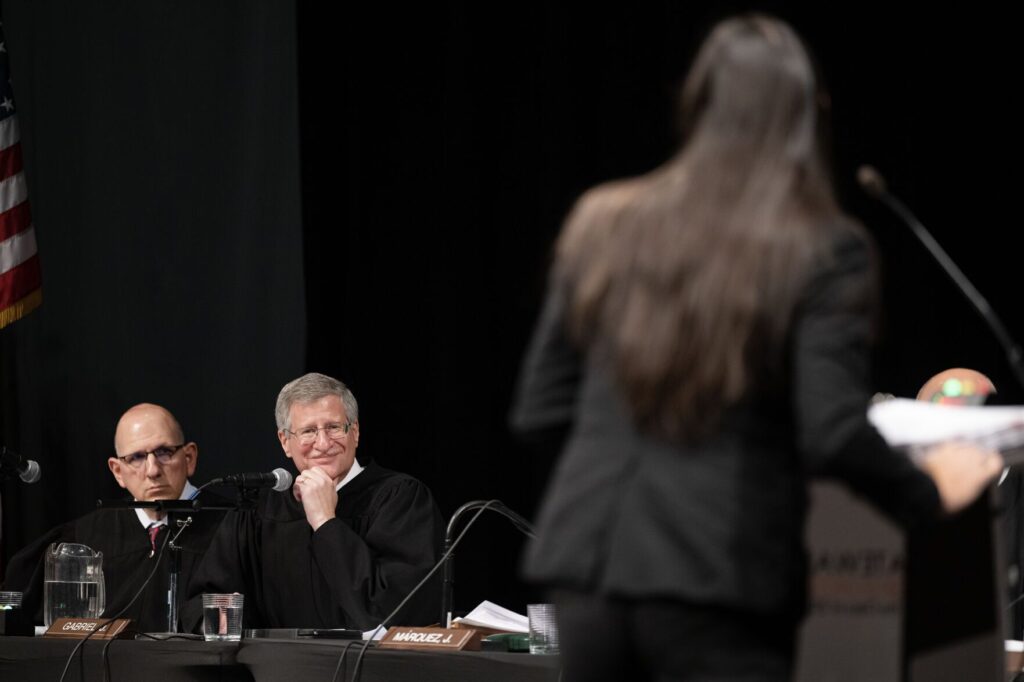
Colorado justices weigh overlap between child prostitution offenses
Michael Karlik
michael.karlik@coloradopolitics.com
Updated 3 days ago
Members of the Colorado Supreme Court last week appeared willing to uphold a man’s conviction for an attempted child prostitution offense, which the state’s second-highest court previously found to be a violation of his right to equal protection under the...