

Plaintiffs struggle to prove intimidation in second day of Colorado voting rights trial
The plaintiffs who are trying to prove an “election integrity” effort resulted in the illegal intimidation of Colorado voters ran into multiple stumbling blocks in federal court on Tuesday, including the aggressive questioning of the lone voter who claimed she was intimidated and the judge’s skepticism about an attempt to introduce new victims at the last minute.
Three civic groups — the Colorado Montana Wyoming State Area Conference of the NAACP, the League of Women Voters of Colorado, and Mi Familia Vota — sued the founders of U.S. Election Integrity Plan (USEIP), which was an organized effort following the 2020 election to visit voters at more than 9,400 homes to inquire about their registrations and past voting behavior.
The plaintiffs alleged such conduct by people who distrusted the results of the election amounted to prohibited voter intimidation under the Voting Rights Act and a conspiracy to intimidate voters under the Ku Klux Klan Act.
Although U.S. District Court Judge Charlotte N. Sweeney decided last year there were factual disputes for trial about whether the door-to-door questioning of voters constituted intimidation, she spent the first day of the proceedings on Monday repeatedly venting her frustration that the plaintiffs were failing to address the USEIP founders’ specific conduct in Colorado that violated federal law.
The next day also unfolded roughly, beginning with the plaintiffs’ questioning of Deputy Secretary of State Christopher Beall. He spoke about a press release he and Secretary of State Jena Griswold issued in September 2021 out of concern that canvassers, who may or may not have been armed, could be perceived as threatening to voters who were unaware they had the right to secrecy for their votes.

Colorado Secretary of State Jena Griswold gives a midday elections briefing to media at the Denver Elections Division on Bannock Street on Tuesday, June 28, 2022, in Denver, Colo. (Timothy Hurst/The Denver Gazette)
Beall said some employees in Griswold’s office feared for their safety after hearing comments by Shawn Smith, one of the defendants who was involved with USEIP, stating those who commit election fraud “deserve to hang.” The line of questioning about potential intimidation of election workers led Sweeney to wonder if the plaintiff groups were now arguing — for the first time — that Griswold’s employees were the actual victims.
“Are you saying that’s part of your claim of voter intimidation?” she asked.
“Yes, I think it would be,” responded attorney Amy Erickson. “If any registered voter in Colorado has been intimidated by defendants’ conduct, that goes to our claims.”
“Based on the pretrial order, that’s not been part of your claim, as I read it,” responded Sweeney, an appointee of President Joe Biden, shutting down the mid-trial attempt at reframing the case.
The plaintiffs’ remaining witnesses underwent withering cross-examination from the USEIP defendants’ attorneys.
Yvette Roberts, a retired teacher living in Grand Junction, was the voter the plaintiffs chose to testify about her alleged intimidation by USEIP canvassers. In her telling, a man and woman approached her house in June 2021 to say they were “part of an investigation looking into the Colorado 2020 election” and wearing semi-professional-looking badges.
The man allegedly said he was with “the Republicans” and asked Roberts how many people lived in her house and how she submitted her ballot.

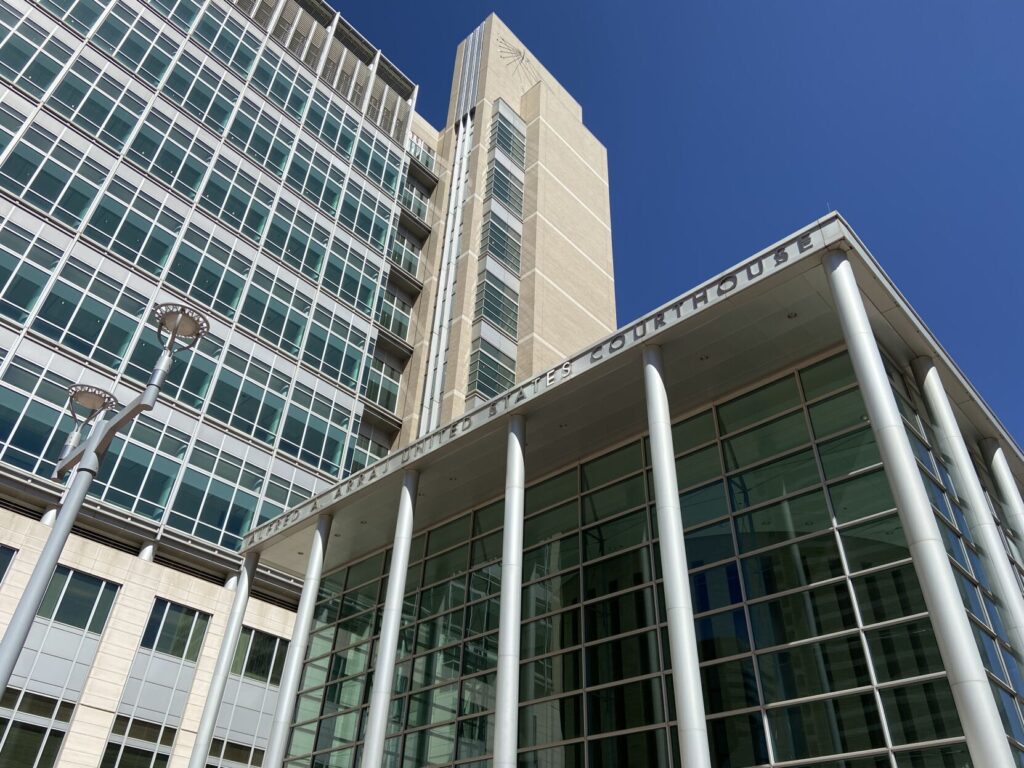
The Alfred A. Arraj U.S. Courthouse in downtown Denver. (Photo courtesy of United States District Court – Colorado)
“I’m a little old lady. I don’t want to tell any strange man or woman on my doorstep that I live alone. That’s not smart,” Roberts testified. “I didn’t think that was any of his business. So, I thought, ‘Gosh, this has gone on long enough.’ And I asked them both to leave.”
Roberts deemed the interaction “pretty scary” and said she felt intimidated. She sent an email to the secretary of state’s office titled, “Grand Junction voter intimidation effort,” outlining what happened. Roberts also reported the encounter to law enforcement.
However, the attorney for Smith pressed Roberts on a written declaration she submitted to the court, under penalty of perjury, identifying USEIP as the organization that sent the canvassers.
“You have no independent knowledge the people who came to your door in 2021 were affiliated with USEIP. You have no personal knowledge,” said lawyer R. Scott Reisch.
He named two other organizations that were undertaking voter verification efforts in Mesa County at the time and asked if the plaintiffs’ lawyers ever suggested those groups actually sent the canvassers to Roberts’ door. Roberts said she did not know.
“None of those other organizations were being sued by the plaintiffs, were they?” Reisch observed. “So, when you signed this under the pains and penalties of perjury, it turns out not to be true. Correct, ma’am?”
“I don’t believe I need to hear one word more from this witness,” Sweeney announced after Resich concluded his questioning.

Attorney David Gartenberg applauds for U.S. District Court Judge Charlotte N. Sweeney at a legal event in Denver on July 21, 2023.
Resich engaged in even more combative questioning with Beth Hendrix, the executive director of the League of Women Voters of Colorado. He slammed Hendrix for relying on media reports claiming USEIP canvassers were intimidating voters and of pursuing the lawsuit at the direction of the out-of-state advocacy organization Free Speech For People, which is representing the plaintiffs.
“The point was to chill the defendants’ First Amendment right to canvass and have free speech,” said Resich.
“To prevent canvassers from intimidating voters,” retorted Hendrix.
“And you have no personal knowledge of any member of USEIP, specifically these defendants — specifically Mr. Smith — of intimidating a voter, do you, ma’am?” pressed Reisch.
“I am a voter. I have been intimidated by Mr. Smith’s statements,” Hendrix shot back.
Reisch also elicited from Hendrix that she had “no knowledge” who was paying the plaintiffs’ attorneys.
The trial is scheduled to continue throughout the week. Sweeney will eventually decide if the defendants committed a voting rights violation.
The case is Colorado Montana Wyoming State Area Conference of the NAACP et al. v. Smith et al.


Federal judge sides with Mesa County school district in ex-student’s First Amendment claims
Michael Karlik
michael.karlik@coloradopolitics.com
Updated 1 day ago
A federal judge concluded last week that Mesa County Valley School District 51 and three of its administrators did not violate the First Amendment rights of a former student when they imposed minor discipline in response to disruptive behavior. In...
Colorado Supreme Court intervenes in 4 ongoing cases
Michael Karlik
michael.karlik@coloradopolitics.com
Updated 2 days ago
The Colorado Supreme Court recently moved to intervene in four ongoing cases, including two criminal prosecutions, a civil lawsuit, and a child welfare proceeding. At least four of the court’s seven members must agree to hear a case outside of...
Federal judge releases man immediately as consequence for immigration judge disobeying orders
Michael Karlik
michael.karlik@coloradopolitics.com
Updated 2 days ago
A federal judge ordered a man’s immediate release from immigration detention on Thursday after finding an immigration judge disregarded his prior orders requiring a bond hearing. For the past year, Colorado’s federal district court has faced a flood of “habeas corpus”...
Denver judge denies Gov. Polis request to dismiss ICE-related records case
Marianne Goodland
marianne.goodland@coloradopolitics.com
Updated 20 hours ago
A year after blocking the release of state records to federal immigration agents, a Denver judge has now denied Gov. Jared Polis’ effort to end the lawsuit at the center of the dispute. The lawsuit filed against the governor in...
Colorado justices accept appeals on Netflix taxation, children pursuing neglect cases
Michael Karlik
michael.karlik@coloradopolitics.com
Updated 1 day ago
The Colorado Supreme Court announced on Monday that it will decide whether Netflix subscriptions are subject to the state’s sales tax as “tangible personal property.” At least three of the court’s seven members must agree to hear an appeal. The...
Letecia Stauch murder conviction in stepson Gannon’s death overturned by Colorado appeals court
Nick Smith
nick-smith@coloradopolitics.com
Updated 2 days ago
An El Paso County woman convicted of killing her stepson in 2020, shoving his body in a suitcase, then dumping it in Florida, is getting a new trial. The Colorado Court of Appeals published a 52-page ruling on Thursday, stating...

10th Circuit grants rare all-judges’ review of Colorado banking regulation
Michael Karlik
michael.karlik@coloradopolitics.com
Updated 2 days ago
The Denver-based federal appeals court announced on Thursday that it will hold a rare all-judges review of a recent decision that permits Colorado to require out-of-state banks to abide by the state’s maximum interest rates when they lend to in-state...
Colorado appeals court orders new sentencing for Tina Peters, upholds convictions
Michael Karlik
michael.karlik@coloradopolitics.com
Updated 2 days ago
Colorado’s second-highest court determined on Thursday that a trial judge improperly sentenced former Mesa County clerk Tina Peters based upon her exercise of protected speech, while at the same time upholding her convictions. The three-judge Court of Appeals panel also...
Judge rules that Colorado law makes it too hard for parties to bar unaffiliated voters from primaries
Ernest Luning
ernest.luning@coloradopolitics.com
Updated 3 days ago
A federal judge ruled in favor of the Colorado Republican Party late Tuesday, saying that a portion of the state law that allows unaffiliated voters to cast ballots in party primaries is unconstitutional because it imposes an unrealistic burden on...
10th Circuit upholds regulator’s methodology for Tri-State exit fees
Michael Karlik
michael.karlik@coloradopolitics.com
Updated 3 days ago
The Denver-based federal appeals court upheld a regulatory agency’s methodology for calculating the fee owed by entities seeking to withdraw from Tri-State Generation and Transmission Association last week. Tri-State is a Westminster-based cooperative that provides and transmits electricity to member...