

Colorado justices find Denver judge appropriately subbed in alternate juror mid-deliberations
The Colorado Supreme Court concluded on Monday that a Denver judge did what he needed to do to ensure a defendant received a fair trial after one juror became ill in the middle of deliberations and had to be replaced with the alternate.
Ricardo Castro’s jury deliberated for 11 hours total until it recessed on Friday evening. One juror’s daughter subsequently alerted then-District Court Judge Morris B. Hoffman that her father had a heart attack over the weekend and could not return to finish the case.
The defense would not agree to proceeding with 11 jurors and the prosecution did not want a mistrial. Hoffman chose the third option and addressed the remaining jurors. Before sending them to deliberate, he had selected an alternate juror and told her not to discuss the case with anyone and to keep her mind open, just in case.

Would it be feasible, Hoffman asked the other jurors, to bring back the alternate and restart the deliberations from the beginning with her?
“If you don’t think you can do it, just let me know,” he added.
Half an hour later, Hoffman received a note from the jury. Of the two sex offenses Castro was charged with, the jurors had reached a unanimous verdict on Friday for one of them. They were close to unanimity on the second.
“If the question is whether we can approach new deliberations w/ an open mind, because the alternate will be bringing new perspective, yes, we believe it’s feasible. If the question is whether we can enter new deliberations in the same state of mind,“ read the note, “no, we can’t undo all the conversations/learning from prior deliberations.”

The jury’s note in People v. Castro.
Hoffman told the parties that legal precedent in Colorado assumed the substitution of a juror would harm the defendant in some way. But in this instance, “We’ve got a note from the jury that overcomes every dimension of that prejudice that you can imagine.”
He summoned the alternate juror and explained to everyone deliberations would need to start completely anew. Hoffman told the juror she could not let the others rely upon their previous discussions. Hoffman then asked each juror individually if they were able to do that. Yes, they all said.
Five-and-a-half hours later, they returned a guilty verdict.
Castro appealed his convictions, but a three-judge panel for the Court of Appeals believed Hoffman had “painstakingly” ensured the juror substitution still resulted in a fair trial. The Supreme Court agreed with that conclusion.
“The trial court’s actions in this case provide a model for trial courts to apply,” wrote Justice Carlos A. Samour Jr. in the July 1 opinion.

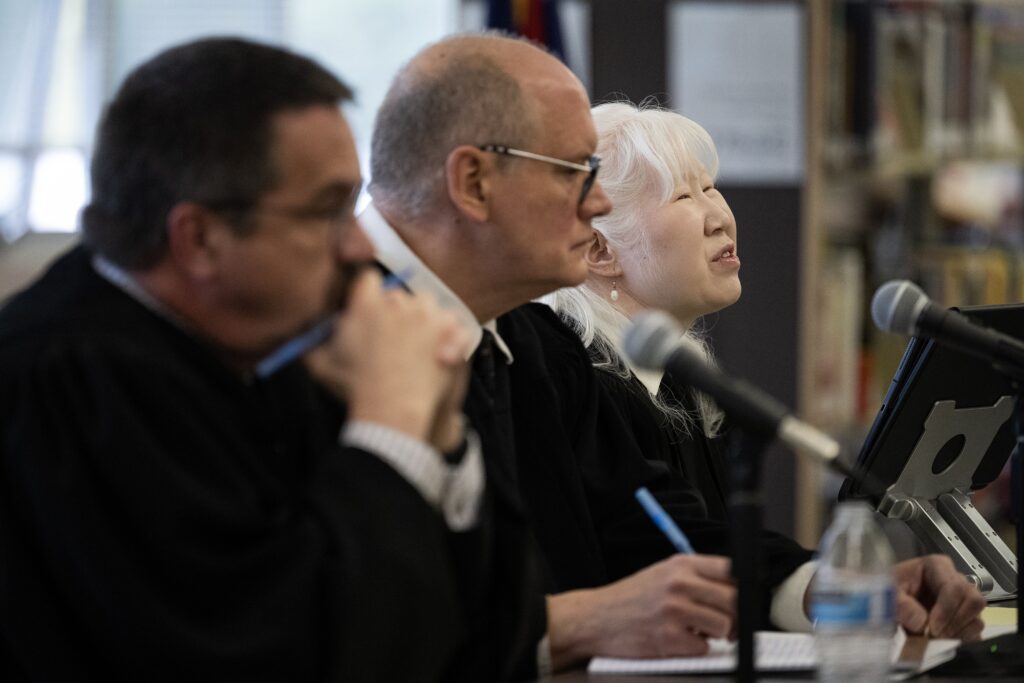
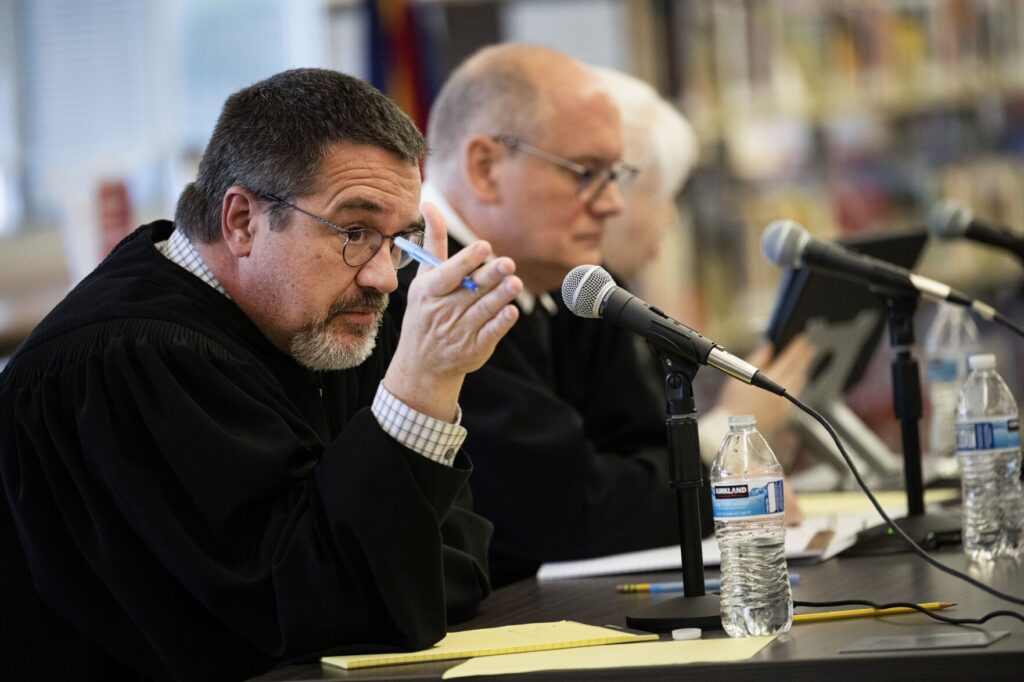
Colorado Supreme Court Justices Carlos A. Samour Jr. and Richard L. Gabriel listen to Assistant Deputy Jefferson County Attorney Rebecca P. Klymkowsky during oral arguments in the County of Jefferson v. Beverly Stickle case during Courts in the Community on Thursday, Oct. 26, 2023, at Gateway High School in Aurora, Colo. (Timothy Hurst/Denver Gazette)
Although Castro contended the much shorter deliberation the second time suggested jurors truly did not start from scratch, Samour noted 5.5 hours are “substantial” and there may have been benign reasons the jury moved quicker — like better organization or less time selecting a foreperson.
Much of the court’s opinion pertained to the standard for reviewing juror substitutions after deliberations have started. Samour, writing for the majority, noted Colorado law is ambiguous about whether such substitutions are allowed, so it was reasonable to assume some harmful effect to the defendant. However, that assumption can be dissipated with appropriate precautions, like the ones Hoffman took.
“Even so, it would be preferable to have the legislature clarify its intent,” Samour added, as the appellate courts “remain in the dark about the legislative intent behind the statute.”
Justice Richard L. Gabriel wrote separately for himself and Justice William W. Hood III. Unlike the majority, Gabriel would have deemed it an error to bring in the alternate juror during deliberations, triggering the question of whether the error was harmless beyond a reasonable doubt to Castro. Using that path, Gabriel reached the same conclusion: Hoffman’s safeguards ensured the jury understood its obligation to start anew after the substitution.
The case is Castro v. People.

Federal judge upholds constitutionality of Colorado campaign contribution limits
Michael Karlik
michael.karlik@coloradopolitics.com
Updated 23 hours ago
A federal judge upheld Colorado’s individual campaign contribution limits as constitutional on Thursday, finding that three Republican plaintiffs failed to prove the campaign finance framework violates their First Amendment rights. U.S. District Court Senior Judge John L. Kane recognized that...

Appeals court rejects theory that existing tax revenue undermines need for new fees
Michael Karlik
michael.karlik@coloradopolitics.com
Updated 1 day ago
Colorado’s second-highest court rejected a plaintiff’s claim on Thursday that the tax revenue generated by an existing activity should prevent local governments from imposing new fees aimed at regulating the activity. The question stemmed from Colorado’s unique constraints on taxation...
Appeals court finds no illegal sentence when defendants forfeit time-served credit
Michael Karlik
michael.karlik@coloradopolitics.com
Updated 1 hour ago
Colorado’s second-highest court ruled on Thursday that criminal defendants may agree to relinquish the credits they earned while incarcerated pending trial, despite a state law guaranteeing that such time “shall be deducted” from a person’s sentence. Kerry Ellis Endsley pleaded...
Appeals court reinstates Garfield County arson charge
Michael Karlik
michael.karlik@coloradopolitics.com
Updated 2 days ago
Colorado’s second-highest court reinstated a Garfield County defendant’s arson charge on Thursday, concluding a trial judge improperly credited a witness’s claim that she alone was responsible for starting the fire. A sheriff’s deputy responded to a brush fire near Parachute...
Federal judges rebuke ex-Colorado judicial discipline director for conduct in lawsuit
Michael Karlik
michael.karlik@coloradopolitics.com
Updated 2 days ago
A pair of federal judges expressed a desire on Thursday to break the logjam on a lawsuit by Colorado’s former judicial discipline director against the state Supreme Court and related entities, while simultaneously showing little tolerance for the plaintiff’s scorched-earth...
Democratic bill would let recipients of ‘conversion therapy’ sue Colorado providers with no statute of limitations
Marissa Ventrelli
marissa.ventrelli@coloradopolitics.com
Updated 2 days ago
Colorado lawmakers have advanced a proposal that would allow people who underwent conversion therapy to sue licensed providers for damages, moving the measure forward on a party-line vote in the House Judiciary Committee. House Bill 1322, proposed by Democratic Reps....
Federal judge refuses to authorize immediate appeal in World Cup trafficking lawsuit
Michael Karlik
michael.karlik@coloradopolitics.com
Updated 3 days ago
A federal judge declined to authorize an immediate appeal last week of a prior decision allowing companies operating out of Colorado to be sued for allegedly participating in a human trafficking venture involving Filipino laborers who constructed facilities for the...
Federal judge considers second round of sanctions against ex-Colorado judicial discipline director
Michael Karlik
michael.karlik@coloradopolitics.com
Updated 3 days ago
A federal judge ordered Colorado’s former judicial discipline director on Tuesday to explain why she should not sanction him a second time for filing documents for improper purposes, such as harassment or delay. U.S. District Court Senior Judge Kathryn H....
Colorado justices agree to review insurance question that has divided federal judges
Michael Karlik
michael.karlik@coloradopolitics.com
Updated 4 days ago
The Colorado Supreme Court granted a federal judge’s request on Friday to address an issue that has produced conflicting answers in policyholders’ lawsuits against insurance companies over unpaid benefits. “Parties (and judges) regularly spend undue time and money fighting in...
Federal judge dismisses background screeners’ challenge to Colorado law
Michael Karlik
michael.karlik@coloradopolitics.com
Updated 6 hours ago
A federal judge dismissed a challenge on Friday to a portion of Colorado law that prohibits certain information from being included in consumer reports, in what seemed to be a conflict with federal law. Congress originally enacted the Fair Credit...