

Appeals court reverses stalking conviction after Douglas County judge violated right to counsel
A Douglas County judge violated the rules of criminal procedure and the Sixth Amendment’s right to counsel when she allowed a defense attorney to withdraw, did not seek input from the defendant and did not evaluate the necessity of the withdrawal, Colorado’s second-highest court ruled on Thursday.
Shari Leigh Dooley ended up representing herself at trial, where jurors convicted her of a felony for stalking and for violating a restraining order. Weeks before trial, her hired defense attorney moved to withdraw. Although the procedural rules require a notice of withdrawal to inform a defendant of her right to object and that a hearing will be held, those elements were absent in Dooley’s case.
Moreover, trial judges “shall balance” the reasons for withdrawal with the needs of justice. Instead, then-District Court Judge Patricia Herron did not hold a hearing and granted the motion outright. Dooley was left without representation and told jurors she was “here today defending myself” because “I can’t afford another attorney.”
A three-judge panel for the Court of Appeals reversed Dooley’s convictions, finding the withdrawal of her attorney “violated several provisions” of the procedural rules and Dooley’s constitutional right to counsel.
“Neither counsel’s written motion nor anything said by counsel or the trial court in Dooley’s presence informed her that she had the right to object to the motion to withdraw. Nor was Dooley informed that a hearing would be held,” wrote Judge Neeti V. Pawar in the April 18 opinion. “Instead, the court simply granted the motion without soliciting input from Dooley or explaining anything to her.”
In late May 2021, Dooley’s attorney, Richard A. Schwartz, filed a three-sentence motion to withdraw from the case because of an “irremediable breakdown in the attorney client relationship.” Previously, he called Dooley an “unruly client” and said he was “between a rock and a hard place.”
At a court appearance the following month, Herron granted the motion without elaboration. District Court Judge Theresa Slade, the regular judge assigned to the case, followed up with a written order stamping Schwartz’s motion as “granted.”
Shortly before trial, Slade noted Dooley had applied for public defender representation, but “you have too much of an income.” Slade asked if Dooley had hired another private attorney.
“No, ma’am. I cannot afford it,” Dooley responded. “I guess I’m representing myself.”

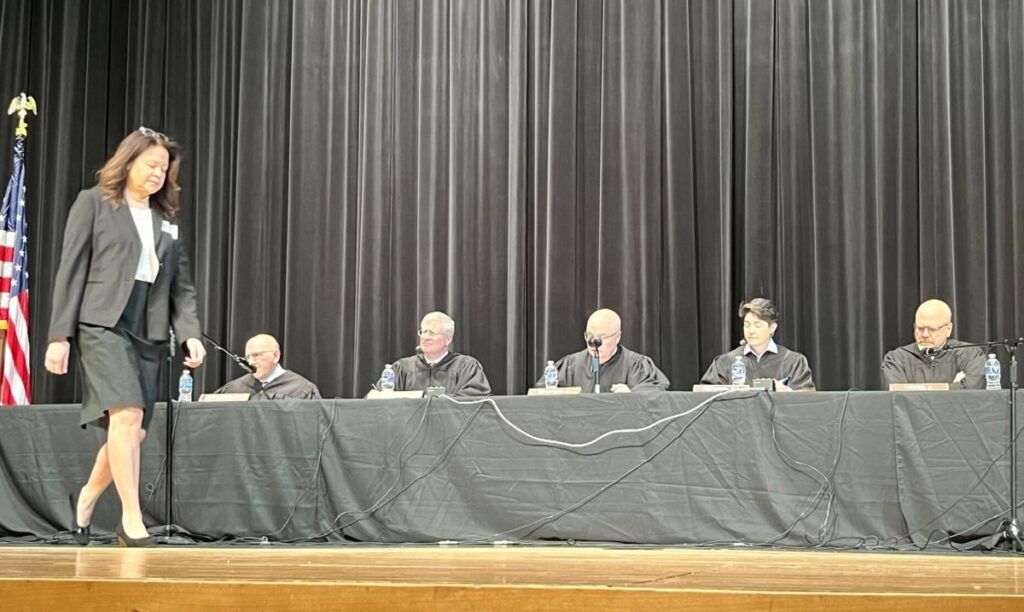
FILE PHOTO: Colorado Court of Appeals Judge Neeti V. Pawar walks into the auditorium for oral arguments at Fort Lupton High School on Tuesday, April 2, 2024 in Fort Lupton, Colorado. The Colorado Court of Appeals and Supreme Court hold “Courts in the Community” event for students to learn about the justice system and hear real cases. (Rebecca Slezak For The Denver Gazette)
After her conviction, Dooley appealed on several grounds — with a focus on the faulty process that allowed for her lawyer to exit the case with minimal scrutiny.
“Trial courts have an affirmative duty to safeguard a defendant’s right to counsel because without an attorney, a defendant may not even know their rights, let alone how to enforce them,” public defender Leah Scaduto told the appellate panel at oral arguments this month. “Without counsel, even the innocent can look guilty.”
She elaborated it is not “common knowledge” that a judge needs to approve a lawyer’s withdrawal, and it is not as simple as an attorney “firing” a client.
The government acknowledged the withdrawal motion was non-compliant and Herron neglected to talk Dooley through the process.
But Dooley “had an opportunity to say something if she wanted to say something. She never expressed any hesitation speaking up in court in any other hearing,” maintained Senior Assistant Attorney General Jacob R. Lofgren.
Pawar, writing for the panel, declined to hold Dooley’s silence against her, given that no one informed her she had the right to object. Although Schwartz cited a breakdown in his relationship with his client, Pawar faulted the trial judge for failing to explore the facts to determine if withdrawal was merited.
“In sum, granting the motion to withdraw without explanation, inquiry, or notice to Dooley of her right to object or obligations if the motion were granted violated several provisions” of the procedural rules, she wrote, and “Dooley’s constitutional right to counsel of choice.”
The case is People v. Dooley.

Federal judge sides with Mesa County school district in ex-student’s First Amendment claims
Michael Karlik
michael.karlik@coloradopolitics.com
Updated 2 hours ago
A federal judge concluded last week that Mesa County Valley School District 51 and three of its administrators did not violate the First Amendment rights of a former student when they imposed minor discipline in response to disruptive behavior. In...
Denver judge denies Gov. Polis request to dismiss ICE-related records case
Marianne Goodland
marianne.goodland@coloradopolitics.com
Updated 5 hours ago
A year after blocking the release of state records to federal immigration agents, a Denver judge has now denied Gov. Jared Polis’ effort to end the lawsuit at the center of the dispute. The lawsuit filed against the governor in...
Colorado justices accept appeals on Netflix taxation, children pursuing neglect cases
Michael Karlik
michael.karlik@coloradopolitics.com
Updated 21 hours ago
The Colorado Supreme Court announced on Monday that it will decide whether Netflix subscriptions are subject to the state’s sales tax as “tangible personal property.” At least three of the court’s seven members must agree to hear an appeal. The...
Letecia Stauch murder conviction in stepson Gannon’s death overturned by Colorado appeals court
Nick Smith
nick-smith@coloradopolitics.com
Updated 3 hours ago
An El Paso County woman convicted of killing her stepson in 2020, shoving his body in a suitcase, then dumping it in Florida, is getting a new trial. The Colorado Court of Appeals published a 52-page ruling on Thursday, stating...

10th Circuit grants rare all-judges’ review of Colorado banking regulation
Michael Karlik
michael.karlik@coloradopolitics.com
Updated 4 hours ago
The Denver-based federal appeals court announced on Thursday that it will hold a rare all-judges review of a recent decision that permits Colorado to require out-of-state banks to abide by the state’s maximum interest rates when they lend to in-state...
Colorado appeals court orders new sentencing for Tina Peters, upholds convictions
Michael Karlik
michael.karlik@coloradopolitics.com
Updated 20 hours ago
Colorado’s second-highest court determined on Thursday that a trial judge improperly sentenced former Mesa County clerk Tina Peters based upon her exercise of protected speech, while at the same time upholding her convictions. The three-judge Court of Appeals panel also...

Judge rules that Colorado law makes it too hard for parties to bar unaffiliated voters from primaries
Ernest Luning
ernest.luning@coloradopolitics.com
Updated 1 day ago
A federal judge ruled in favor of the Colorado Republican Party late Tuesday, saying that a portion of the state law that allows unaffiliated voters to cast ballots in party primaries is unconstitutional because it imposes an unrealistic burden on...
10th Circuit upholds regulator’s methodology for Tri-State exit fees
Michael Karlik
michael.karlik@coloradopolitics.com
Updated 1 day ago
The Denver-based federal appeals court upheld a regulatory agency’s methodology for calculating the fee owed by entities seeking to withdraw from Tri-State Generation and Transmission Association last week. Tri-State is a Westminster-based cooperative that provides and transmits electricity to member...
Federal judge proposes sanctions against Mike Lindell’s lawyers for continued fake citations
Michael Karlik
michael.karlik@coloradopolitics.com
Updated 2 days ago
A federal judge is once again pursuing sanctions against lawyers for MyPillow CEO Mike Lindell for continuing to cite to court cases that do not exist, likely based on the faulty output of artificial intelligence tools. Last year, a jury...
Susan Blanco signals views on role of appellate courts in first opinion as Colorado justice
Michael Karlik
michael.karlik@coloradopolitics.com
Updated 2 days ago
Justice Susan Blanco’s first solo opinion as a new member of the Colorado Supreme Court made clear her view of the guardrails that keep the state’s highest court tethered to the issues it is asked to decide. On Monday, the...