

Single-payer study bill helps Colorado small biz with health care cost | NOONAN

Small business owners face daunting tasks in purchasing health insurance for employees. It’s hard if your employee base is under 50 employees when the Affordable Care Act comes into play. It’s hard to decide which plans to select. It’s hard to decide how much to pay out of company coffers and how much needs to come from employees. It’s hard to decide whether to offer individual-only or family plans.
Every decision costs money out of the bottom line, affecting profits, investment, hiring, part-time vs. full-time employment, ad nauseum. Most small businesses use brokers who take a commission on sales, another cost. Premiums have gone up every year, especially recently with upward pressures of inflation.
The National Federation of Independent Businesses conducted a health insurance study last year to determine the state of affairs related to health insurance impacts on small business. The results aren’t pretty.
Stay up to speed: Sign up for daily opinion in your inbox Monday-Friday
The most pressing issue for small employers is ever-rising health premium costs. Though insurance costs have concerned small employers for four decades since the (National Federation of Independent Business) NFIB has conducted surveys, now small business employers say they soon may be unable to afford to bring health care to employees. “Ninety-eight percent of small businesses offering health insurance are concerned that healthcare costs will become unsustainable for them within the next 5-10 years,” the survey report states. That’s a lot of small businesses and a lot of employees facing a dismal future.
“The cost of health insurance is by far the biggest challenge for employers who offer health insurance and for those who do not offer it. Small employers compete for talent in filling open positions and are aware that health insurance is an important benefit for many employees and job seekers.” That statement comes from Holly Wade, the executive director of NFIB’s research center.
Small business owners face a classic pinch: Don’t offer health insurance, save money, but face more sick time off from employees, turnover and employee dissatisfaction. Offer insurance and face rising premiums, complicated tax rules, and helpful but difficult-to-figure government incentives. Grim and grimmer.
Let’s get to the nitty gritty. In 2022, according to Value Penguin with Lending Tree, employers paid an average of $6,584 in annual health insurance costs for single workers and $16,357 for families. For companies with 49 workers or fewer, just under the ACA requirements, that’s $322,616 off the top. That leaves an additional $1,327 for the employee to cover for an individual plan and $6,106 for the employee to cover in a family plan.
An option for employers with fewer than 25 employees is SHOP, Small Business Health Options Program. But employers can’t pay employees more than $56,000 per year, and the employer must cover at least half of every worker’s health insurance plan. Then government programs will cover up to half of the annual employer health insurance contribution.
Based on these factors in Colorado, it’s easy to sympathize with small business owners, the job creators at the heart of the state’s economy.
When there’s a hard problem, someone or group of people will come together to think of solutions. That’s what’s happening with HB24-1075. At least the bill is the beginning of possible solutions.
The legislation, “Analysis of Universal Health-Care Payment System” with Rep. Karen McCormick from Longmont as lead sponsor, will authorize the Colorado School of Public Health to analyze how a universal single-payer payment platform may work for Coloradans.
The concept is simple: Rather than paying insurance premiums to the multitude of for-profit insurers in the marketplace, every Coloradan would pay a premium, based on ability to pay to a single non-profit, publicly financed entity. That entity then pays the private medical practitioners, hospitals, clinics and other care providers directly for their services.
The study will analyze the cost of providing current, comprehensive health care services as well as other potential care for home care, long-term care, etc. The concept is to figure out how much care, and at what cost, state residents receive through the private sector under a single, universal payment system.
The benefits of this possibility are self-evident. For health care providers, the complicated problems of navigating the bureaucracies of multiple insurance companies disappear. For Coloradans, the complicated problems of finding affordable insurance coverage disappears.
For small business owners, the uncompetitive playing field for attracting employees gets competitive. Their business operations are more profitable because health care insurance is no longer a cost of goods sold. For non-profits, more funds for their missions get focused on the missions.
Large employers may lose some hiring advantage, but they gain more money for investment or shareholders and for paying salaries rather than for insurance.
Does it sound too good? That’s what HB24-1075 will find out. It may be exactly as good as it appears for the millions of us affected by the unending drip, drip, drip of health care expense on our individual bottom lines.
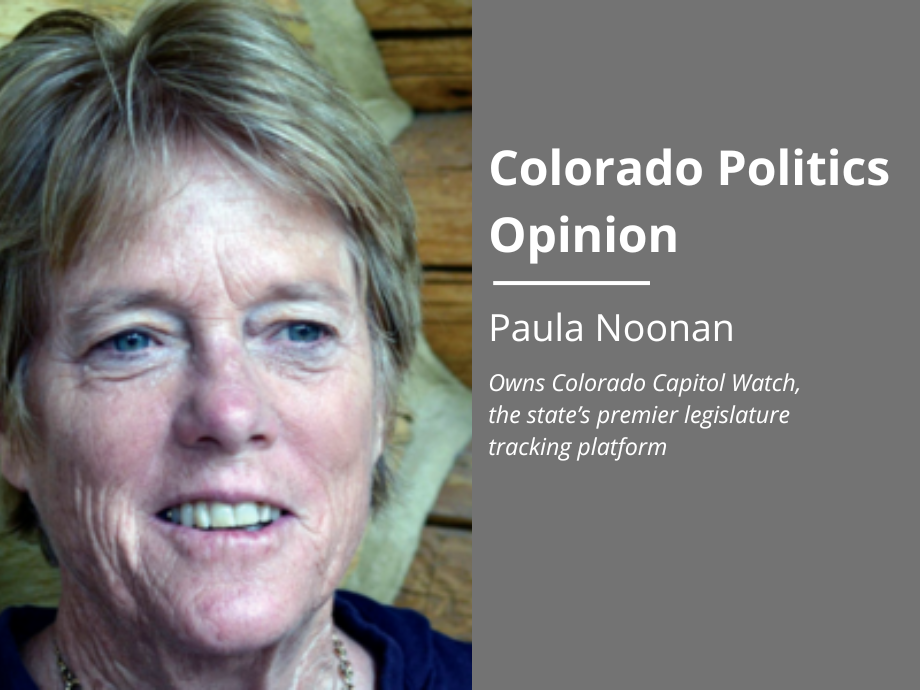
Paula Noonan owns Colorado Capitol Watch, the state’s premier legislature tracking platform.


The Centennial State’s nuclear energy opportunity | OPINION
Michael Hancock
michael-hancock@coloradopolitics.com
Updated 9 hours ago
Colorado was given a clear opportunity earlier this year. On Jan. 28, the U.S. Department of Energy issued a Request for Information (RFI) seeking potential hosts for Nuclear Energy Innovation Campuses — an early-stage process designed to identify states serious...

More pain than gain in upending Colorado’s water-access laws | OPINION
Colorado Politics
colorado-politics@coloradopolitics.com
Updated 9 hours ago
By Greg Walcher and Mike King Colorado’s long-standing balance between public recreation and private property along rivers is now under renewed pressure. But changing stream access law would impose significant fiscal and legal costs for relatively limited new recreational benefit....
Guardianship is not a homelessness policy | OPINION
Colorado Politics
colorado-politics@coloradopolitics.com
Updated 9 hours ago
By Amelia McKeon The federal government’s proposal to expand guardianship for homeless veterans is being framed as compassionate. It is anything but. It is a dangerous shift toward using one of the most restrictive legal tools we have as a...

Ready to build next-gen clean-energy infrastructure —data centers included | OPINION
Colorado Politics
colorado-politics@coloradopolitics.com
Updated 9 hours ago
By Nate Bernstein and Jason Wardrip Colorado has long taken pride in doing things a little differently. We are a state of innovators, entrepreneurs and adventurers, and often lead the nation in new policies and new ideas. For generations, our...
Untraditional education platform makes fool out of state ed department | Paula Noonan
Paula Noonan
paula-noonan@coloradopolitics.com
Updated 19 hours ago
It’s April Fool’s week and ERBOCES, Education Re-envisioned BOCES, is one of the state’s biggest jokers. This untraditional education platform authorized through five founding school districts including Falcon School District 49 in El Paso County has played the Colorado Department...

‘Steel for fuel’ — but bill consumers for both | PODIUM
Colorado Politics
colorado-politics@coloradopolitics.com
Updated 19 hours ago
By Sarah Montalbano In 2018, Xcel Energy, an investor-owned utility serving millions of customers across eight states, was the first U.S. utility to pledge to deliver 100% carbon-free electricity by 2050. Eight years later, Xcel is pleading with Colorado...
Mental health education for coaches can help young athletes on and off the field | OPINION
Colorado Politics
colorado-politics@coloradopolitics.com
Updated 2 days ago
By Erin Harrop Youth athletics have become significantly more intense and competitive. The physical effects of training or injury can be grueling — but so are the mental health effects, particularly as performance pressure increases. As leaders and mentors, coaches...
Legislature busy sending lots of minor bills for governor’s signature | Hal Bidlack
Hal Bidlack
hal-bidlack@coloradopolitics.com
Updated 3 days ago
One of the benefits of being, well, I guess technically, some type of journalist writing here on Colorado Politics, isI get on interesting mailing lists. A while back, some kind soul in the governor’s office added me to the daily...
SB26-140 will protect access to rare disease treatments | OPINION
Colorado Politics
colorado-politics@coloradopolitics.com
Updated 3 days ago
By Amanda Boone There are moments in life that leave an indelible mark on your soul. For me, one came in the middle of the night when I took a full breath for the first time in over a decade....
Lawmakers hold the key to solving Colorado’s mental health crisis | OPINION
Colorado Politics
colorado-politics@coloradopolitics.com
Updated 3 days ago
By Ryan M. Burkhart The U.S. is currently in the midst of a mental health crisis, and here in Colorado, more than 28% of residents live with a mental health condition. Unfortunately, a majority of Colorado residents are currently locked...
PREV
PREVIOUS

Rep. Lynch joins club of politicians acting entitled | Durango Herald
Cringey is the best way to describe the September 2022 arrest video of Republican Rep. Mike Lynch of Wellington, as he took multiple missteps alongside I-25 north of Fort Collins. Lynch, now former state House minority leader, was pulled over for speeding at 90 mph. When told to exit his vehicle to take a sobriety […]
Dems bow to local control on guns — then take it away | BRAUCHLER
George Brauchler It is hard to tell which of the following Colorado Democrats hate more: the Second Amendment, or local control of government. A newly drafted bill sponsored by Dems allows them to continue to attack both. Fewer than three years ago, Sen. Sonja Jaquez Lewis of Longmont, Sen. Chris Kolker of Littleton and Sen. […]