

Colorado’s latest revenue forecast projects slight drop in general fund revenues
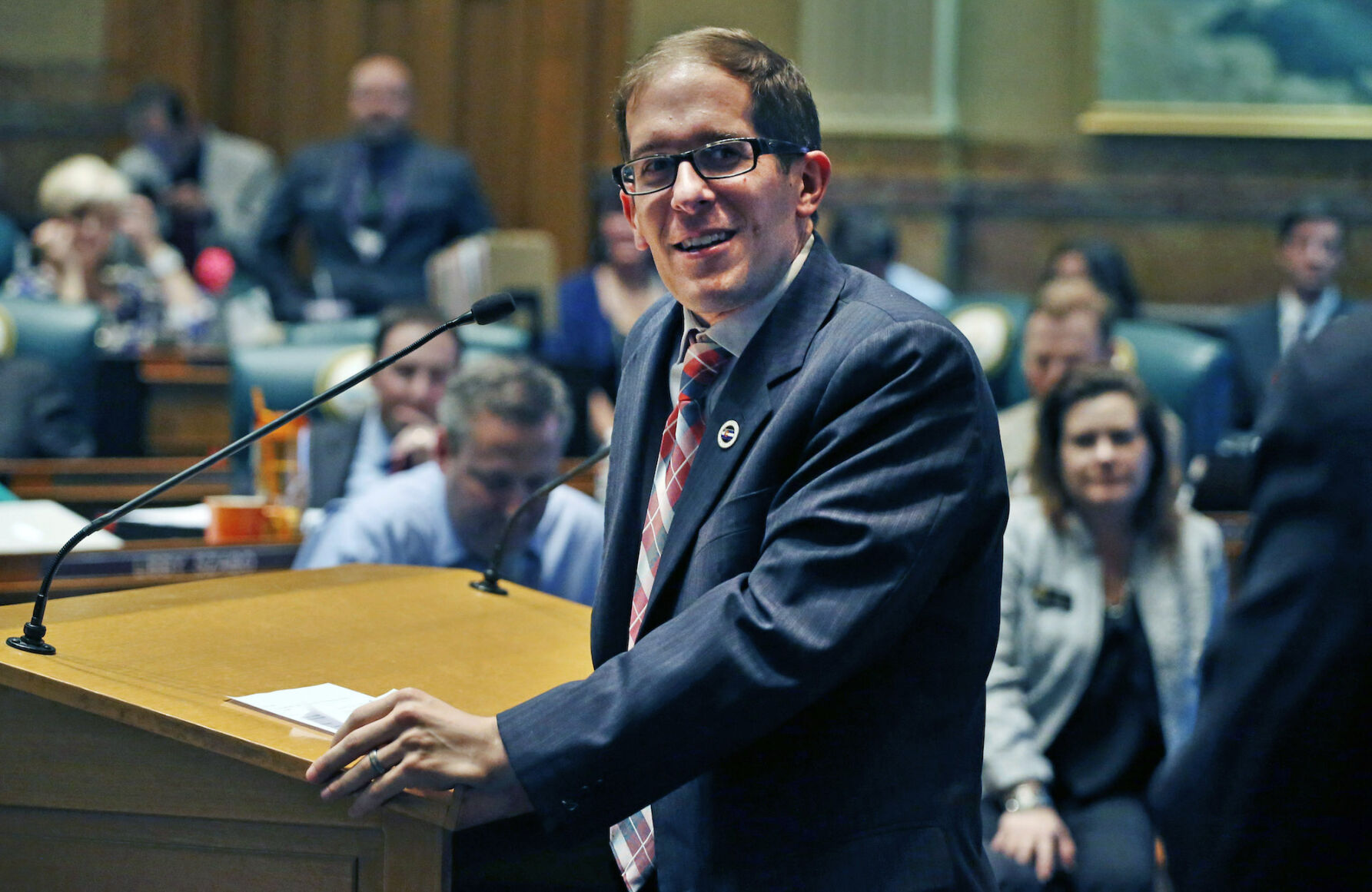
The quarterly revenue forecast released by state economists Wednesday shows Colorado lawmakers may have more breathing room than expected for the 2024-25 budget year, despite a projected decline in tax collections.
Additional general fund revenues available to spend in 2024-25 are estimated at $1.195 billion, about $23 million more than anticipated expenses, the report said. That’s an improvement over the June forecast, Chief Economist Greg Sobetski of the Legislative Council staff told lawmakers, which projected a slight deficit heading into 2024-25.
General fund revenues, which are the state’s most flexible form of revenue and used to pay operating expenses, are expected to head downward in the next year, economists reported.
Revenues came in stronger at the end of the current budget year, revised upward from June by $306 million. But the situation could take a 180-degree turn the nest year, with revenues projected to drop by $304 million in 2023-24, and by $82 million the following year.
That’s driven by significant declines in state individual income tax, according to Sobetski.
On the other hand, there were record revenues from corporate income tax. That traditionally is the third largest source of general fund revenue, behind individual income tax and sales tax.
Corporate profits peaked in 2022, the highest level ever, Sobetski said. Those and are expected to drop but, remain well above historical trends. Corporate income tax collections will decline some, but will remain well above the pre-pandemic levels.
But overall, general fund revenue collections are expected to drop by about 3.1%, the forecast said.
That won’t stop the state from issuing TABOR refunds, as surplus revenues will still exceed the TABOR/Referendum C cap by some $3.57 billion in 2022-23 and by $1.7 billion in 2024-25. The surplus from 2022-23 will be paid out in 2024, while the surplus from 2024-25 is set to be paid out in 2025.
The 2022-23 surplus of $3.57 billion is nearly 18% of almost all state revenues, or about 20% of gross general fund revenues, Sobetski said. The total anticipated TABOR refund, which includes some carryover from the previous year, is $3.68 billion.
The forecast presented by the governor’s Office of State Planning and Budgeting, under new director Mark Ferrandino, showed a rosier outlook for the economy and for the state budget.
“It’s nice to be back in budget geek world,” joked Ferrandino, who previously served as House speaker and also spent three years on JBC.
Colorado job growth has flattened a bit, said Alex Carlson, the agency’s long-range financial planning manager. He also noted that migration into Colorado has declined, which he said is contributing to a constraint on the labor supply.
The housing market continues to struggle, he said, with lack of affordable housing also contributing to new additions to the workforce. That’s aggravated by people staying in their homes, and not selling what could be more affordable units.
Both the OSPB and legislative council forecasts showed Coloradans are spending down their savings, although wage growth is still exceeding inflation, according to Carlson. The decline in savings is a major factor in continued high consumer spending, he added.
Carlson pointed to a lower risk of inflation, which remains a concern for economists, tied to wage growth, strong labor demand, and low credit delinquency rates. That’s balanced by downside risks such as geopolitical issues and a potential federal government shutdown, he said.
However, Carlson said he does not expect a shutdown to create a risk to the state’s economy.
Sen. Julie Gonzales, D-Denver, who was sitting in on the hearing, asked about the net migration rate and the impact of people leaving Colorado versus migrating in. Carlson said those leaving the state are similar to those coming in, in terms of numbers and age. People are headed to Colorado from more expensive states, like California, and leaving for states like Utah, he said.
The OSPB forecast said general funds, cash funds and TABOR refunds were all revised upward, based on better than expected economic conditions, including record corporate profits, which they estimate at $411 million higher than in June.
Their projections showed a slightly smaller increase in general fund revenues compared to June, by about $223 million (the legislative council forecast revised their estimate upward by $306 million). But for 2023-24, they projected $793 million more than in June, based on their expectations of $411.6 million in higher individual income.
The OSPB expectations for TABOR surpluses show revenue will drop by 3.4%, a smaller downturn than previously expected in June (more than 7%). Their expectations for the TABOR refund for 2022-23 (and paid out next April) is nearly identical to what the legislative council estimated.
Ferrandino pointed out over the last several years that the legislature and governor have made “great strides” on tax expenditure legislation, with 64 bills adopted and with a tax expenditure impact of $580.7 million. “Based on those successes” and other factors, “it is important to not overextend in future sessions.” Some of those tax expenditure bills will sunset in the next few years, he noted.
“We are back to a very normal budget cycle,” Ferrandino said, which follows several years of the pandemic and federal funding.
The JBC also announced a new staff director on Wednesday. Craig Harper, who steps into that role on Oct. 1, succeeding Carolyn Kampman, who is retiring after four years as director and 19 years as a member of the JBC staff.

Appeals court shuts down path to challenge convictions if lawyer tells jury that defendant is guilty
Michael Karlik
michael.karlik@coloradopolitics.com
Updated 12 hours ago
Colorado’s second-highest court concluded on Wednesday that defendants cannot challenge whether the evidence was sufficient to sustain their convictions if their lawyer argues to the jury that it should find the defendant guilty. The U.S. Supreme Court has provided guidance...
Colorado legislature votes to make committee hearing livestreams permanent
Marianne Goodland
marianne.goodland@coloradopolitics.com
Updated 12 hours ago
The executive committee of the legislative council—the six top leaders of the House and Senate—voted 5-1 Wednesday to make permanent the video livestreaming of committee hearings, starting in the 2026 legislative session, which begins Jan. 14. And they managed to...
Here’s where House retirements stand as clock strikes midnight on 2025
Rachel Schilke, Washington Examiner
rachel.schilke.washington.examiner@gazetteedit.wpenginepowered.com
Updated 14 hours ago
The House will return on Jan. 6, and with it, some 10% of lawmakers will start their final year in the lower chamber, either retiring or seeking higher office in the 2026 midterm elections. The lower chamber will get its...

Colorado senator, local officials push for new Colorado Springs federal courthouse
Michael Karlik
michael.karlik@coloradopolitics.com
Updated 13 hours ago
Local officials and one of Colorado’s U.S. senators urged the judiciary earlier this year to explore placing a new federal courthouse and judge’s chambers in Colorado Springs, while the district court is cautioning that Congress must establish new judgeships before...

SNAP recipients in five states will be banned from using assistance for candy and soda, beginning 2026
David Zimmermann Washington Examiner
davidzimmermannwashingtonexaminer@wpstage.coloradopolitics.com
Updated 14 hours ago
More than 1.4 million recipients of the Supplemental Nutrition Assistance Program across five states will be banned from using federal food assistance for candy and soda purchases, starting Thursday. Indiana, Iowa, Nebraska, Utah, and West Virginia are the first group...

Trump’s first year back in office: Four successes and four failures
NAOMI LIM Washington Examiner
naomi-lim-washington-examiner@coloradopolitics.com
Updated 13 hours ago
President Donald Trump is closing a seismic year as the country’s commander in chief. Since the first day of his second administration, when he issued 26 executive orders, 12 presidential memos, and four proclamations, the most first-day actions of any...
Gov. Polis appoints Lindstedt to Colorado Senate District 25 after vacancy committee misses deadline
Marianne Goodland
marianne.goodland@coloradopolitics.com
Updated 11 hours ago
Despite a similar vote by a Senate District 25 vacancy committee last week, it was up to Gov. Jared Polis on Tuesday to make sure the Senate seat was filled and ready for the 2026 session. That’s because the vacancy...

‘Rot in hell’: Trump post reignites feud with Colorado Gov. Jared Polis over Tina Peters
Thelma Grimes
thelma.grimes@coloradopolitics.com
Updated 12 hours ago
Heading into the New Year, President Donald Trump said he would like Gov. Jared Polis and others in Colorado to “rot in hell.” The object of the president’s ire is Tina Peters, the former Mesa County clerk convicted of state...
US Rep. Lauren Boebert calls for override vote after Trump vetoes bipartisan Colorado water bill
Marianne Goodland
marianne.goodland@coloradopolitics.com
Updated 12 hours ago
President Donald Trump issued the first veto of his second term Tuesday, blocking a long-awaited bipartisan effort to finish a southeastern Colorado water project that supporters say is critical to delivering clean drinking water to roughly 50,000 residents of the...

From Pope Francis to Charlie Kirk, many deaths in 2025 had a wide impact
Bernard Mcghee
bernard.mcghee@associatedpress.com
Updated 18 hours ago
The death of Pope Francis brought change to the Catholic Church, which counts 1.4 billion adherents and is now led — for the first time — by an American pope. The fatal shooting of conservative activist Charlie Kirk as he...
PREV
PREVIOUS

Colorado justices ponder dismissal of Jeffco criminal appeal during oral arguments
Following her convictions for felony menacing and child abuse, news reports surfaced describing Adrienne Marie Stone’s history of threatening neighbors, endangering her kids and maintaining an unsanitary “hoarder” household. But on Tuesday, the mess that members of the Colorado Supreme Court were concerned about was the unclear sequence of events underlying Stone’s prosecution. In an […]

Colorado's urban renewal law under scrutiny by state Supreme Court
For years, Colorado’s urban renewal law has enabled local governments to spur redevelopment of areas deemed blighted, with downtown Golden, Denver’s Central Park neighborhood, and the Anschutz Medical Campus in Aurora among the projects completed under the state’s framework. On Tuesday, the state Supreme Court examined a key tool that urban renewal authorities use to […]