

Weighing water | BIDLACK
Back when I was a staffer for Sen. Michael Bennet, one of the two terrific United States senators whom the people of Colorado are fortunate to have representing us, I would often get phone calls from people who wanted to talk to the senator about a particular issue they were confronted with. Sometimes these requests made sense, and sometimes not, like the fellow who argued with me for 25 minutes that Sen. Bennet should come look at the really big pothole in front of his house. I offered up the numbers of his county commissioner, city council member, road department and others, but this gent was quite sure the way potholes get fixed is by a senator. He wasn’t clear if Bennet should do the actual shoveling or not.
Pretty much every elected official, above a certain level, will have staffers who are tasked with certain issue areas. In my case, I was the veterans and military personnel guy for Bennet, so if someone was having trouble with, say, their VA pay, they were actually better off speaking with me, rather than the senator himself, as I was the staffer who was going to yell at the VA on their behalf.
Bennet did call me and other staffers, from time to time, to tell me to make sure a particular problem gets fixed. As an aside (Editor: sigh…), I still clearly remember the call from Sen. Bennet I got to check if I had ensured a bugler would be available to play taps at a World War II hero’s graveside service. I had, I told the boss. Happily, a member of the Denver Symphony was honored to play.
Stay up to speed: Sign-up for daily opinion in your inbox Monday-Friday
The point of this rambling (Ed: yes?) is there are very often non-partisan people working at all levels of government, who are the key folks on particular issues. Talking with the wrong person, or, frankly, talking to the elected official him or herself, is often not your best way to get things done or to find out information, in a timely manner. The elected folks, especially at the state and national levels, often have so many issues on their plates staffers may prove more helpful in the shortest time.
Though the term “bureaucracy” is seen by many as a negative thing, with “bureaucrat” seen by some as the enemy, in fact these folks are the ones that get the day-to-day business of governance done. I was reminded of that, yet again, when I read a very interesting Colorado Politics interview with the new permanent director of the Colorado Water Conservation Board, Lauren Ris.
If you pay any attention at all to state issues here in Colorado, you know that water, its use and its collection, are key issues that face not only the Centennial State, but the entire southwestern region of the U.S. I’ve often written on the importance of Colorado’s membership in the Colorado River Compact of 1922. Yet water is something not too many people think about all the time, absent a shortage or fear of future scarcity.
Ris now oversees and manages one of the most important state government organizations you likely haven’t heard of, or at least haven’t thought about too much. And that fact that we both have masters’ degrees from the University of Michigan in no way influences my decision to highlight her story – well, almost none, Go Blue!
Ris has long been involved in water issues. Growing up in Colorado she spent a good bit of time outside and appreciates the importance of wild spaces and water supplies. She has years invested in the study and management of watersheds. And if you are a person who consumes water, as many of you are, what Lauren Ris does in her work matters to you.
Ris noted the inclusion of the Water Conservation Board in funding from Prop DD, the sports betting revenue, has been very helpful. She noted this year, they may see as much as $28 million added to their budget. These funds, along with funds from Biden’s Inflation Reduction Act and the bipartisan infrastructure bill will help Ris and her team support efforts to create drought resiliency for farmers, ranchers, cities, and other large water consumers.
As Ris notes in the CoPo story, demand management is going to be an increasingly important issue, and hopefully the increased funding will help the board address the issue more directly and effectively. And Ris works with federal and regional level folks about how to properly restructure the plans for Lakes Mead and Powell, critical to all but especially those downstream.
So, I guess there are two points to be made here. First, your life and lifestyle are often more directly impacted by the day-to-day work (or non-work) of bureaucrats and second, these “lower” levels of government must be properly staffed by subject mater experts, who can bring years of experience and insight to the tasks at hand.
It is not too much of an exaggeration to say every time you turn a tap, water a lawn, or quench the thirst of a herd of Colorado cattle, Lauren Ris and her team have influenced the cost and availability of that water.
I’m pleased to see she is on the job – and Go Blue.
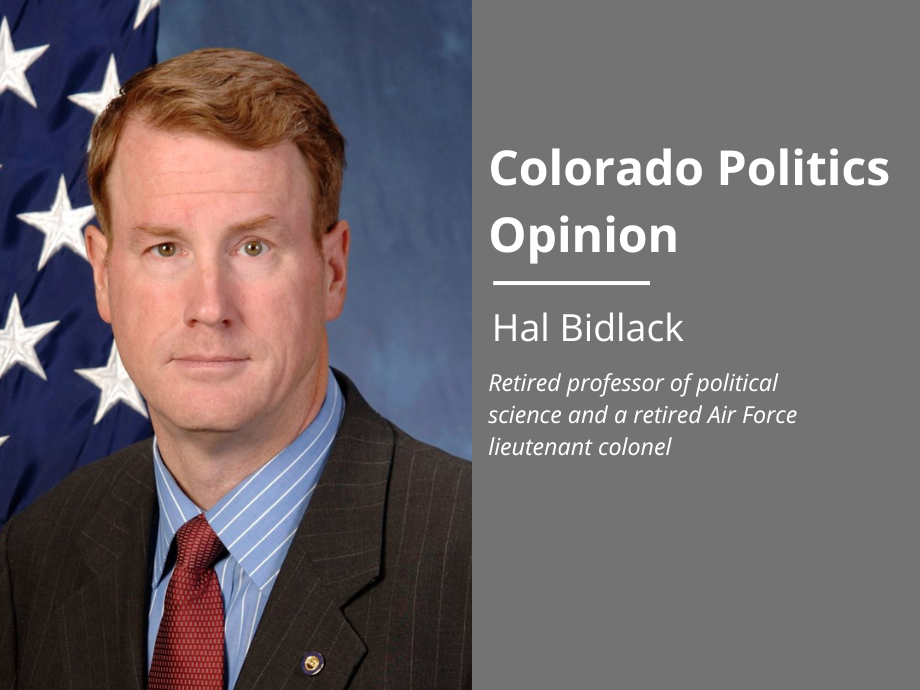
Hal Bidlack is a retired professor of political science and a retired Air Force lieutenant colonel who taught more than 17 years at the U.S. Air Force Academy in Colorado Springs.


Threats inside and out loom for Colorado’s Republicans | Dick Wadhams
Dick Wadhams
dick-wadhams@coloradopolitics.com
Updated 16 hours ago
Colorado Republicans made strides in 2024 despite an insidious state chairman who tried to defeat successful Republican candidates. Newly elected U.S. Reps. Gabe Evans, Jeff Hurd and Jeff Crank fought off unethical opposition from their own state party chairman, making...

Is it time for both parties to bail on Colorado’s political nominating system? | Miller Hudson
Miller Hudson
miller-hudson@coloradopolitics.com
Updated 16 hours ago
Cracks are beginning to appear in Colorado’s political nominating system. Recently, Mario Nicolais, a formerly Republican-leaning pundit, and Doug Friednash, former Democratic legislator, have opined regarding the imminent demise of the caucus/assembly framework which controls partisan candidate selection. There has...

Recognizing the value of generational work | Rachel Gabel
Rachel Gabel
rachel-gabel@coloradopolitics.com
Updated 16 hours ago
The Lesser Prairie Chicken habitat in southeastern Colorado is a swath of prairie that begins in Cheyenne and far-southeastern Lincoln counties and moves south and east into Kiowa, Prowers and Baca counties. This is cattle country where the short grass...

Why the controversy with mail-in ballots? | Cronin & Loevy
Tom Cronin Bob Loevy
tom-cronin-bob-loevy@coloradopolitics.com
Updated 16 hours ago
Most Coloradans enjoy the right to vote “by mail” at election time. Most Americans favor this process. But U.S. President Donald Trump is trying to federalize (nationalize) this practice and shift the supervision of voting from county clerks to the...

Who are the kings being crowned here in Colorado? | Jon Caldara
Jon Caldara
jon-caldara@coloradopolitics.com
Updated 3 days ago
Though most of us celebrate “No Kings Day” on July 4, the Trump-deranged got a head start last weekend with rallies around the state. Attendees bravely fought oppression by blocking traffic for people with jobs. Rally-goers demanded freedom from tyranny,...
An April Fool’s Day to remember | Capitol M | Week of April 4, 2026
Marianne Goodland
marianne.goodland@coloradopolitics.com
Updated 4 days ago
The lighter side of the Capitol, and if light were weight, the Capitol would have lifted off better than the Artemis II rocket on April Fool’s Day. There was a plethora of Fools at the Capitol for April Fool’s Day...

Democrats rebounding without learning necessary lessons | SONDERMANN
Eric Sondermann
eric-sondermann@coloradopolitics.com
Updated 2 days ago
“When we fight, we win!” That, reportedly, was the chant heard over and over again at the Colorado Democratic Assembly a week ago. It suggests that pugilism has been the piece missing from the Democratic toolkit. Perhaps it was just...

The Centennial State’s nuclear energy opportunity | OPINION
Michael Hancock
michael-hancock@coloradopolitics.com
Updated 3 days ago
Colorado was given a clear opportunity earlier this year. On Jan. 28, the U.S. Department of Energy issued a Request for Information (RFI) seeking potential hosts for Nuclear Energy Innovation Campuses — an early-stage process designed to identify states serious...

More pain than gain in upending Colorado’s water-access laws | OPINION
Colorado Politics
colorado-politics@coloradopolitics.com
Updated 3 days ago
By Greg Walcher and Mike King Colorado’s long-standing balance between public recreation and private property along rivers is now under renewed pressure. But changing stream access law would impose significant fiscal and legal costs for relatively limited new recreational benefit....
Guardianship is not a homelessness policy | OPINION
Colorado Politics
colorado-politics@coloradopolitics.com
Updated 3 days ago
By Amelia McKeon The federal government’s proposal to expand guardianship for homeless veterans is being framed as compassionate. It is anything but. It is a dangerous shift toward using one of the most restrictive legal tools we have as a...
PREV
PREVIOUS

Support eastern Colorado — build Ports-to-Plains | OPINION
Greg Fulton In the last election, we saw, as in years in the past, various candidates running for state and federal office make a pilgrimage to Colorado’s eastern plains. In seeking votes, candidates professed their appreciation and love for farming, ranching and the eastern plains. They promised if elected, they were committed to taking actions […]

Mask mandates masquerade as prudent public health policy | DUFFY
Sean Duffy Two words returned to the media in recent days that should raise the blood pressure of freedom-loving Coloradans: mask mandates. The arrival of two new COVID variants sparked nervous Nellie stories about whether it’s time for a return to public and private entities demanding we wear pieces of cloth or paper on our […]