

When will Polis meet expectations, rise to challenges? | NOONAN
Dilatory, slow-mo, recalcitrant and unresponsive are descriptors of the Polis administration’s, and the state legislature’s, Joint Budget Committee responses to numerous urgent – even existential – state problems.
In 2020, the legislature passed SB20-023 unanimously to study school safety issues. In 2022, the legislature passed HB22-1274, to continue the working group that had not yet been formed but was about to “sunset.” Now, finally, in 2023, this working group has been formed and its first meeting was held in March with some reported work in July. Whether with intention or not, no appointment to this working group represents large metro area districts in either Denver or Colorado Springs while two rural school districts are included. This year, the legislature created a state Office of School Safety that has opened expeditiously. About time, many would say.
The state’s 2022-2023 CMAS school achievement test results came out recently just as students returned to school for the 2023-2024 school year. Students in third grade in 2022-2023 are moving on to fourth grade, etc. Teachers will receive test scores for their previous year’s students. That won’t help them much unless they happen to have the same students in 2023-2024, which is unlikely in that teachers change grades they teach, or schools, or districts – especially if they teach in Woodland Park. Students move around also.
Stay up to speed: Sign-up for daily opinion in your inbox Monday-Friday
While English and math achievement results in some schools have improved slightly in some grades, the practical application of the data that informs the test scores is greatly diminished by the state’s inability to produce actionable statewide test results timely. Is this a function of the test builder, Pearson out of the United Kingdom? Or the Colorado Department of Education, who oversees the administration of the tests? Or the legislature’s Joint Budget Committee that claims there’s only so much money that can be put into state school funding? Or Gov. Jared Polis, who has not put enough money into K-12 education and has shorted his much-ballyhooed early childhood education program as well?
Then there’s the massive climate change challenge that has received more talk than necessary and less action than mandatory. Our summer has been wetter and cooler than usual, but that cannot be said of the rest of the nation. Arizona, Texas and New Mexico have sweltered, Maui has burned up, and Southern California has gone from excess heat to drowning in flood waters. Our air quality is terrible, our drinking and agricultural water has been tainted, the Colorado River is drying up, our risk of wildfire is always high, and hailstone, wind and rain damage to structures and vehicles will surely increase costs across the state in this decade.
Polis’s administration could take aggressive steps to manage some of the climate challenge. His renamed Colorado Energy and Carbon Management Commission (ECMC), formerly the Colorado Oil and Gas Conservation Commission, could speed up its rule-making and change its conciliatory attitude to extraction industries. SB19-181 required the former COGCC to address the cumulative polluting effects of oil and gas drilling across extraction sites. That requirement embedded in SB-181 was successfully ignored until this legislative session.
HB23-1294 “Concerning Measures to Protect Communities from Pollution” requires the ECMC to define “cumulative impacts” of pollution and evaluate and address impacts by April, 2024, not to rush anything. To make sure the commission’s work isn’t too energetic, the legislature limited evaluation of “cumulative impacts” to “addressable impacts.” A citizen can assume “unaddressable impacts” are wildfire smoke and particles coming from out-of-state. Of course, these impacts could be somewhat “addressed” by limiting the additional pollution coming from in-state oil and gas drilling and doing more to reduce combustion-engine driving during high ozone months, just for a couple of common ideas. The definition of “addressable impacts,” ultimately, may be more important than “cumulative impacts,” so expect much procrastination on that issue.
That brings this discussion to the Suncor Refinery. The foot-dragging by the Colorado Department of Public Health and Environment on air and water permits exceeds any definition of time wasted. The permitting hasn’t been delayed for months or even several years. It’s been delayed across multiple governors’ administrations. During that time, Suncor has repeatedly and recklessly polluted metro area air and water with barely a wrist slap. Some labelled the $9 million pollution penalty on Suncor a couple of years ago “significant,” but not really. More than half of the money went to pay consultants to tell refinery management that it mismanaged the refinery. Residents of Commerce City could give out that advice to Suncor for free.
Then there’s the recent report the state is down almost a quarter of its needed employees to keep the state’s many moving balls moving. Current JBC chair Rachel Zenzinger says the state can’t fill these positions because it doesn’t have enough money. The state will continue not to have enough money because Polis, with Zenzinger’s support, put up the indecipherable Proposition HH to alleviate property tax increases. There’s no question property taxes need to be addressed. But voters will no doubt reject this option. Gov. Polis and Zenzinger are unwilling to make a more straightforward case for how to straighten out Colorado’s fiscal logjam.
Gov. Polis has two more years to show his legislative and administrative chops to position himself for federal office-seeking or a cabinet job in the next U.S. president’s administration. In two years, climate change will be worse, more kids will be on the butt end of diminished school funding and impossible school safety conditions, and every property owner will be fed up with property tax increases. Like kids taking standardized tests in English and math, will Polis meet or exceed expectations to resolve our challenges, or not?
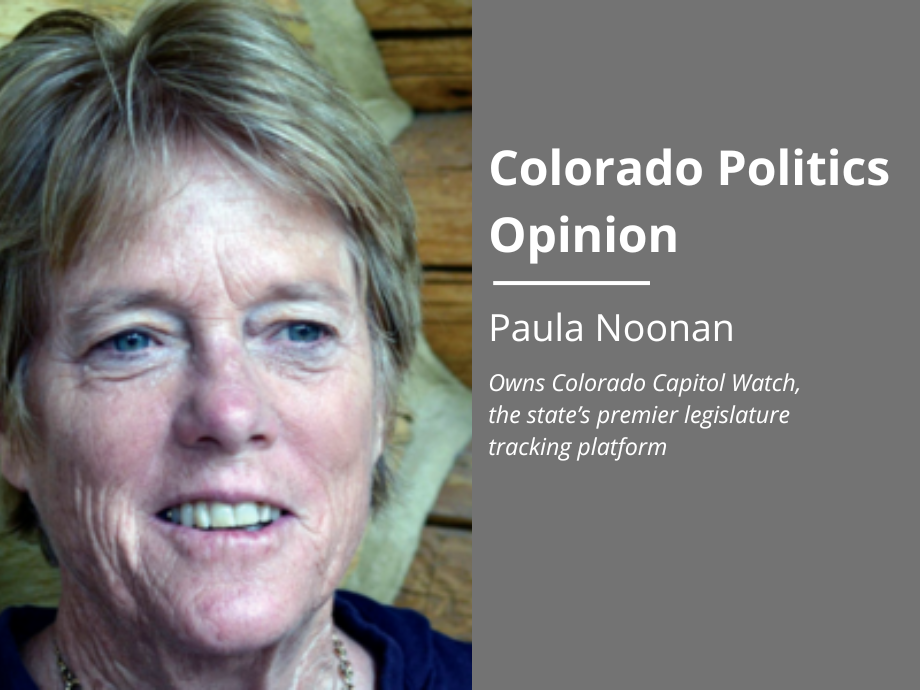
Paula Noonan owns Colorado Capitol Watch, the state’s premier legislature tracking platform.


Colorado is shrinking — time for our elected officials to take notice | Jon Caldara
Jon Caldara
jon-caldara@coloradopolitics.com
Updated 3 days ago
By Jon Caldara Something strange is happening in Colorado — strange enough that the political class should notice. People are leaving Colorado. After years of being one of the fastest-growing states in the nation, net in-migration has stopped and may...

Capitol M: Return to Gold Dome High, 2026 edition, and a salute to old IU
Marianne Goodland
marianne.goodland@coloradopolitics.com
Updated 3 days ago
Welcome back, campers! The 2026 legislative session is upon the good citizens of Colorado, and for a few, the first Monday of the session, Jan. 19, was pretty special. There are at least four folks in the Capitol who are...

The biggest accelerant of our political tribalism | SONDERMANN
Eric Sondermann
eric-sondermann@coloradopolitics.com
Updated 4 days ago
In years past, my go-to word in describing our political condition was “polarization.” I used it endlessly and still do on occasion. But as time has moved on, and the divide has only grown in depth and toxicity, polarization no...
The ramifications of President Trump’s pursuit of Greenland | Kelly Sloan
Kelly Sloan
kelly-sloan@coloradopolitics.com
Updated 3 days ago
President Donald Trump has evidently stepped back from his threatened fantasy of invading Greenland — the sovereign territory of a U.S. ally — to which many a sigh of relief has been expressed, including by the markets. There was next...
Let’s find out who’s up to the gubernatorial task post Polis | Paula Noonan
Paula Noonan
paula-noonan@coloradopolitics.com
Updated 3 days ago
Gov. Jared Polis is bold and his policies are bolder than bold. That’s the paraphrase of his State of the State speech to open the 2026 General Assembly and start off his last year in office. His sweeping review of...

We dream, we dare, we decouple — how Colorado turns values into policy | OPINION
Colorado Politics
colorado-politics@coloradopolitics.com
Updated 4 days ago
By Kathy White Gov. Jared Polis’ final State of the State address was a clear victory lap. After eight years as governor, he used the moment to highlight accomplishments, reflect on progress and remind Coloradans what his administration has delivered....

Volunteer homeowners’ associations to be hit with new lot-splitting law | Bob Loevy
Bob Loevy
bob-loevy@coloradopolitics.com
Updated 4 days ago
Volunteer homeowners’ associations in Colorado Springs, particularly those close to the downtown area, are preparing for another attack on single-family zoning from Gov. Jared Polis and the state legislature during the just underway 2026 legislative session. The new proposal is...

Comprehensive energy permitting reform benefits Colorado, the mountain west | PODIUM
Colorado Politics
colorado-politics@coloradopolitics.com
Updated 5 days ago
By Ron Dickson Thank you, U.S. Reps. Gabe Evans and Jeff Hurd, for your participation in the Congressional Problem Solvers Caucus and your support of comprehensive energy permitting reform. We also appreciate U.S. Sen. John Hickenlooper’s continued efforts to enhance...

Colorado kids will die with CDC’s recent changes to vaccine schedule | OPINION
Colorado Politics
colorado-politics@coloradopolitics.com
Updated 5 days ago
By Connie Ingram and Lesley Thompson No parent or grandparent should ever face the terror of watching a child fight for their life against a disease that could have been prevented. Yet more families could be put in exactly this...

Solutions right in front of us to solve political extremism crisis | OPINION
Colorado Politics
colorado-politics@coloradopolitics.com
Updated 5 days ago
By Landon Mascareñaz Everywhere I went these past two weeks, the sentiment was the same: “What are we going to do about political extremism and the conflict in this country?” I heard it from folks on the left, right and...
PREV
PREVIOUS
Transparency a two-way street for metro district debt | OPINION
Rick Taggart In the last legislative session I worked as a cosponsor to successfully pass a bipartisan bill codifying best practices for metro districts, which included strong local oversight, greater accountability for district directors, mandated disclosures, caps on bond payments so property taxes don’t go above a certain level and requirements that the interest rate […]
GOP presidential debate spotlights strong bench | Colorado Springs Gazette
The winner in Wednesday night’s Republican presidential debate was the bench. If Republicans lose the White House again in 2024, they will do so with a lineup of viable, articulate candidates focused on social, cultural, economic and educational agendas. Florida Gov. Ron DeSantis set the tone by talking about an America in decline “by choice.” […]