

Roosevelt rolling over in grave over Antiquities Act abuse | GABEL
The Antiquities Act of 1906 authorizes the president of the United States to proclaim national monuments of federal lands that contain historic landmarks, historic and prehistoric structures, or other objects of historic or scientific interest. According to the Congressional Research Service, the president is to reserve “the smallest area compatible with the proper care and management of the objects to be protected” and presidents have proclaimed more than 160 monuments using the act.
President Theodore Roosevelt used the authority in 1906 to create the first national monument, Devil’s Tower in Wyoming. Roosevelt utilized the act frequently, protecting places like New Mexico’s Gila Cliff Dwellings National Monument, Grand Canyon National Park and a portion of Colorado’s Rio Grande National Forest (originally Wheeler).
A slew of historically and culturally important sites are protected by the Antiquities Act, one of the most recent in Colorado, Camp Hale-Continental Divide National Monument, was protected in 2022. Camp Hale was utilized during World War II when 15,000 recruits arrived by train to form the Army’s 10th Mountain Division. According to Colorado’s U.S. Sen. Michael Bennet and U.S. Rep. Joe Neguse, many of the recruits had never before seen snow but trained, learning to hike, repel and became expert mountaineers. The 15,000 became the world’s most capable mountain soldiers and in 1945 proved their salt when Axis forces held the high ground in the Italian mountains. The German line could not be broken until the 10th Mountain Division arrived, opening the way for Axis troops, and cleared to path to victory.
Stay up to speed: Sign-up for daily opinion in your inbox Monday-Friday
The 53,804-acre site’s designation was widely supported by stakeholder groups, including adjacent landowners, ranchers and community members. It didn’t create a new burden on the managing entity, nor did it cut communities off from existing resources. It was an appropriate use of the act that adheres to the rules and the spirit in which the act was created.
Designating swaths of millions of acres as monuments is not what the Act was created to protect. It was created as an efficient way to preserve resources on federal lands with a scalpel, not a chainsaw drawing the lines. Structures, landmarks and other objects of historical or scientific significance were the goal. Roosevelt used the act most frequently to designate monuments and President Barack Obama proclaimed the most monument acreage. Other presidents have designated monuments, increased, or decreased the size of existing monuments, and have the power also to diminish protections.
The most common objection to national monuments is the change in management that would preclude uses such as development of mineral and energy leases, claims and permits. The question of access – be it for recreation or timber cutting – has been debated in terms of whether current contracts can be completed and whether such sustainable uses may continue.
The restriction of commercial and recreational fishing has been called into question multiple times, as has grazing, which I continue to maintain is a conservation tool. In these cases, it is most often the economic effects on the surrounding communities that are affected by lost jobs and tax revenue.
President Joe Biden is one of several presidents who has fallen into the trap of utilizing the Antiquities Act to unilaterally “conserve” huge amounts of land with no stakeholder engagement. Is this area in Arizona special and worth protecting? Of course. Using the act as a targeted tool to protect a specific landmark, structure or object is good and fair. Using it, especially in the western United States, without consideration for very clear management budgets means federal agencies tasked with managing these monuments are just asking for disaster.
This act is not a tool through which the president may choose winners and losers, but an expedited method to protect valuable, historic places. Whether or not President Biden reaches his 30 by 30 acreage goals through designating giant amounts of land matters little. The millions of acres where beneficial use grinds to a halt does matter, though. The lack of consultation with stakeholders like grazing permittees who suddenly lose their permits or access matters. The impact is crippling, especially when they have partnered with the federal government for generations to provide for on the ground management.
In this particular case, I’m told the in-person engagement sessions were poorly attended by those who didn’t support the designation and the opponents of what many call a land grab were shouted down by environmental activists. Local elected officials were excluded, the meeting was chaotic, and the ranchers were on the receiving end of threats and name calling. The administration should have done better. The administration should have narrowed down the areas to be protected, and the administration should have better communicated with and heard the concerns of those who are the most impacted, but that’s certainly a storyline we’re already familiar with.
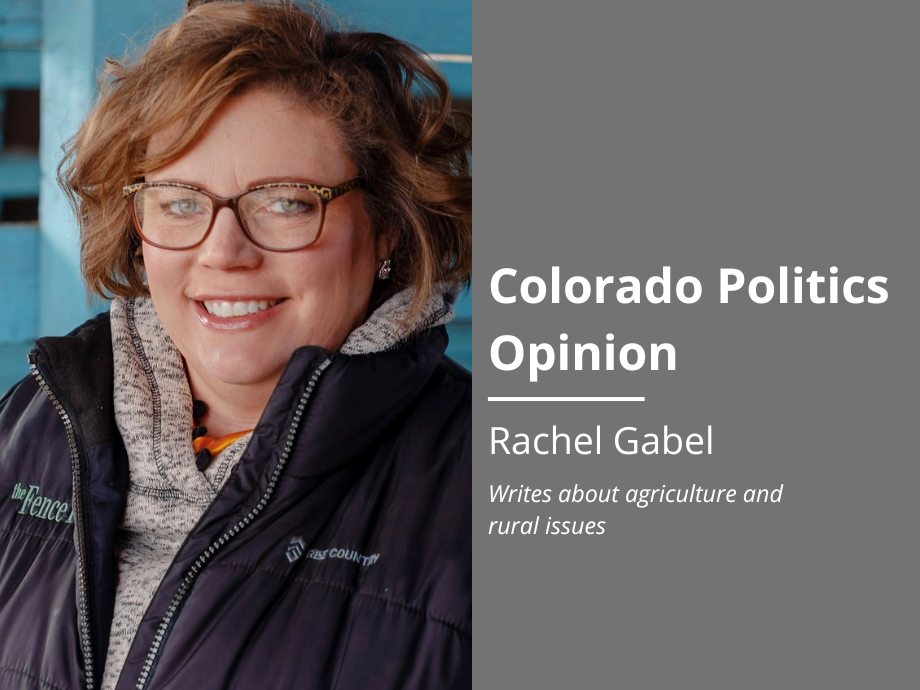
Rachel Gabel writes about agriculture and rural issues. She is assistant editor of The Fence Post Magazine, the region’s preeminent agriculture publication. Gabel is a daughter of the state’s oil and gas industry and a member of one of the state’s 12,000 cattle-raising families, and she has authored children’s books used in hundreds of classrooms to teach students about agriculture.


Mum on his own replacement, Bennet disrespects voters | Dick Wadhams
Dick Wadhams
dick-wadhams@coloradopolitics.com
Updated 2 days ago
U.S. Sen. Michael Bennet is playing an arrogant game of hide-and-seek with Colorado voters as he seeks to abandon his Senate seat to become governor. Bennet insists that if he is elected governor in November, he will wait until he...
What kind of energy independence did we pay for? | Miller Hudson
Miller Hudson
miller-hudson@coloradopolitics.com
Updated 2 days ago
It was during the summer of 1972 AT&T published an internal solicitation for installation and repair supervisors with “inner-city” experience to transfer to Mountain Bell. The catch was an applicant’s readiness to work 10 hours a day, six days a...

Those who cannot live without wild things | Rachel Gabel
Rachel Gabel
rachel-gabel@coloradopolitics.com
Updated 2 days ago
Aldo Leopold wrote in his Sand County Almanac, “There are some who can live without wild things and some who cannot.” The collection of essays first published in 1949 was accepted by a publishing house after a steady stream of...

Thank God for Wyoming — the un-Colorado | Jon Caldara
Jon Caldara
jon-caldara@coloradopolitics.com
Updated 2 days ago
Years ago, I interviewed a Canadian health-care broker whose job was helping his countrymen escape their own failing system. When their “free” health care turned into “free to wait until you die,” he’d save his clients by routing them to...
It’s time to let unaffiliated voters caucus | Vince Bzdek
Vince Bzdek
vince.bzdek@gazette.com
Updated 13 hours ago
There’s no getting around it: Colorado’s 3,000 county caucuses, which just wrapped up recently, left half the electorate out in the cold. Since unaffiliated voters now make up 51% of all Colorado voters, a majority of Colorado electors are barred...
A Mile High, again: Capitol M | Week of March 21, 2026
Marianne Goodland
marianne.goodland@coloradopolitics.com
Updated 5 days ago
The lighter side of the Capitol, usually…. Local Journalism Day, except they forgot their very own local journalists. The state Senate on Thursday, March 19, passed a resolution recognizing Local Journalism Day. Everyone voted for it, which is good, because...

The insular bubble of caucuses and assemblies | SONDERMANN
Eric Sondermann
eric-sondermann@coloradopolitics.com
Updated 4 days ago
Nearly 30 years ago, then-Federal Reserve Chairman Alan Greenspan coined the term “irrational exuberance” to describe the overheated stock market. That descriptive phrase could also apply to much of the political realm. The hype in politics often grossly exceeds the...
Set appropriate state guidelines for critical surveillance technology | OPINION
Colorado Politics
colorado-politics@coloradopolitics.com
Updated 4 days ago
I admit it: I’m worried. I’m hearing a lot about surveillance in the public arena. I hear cameras are capturing my car’s license plate wherever I drive, my face as I go in and out of stores and health facilities,...
Puppy trafficking bill promotes inhumane breeding | OPINION
Colorado Politics
colorado-politics@coloradopolitics.com
Updated 4 days ago
By Patti Strand When Justice Thurgood Marshall wrote “The Constitution does not prohibit legislatures from enacting stupid laws,” he wasn’t wrong. He was referring to a political process sometimes ill-equipped to deal with complex issues that require subject-matter knowledge and a...
Penny wise but foolish by pounds | Paula Noonan
Paula Noonan
paula-noonan@coloradopolitics.com
Updated 4 days ago
Leadership of Colorado’s General Assembly introduced the Fiscal Year 2026-2027 Legislative Appropriation bill, HB26-1333, at $75.72 million. That will be the budget to run the state legislature next year. About $74 million comes out of the general fund and the...
PREV
PREVIOUS

'Progressive' zealots bizarrely bludgeon Polis like yesterday's fetus | CALDARA
Jon Caldara “Bizarro World” was a set of comic books published by DC Comics in the early 1960s. It featured an alternative Earth where everything was, well, completely backward. Earth in Bizarro World was called Htrae, (Earth spelled backward). Htrae wasn’t a round sphere. It was a cube. Yes, Superman lived there, but he was […]
Who can Coloradans trust? | HUDSON
Miller Hudson It’s been 40 years since a therapist and close friend, advised me, “You know, Miller, you seem to have an anti-authoritarian mindset. Why is that?” Her observation came without knowing I had reported my commanding officer to the Judge Advocate General’s staff for diverting funds. I still recall the precise words included in […]