

More than opinions: Some appellate judges wax philosophical in journal articles

The life of an appellate judge revolves around reading and writing, but some members of Colorado’s state and federal courts have published their musings off the bench in recent years, expanding upon the issues and initiatives they confront in their day jobs.
Colorado Politics located five journal articles published in 2022 and 2023 whose authors sit on either the state Supreme Court or the U.S. Court of Appeals for the 10th Circuit, which has jurisdiction over federal cases arising in Colorado. The topics ranged from Colorado-specific case law and the treatment of civil rights claims to the behind-the-scenes workings of the judiciary.
Guidance from executive agencies
In June 2021, the Colorado Supreme Court acknowledged in Nieto v. Clark’s Market, Inc. that state law did not require employers to provide vacation pay. But if they do choose to provide it, they must compensate workers for their earned time upon termination, the court ruled.
The author of the decision, Justice Melissa Hart, published an article about the case in the spring 2023 edition of the Harvard Journal of Law & Public Policy. The publication describes itself as the nation’s “leading forum for conservative and libertarian legal scholarship,” whose alumni include Gov. Ron DeSantis, R-Fla., and U.S. Supreme Court Justice Neil M. Gorsuch, a Donald Trump appointee.

Hart honed in on a specific aspect of the Nieto case: how the state Supreme Court treated the Colorado labor department’s views about earned vacation pay. The court has “decided to chart its own path” when deciding how much weight to give the legal interpretations of executive agencies, Hart wrote. Referring to her opinion in Nieto, she explained the court found the department issued “persuasive” guidance about earned vacation time. But the justices did not automatically defer to the department’s views on state wage law.
“Colorado does not take a ‘rigid’ approach to deference in that the state courts will not bind themselves to accept an agency interpretation of an ambiguous statute,” she wrote.
Hart did not receive compensation for her article.
Educational initiative in Colorado
Last year, Justice Richard L. Gabriel wrote about a Colorado program designed to educate the public about the judiciary, known as Our Courts.

“Our Courts was born in the aftermath of an unsuccessful 2006 ballot initiative that sought to term-limit Colorado’s appellate judges. Among its many lessons, the campaign regarding this initiative revealed how little many Coloradans knew about their courts generally,” wrote Gabriel in Judicature, a publication of Duke Law School.
As of the article’s publication, 300 volunteers had spoken with 20,000 people about Colorado’s judicial selection and retention system, immigration and bankruptcy courts, and how legal proceedings work, among other topics. Gabriel also noted that specific programming exists for Hispanic residents, high school students and state lawmakers.
Gabriel did not receive compensation for his article.
A rare type of proceeding
In the federal appeals courts, the vast majority of cases are decided in three-judge panels. Occasionally, the courts will vote to have all judges hear a case, known as an “en banc” review.

The April edition of the Denver Law Review, which focused on the 10th Circuit, featured an article from Senior Judge Bobby R. Baldock and Judge Joel M. Carson III, both Republican appointees from New Mexico. The men described the rarity of en banc hearings in the 10th Circuit, with the court receiving approximately 190 requests per year but granting fewer than one on average.
“So, statistically speaking, litigants have a greater shot (the odds are roughly 1%) at having the Supreme Court grant certiorari in their case than the Tenth Circuit granting their petition for en banc consideration,” wrote Baldock, Carson and attorney Bryston C. Gallegos, who was formerly Baldock’s law clerk.

In the 10th Circuit, three-judge panels cannot overrule each other’s precedents, except in en banc hearings. The judges suggested successful requests for en banc hearings will show there is a conflict between decisions or that the 10th Circuit is an outlier on a specific issue – with ramifications beyond the specific case being litigated.
A panel “getting it wrong,” even if the decision seems unjust, is not a compelling reason for full court review, the authors wrote.
“Combative language or the use of hyperbole distracts from reasoned legal argument and obscures the point counsel is trying to make,” they warned.
Baldock, Carson and Gallegos did not receive compensation for their article.
Liability for legal violations
In the same edition of the Denver Law Review, Judge Timothy M. Tymkovich wrote about the concept of municipal liability, which involves holding a state government entity responsible for its own role in violating a person’s legal rights.
Tymkovich, a Republican appointee from Colorado, wrote that governmental policies as well as unwritten practices can subject a public entity to liability if one of its employees commits a constitutional violation, provided there is a link between the government’s actions and the employee’s actions.
He stressed that in the 10th Circuit, a public employee who receives a commendation after violating someone’s rights does not mean the government has liability, as the government’s actions have to contribute to the violation in the first place. Tymkovich also pointed to a recent 10th Circuit decision out of New Mexico, in which he and two other judges disagreed about holding a local government liable for a jail assault when the alleged perpetrators were themselves immune as corrections officers.
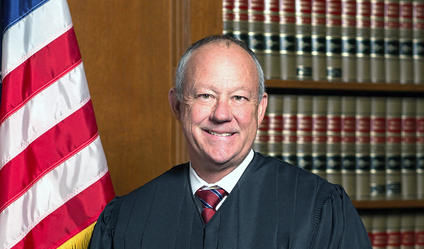
“Some opinions suggest there are limited and narrow circumstances where municipal liability can be avoided if an individual officer has qualified immunity,” he wrote.
Tymkovich did not receive compensation for his article.
Malicious prosecution
Tymkovich and his former law clerk, Hayley Stillwell, also published an article in the winter 2022 edition of The Georgetown Journal of Law & Public Policy, which describes itself as “exploring and critiquing conservative, libertarian, and natural law perspectives.”
Tymkovich and Stillwell wrote about malicious prosecution, which involves intentionally subjecting someone to legal proceedings without probable cause that ultimately end in the person’s favor. The authors argued that while the U.S. Supreme Court has been inclined to link malicious prosecution claims to the Fourth Amendment – which prohibits unreasonable searches and seizures – doing so is “messy, confusing, and unnatural.”
“Malicious prosecution does not fit into the Fourth Amendment,” Tymkovich and Stillwell wrote. “At its core, malicious prosecution has always been about vindicating a deprivation of a liberty interest caused by a wrongful criminal prosecution without probable cause.”
They advocated for malicious prosecution claims to be evaluated through the Fourteenth Amendment’s requirement that states provide due process before depriving someone of their liberty.
Colorado Politics could not verify whether Tymkovich and Stillwell received compensation for their article.


Colorado Supreme Court to address child’s CCTV testimony
Michael Karlik
michael.karlik@coloradopolitics.com
Updated 9 hours ago
The Colorado Supreme Court announced on Monday that it will review the impact of a victim’s closed-circuit testimony on the prosecution of a juvenile defendant. At least three of the court’s seven members must agree to hear an appeal. There...

10th Circuit to hold all-judges hearing, judicial committee turns down ‘civility code’ | COURT CRAWL
Michael Karlik
michael.karlik@coloradopolitics.com
Updated 1 day ago
Welcome to Court Crawl, Colorado Politics’ roundup of news from the third branch of government. The Denver-based federal appeals court agreed to hold a rare all-judges hearing in a criminal case, plus a state Supreme Court committee overwhelmingly rejected a...
Divided Colorado Supreme Court curtails use of laced-substances defense
Michael Karlik
michael.karlik@coloradopolitics.com
Updated 1 day ago
The Colorado Supreme Court on Monday walked back the ability of criminal defendants to claim their conduct was the result of consuming an intoxicating substance that secretly contained another behavior-altering substance. Under state law, “involuntary intoxication” is an affirmative defense,...
Colorado justices say utilities commission overreached by immunizing Xcel in rate document
Michael Karlik
michael.karlik@coloradopolitics.com
Updated 1 day ago
Xcel Energy cannot rely upon a rate-setting document to broadly immunize itself from liability against electrocutions, the Colorado Supreme Court ruled on Monday. The justices originally heard the electrocution-related lawsuit from Francisco Cuevas to decide whether Xcel’s tariff, which sets...
Colorado Supreme Court committee rejects civility proposal amid fears of weaponization by judges, ‘jerks’
Michael Karlik
michael.karlik@coloradopolitics.com
Updated 1 day ago
The Colorado Supreme Court’s Civil Rules Committee overwhelmingly rejected a proposal last week to create an enforceable “civility code” for lawyers and legal paraprofessionals, which would allow judges to quickly impose corrective action without a formal complaint and investigation by...
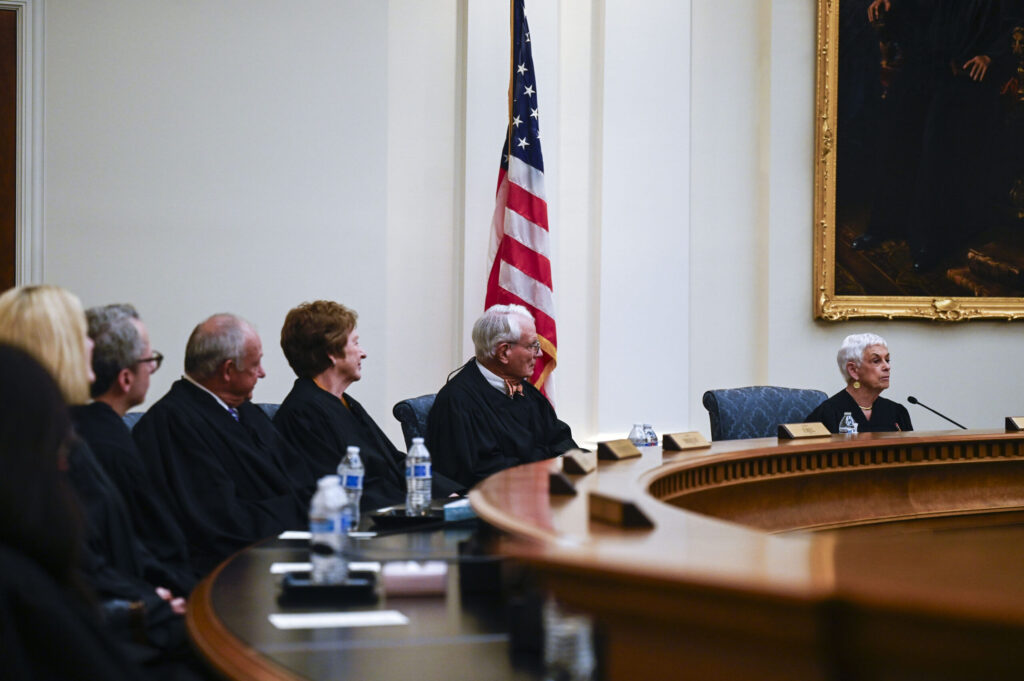
10th Circuit to address resentencing of probation violators in rare all-judges hearing
Michael Karlik
michael.karlik@coloradopolitics.com
Updated 3 days ago
The Denver-based federal appeals court agreed on Thursday to hold a rare all-judges hearing to determine the proper procedure for resentencing a criminal defendant who has violated the terms of his probation. In the federal appellate courts, the vast majority...
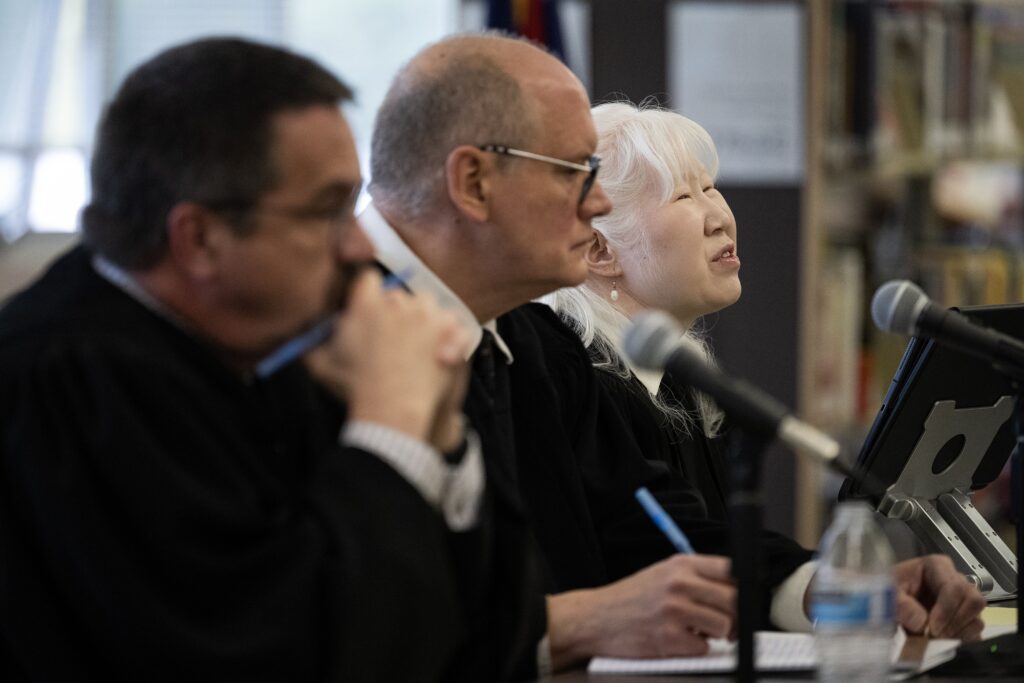
Appeals court overturns Adams County sex offense convictions due to prosecutor’s misconduct
Michael Karlik
michael.karlik@coloradopolitics.com
Updated 2 days ago
Colorado’s second-highest court reversed multiple child sex assault convictions on Thursday after concluding an Adams County prosecutor committed misconduct while cross-examining the defendant. A three-judge Court of Appeals panel observed the charges against Daniel Michael Boerner depended on the jury...
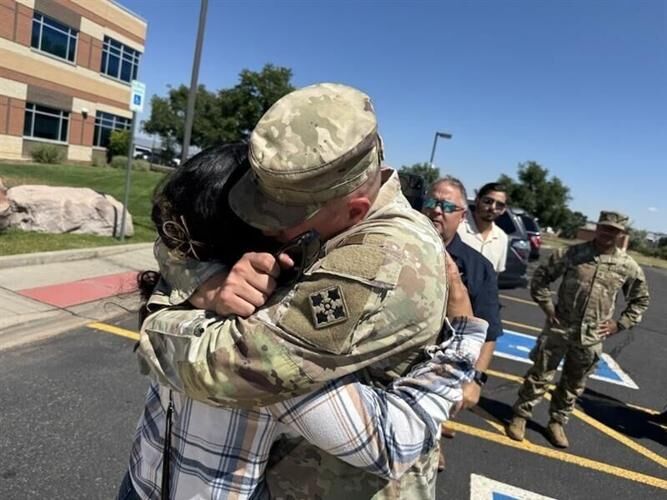
Fort Carson soldier’s wife could be deported
Carol McKinley
carol-mckinley@coloradopolitics.com
Updated 5 days ago
As the country’s largest immigration enforcement crackdown continues in Minnesota’s Twin Cities, a Fort Carson sergeant is fighting a personal immigration crisis — one that may implode his family. Sgt. Tyler Garza’s wife, Jennifer Maradiaga Baca, is not a legal...

Elizabeth School District dismisses challenge to book-ban injunction on eve of appellate arguments
Michael Karlik
michael.karlik@coloradopolitics.com
Updated 5 days ago
An Elbert County school district has dismissed its challenge to a judge’s injunction ordering it to return banned books to library shelves, days before the Denver-based federal appeals court was set to hear oral arguments this week. Although a three-judge...
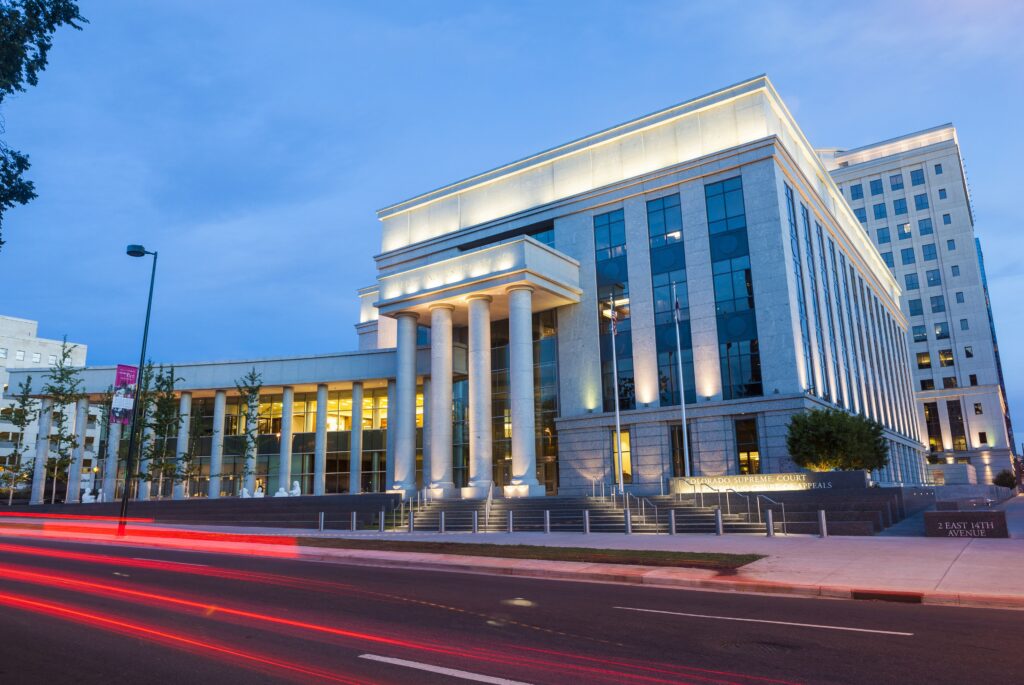
Colorado Supreme Court to hear cases on insurance coverage for COVID, witness credibility
Michael Karlik
michael.karlik@coloradopolitics.com
Updated 6 days ago
The Colorado Supreme Court announced on Tuesday that it will decide the degree to which a virus or other hazard must affect a commercial property before it can trigger loss-or-damage coverage under an insurance policy. At least three of the...
PREV
PREVIOUS

Are big changes up ahead for the marijuana industry?
Is the Biden administration close to a decision on whether to change federal laws around marijuana, with potential major ramifications for the drug’s use and the cannabis industry’s ability to access, among other things, financing? Some believe that decision, which could, at a minimum, involve putting cannabis in the same category as prescription drugs, could […]

Colorado Democrats call for legislative action against HOA foreclosures
Gov. Jared Polis and other Democrats are calling for action after a report revealed homeowner associations have foreclosed on thousands of Colorado properties and auctioned off hundreds due to unpaid HOA fees. In a statement released Wednesday, Polis and four state legislators said the actions of these HOAs exacerbates Colorado’s ongoing housing crisis. Polis said he […]