

Denver breaks record for underpaid worker reimbursement

Denver Labor collected $1,479,453 in restitution as of the end of July, surpassing the highest dollar amount recovered for unpaid workers within a year.
“Every dollar matters to the people who earned that money, and no case is too small for us to investigate,” Denver Auditor Timothy M. O’Brien said in a press release.
For reference, Denver’s Auditor’s Officer recovered $1,101,738 in all of 2022 reporting period.
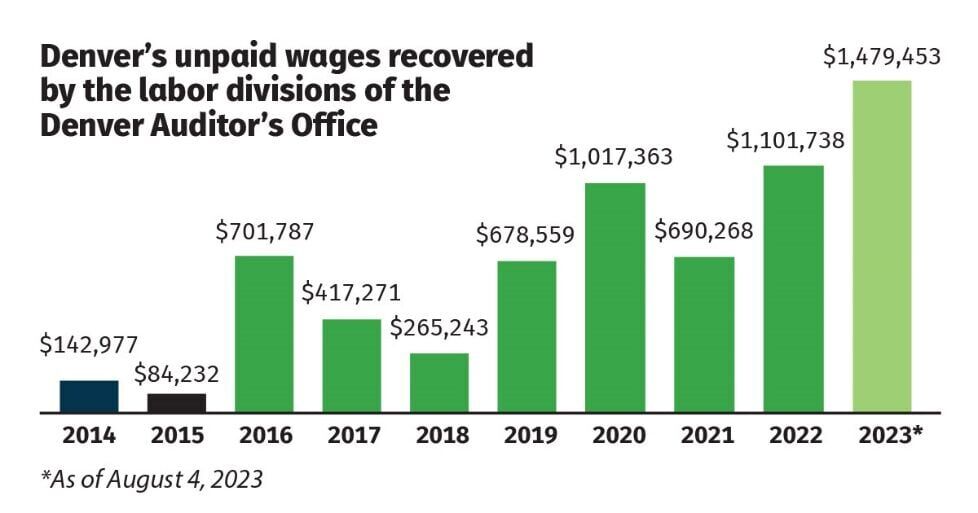
The $1.4 million was distributed to 2,810 people, with 1,646 under the minimum wage and civil wage theft ordinances and 1,164 workers under the prevailing wage ordinance.
The Citywide Minimum Wage Ordinance was approved unanimously by Denver City Council in 2019. It allowed for Denver to establish a minimum wage above the state level based on the Consumer Price Index for Urban Wage Earners and Clerical Workers (CPI-W).
Not paying a worker promised wages, overtime, or forcing them to work off the clock is considered civil wage theft. A new ordinance was established in 2023, giving the Denver Auditor’s Office new procedures and penalties to help combat theft.
As of August, Denver Labor analysts have closed investigations for 40 minimum wage and civil wage theft cases.
The prevailing wage ordinance “declares that any contractor or sub-contractor performing work on or at a City facility costing $2,000 or more, must pay their employees working on those projects nothing less than the appropriate prevailing wage rate for the classification of worker,” according to the Denver Revised Municipal Code (DRMC) Section 20-76.
Denver Labor has closed 370 prevailing wage cases during this reporting period.
“Denver Labor’s goal is to help protect as many workers as possible from wage theft, while supporting the competitive job market for businesses in Denver,” according to the news release. “Wage theft disproportionately impacts people of color, women and other marginalized or underrepresented groups.”
The increase in reimbursement amounts is not thought to be an increase in unpaid workers, but an increase in the auditor’s ability to act.
Tayler Overschmidt, spokeswoman for the auditor’s office, points to the new ordinances put into place.
“What that means for workers and businesses is: our office has been able to enforce prevailing wage requirements on projects using public resources for decades, but since the passage of the new wage laws every worker in the city – regardless of any contractual relationship with the city – is protected,” she said.
“In response to the added worker protections, our office has taken on new resources to expand our efforts to connect with and educate the business community, as well as conduct more investigations citywide,” Overschmidt concluded.
Denver’s minimum wage will be increased to $18.29 an hour as of January 1, 2024.


It’s time to let unaffiliated voters caucus | Vince Bzdek
Vince Bzdek
vince.bzdek@gazette.com
Updated 1 day ago
There’s no getting around it: Colorado’s 3,000 county caucuses, which just wrapped up recently, left half the electorate out in the cold. Since unaffiliated voters now make up 51% of all Colorado voters, a majority of Colorado electors are barred...

With new medical school set to open, Feinstein will step down as UNC president
Hap Fry, Special to The Gazette
hap-fry@gazette.com
Updated 5 hours ago
GREELEY • Dr. Andrew “Andy” Feinstein, the charismatic president of the University of Northern Colorado, has announced that he will step down from his leadership role just on the cusp of what is perhaps his signature accomplishment being realized. He’ll...
Governor warns energy development both a boon and a risk to Colorado | A LOOK BACK
Rachael Wright, Special to Colorado Politics
rachael.wright@coloradopolitics.com
Updated 4 days ago
Forty-Five Years Ago This Week: “The real opportunity and the dangers before us are both real,” said Gov. Dick Lamm in his January state of the state address before the Colorado General Assembly. Lamm argued that energy development would continue...
A Mile High, again: Capitol M | Week of March 21, 2026
Marianne Goodland
marianne.goodland@coloradopolitics.com
Updated 4 days ago
The lighter side of the Capitol, usually…. Local Journalism Day, except they forgot their very own local journalists. The state Senate on Thursday, March 19, passed a resolution recognizing Local Journalism Day. Everyone voted for it, which is good, because...
Colorado Politics Calendar Mar. 23-29
Rachael Wright, Special to Colorado Politics
rachael.wright@coloradopolitics.com
Updated 3 days ago
CoPo’s weekly political calendar will help you find political and public-policy events throughout Colorado. It includes candidate and issue campaign events, public policy meetings, court hearings, state and local party conventions, assemblies, debates, rallies, parades, speaking engagements, traveling dignitary appearances,...

The insular bubble of caucuses and assemblies | SONDERMANN
Eric Sondermann
eric-sondermann@coloradopolitics.com
Updated 3 days ago
Nearly 30 years ago, then-Federal Reserve Chairman Alan Greenspan coined the term “irrational exuberance” to describe the overheated stock market. That descriptive phrase could also apply to much of the political realm. The hype in politics often grossly exceeds the...

Lauren Boebert’s hard ‘no’ on Pentagon Iran funding request puts Mike Johnson in tough spot
Emily Hallas, Washington Examiner
emily.hallas.washington.examiner@gazetteedit.wpenginepowered.com
Updated 2 days ago
Colorado U.S. Rep. Lauren Boebert announced on Thursday that she will not support further funding for the United States’s war in Iran, marking an uphill battle for the Trump administration’s effort to secure additional financing from Congress. “I’ve already told...
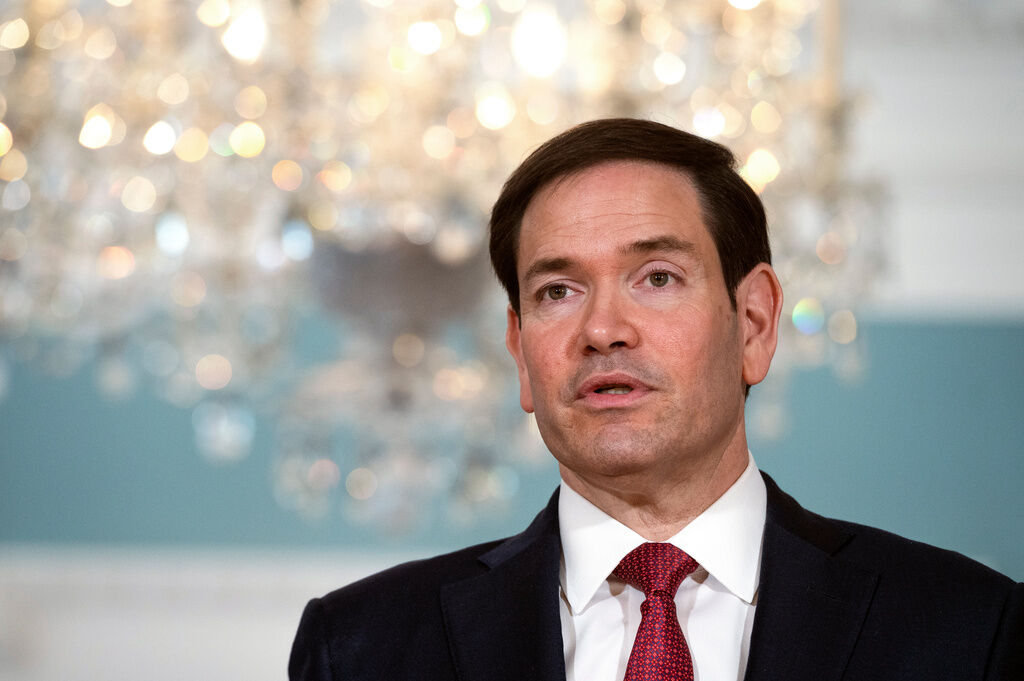
Rubio gains ground in 2028 jockeying as Iran war elevates his profile
Samantha-Jo Roth, Washington Examiner
samantha-jo.roth.washington.examiner@gazetteedit.wpenginepowered.com
Updated 2 days ago
Secretary of State Marco Rubio’s high-profile role in the Trump administration’s response to the Iran war is boosting his standing in the early jockeying for the 2028 Republican presidential nomination — and positioning him as a possible rival to Vice...
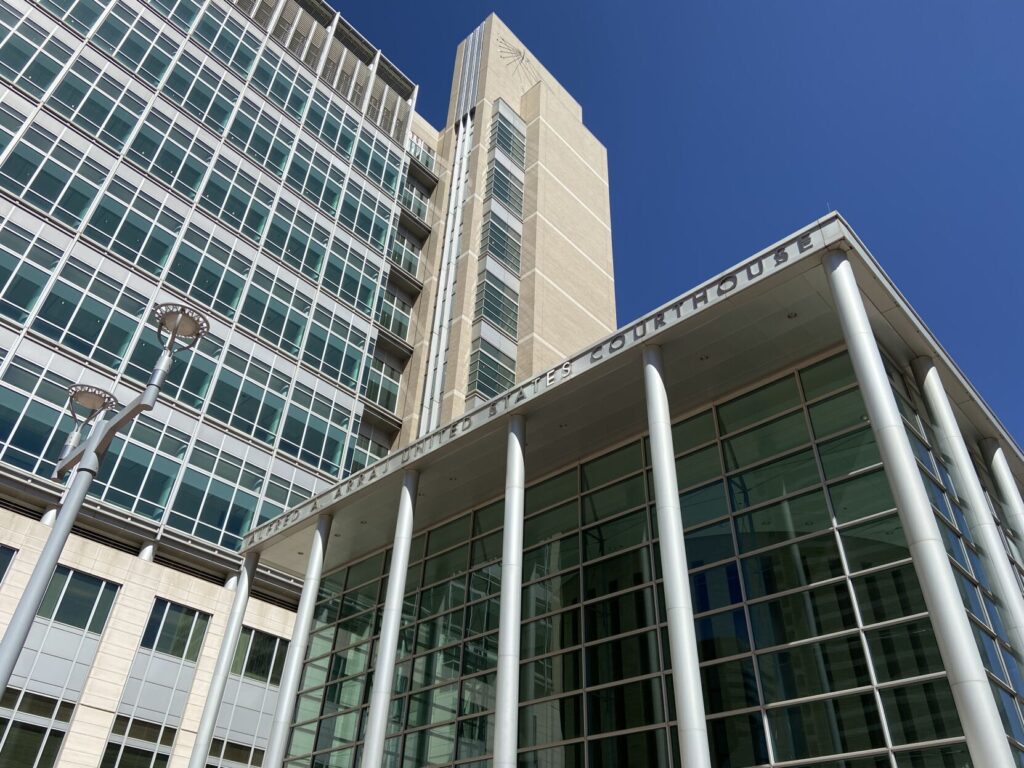
Federal judge dismisses claims against medical contractor for Eagle County jail suicide
Michael Karlik
michael.karlik@coloradopolitics.com
Updated 2 days ago
A federal judge dismissed the claims against a medical contractor for the Eagle County jail and its employees earlier this month, concluding there were insufficient allegations that they violated the constitutional rights of a man who died by suicide in...

Colorado Senate committee advances bill increasing overtime threshold for farmworkers
Marianne Goodland
marianne.goodland@coloradopolitics.com
Updated 1 day ago
The struggle to balance farmworker protections with the survival of Colorado’s family farms took center stage Thursday as senators debated two competing overtime bills. The Senate Business, Labor and Technology Committee held a rare double-bill hearing that led to a...
PREV
PREVIOUS

Aurora sees early success from new 'proven model' to reduce youth violence
Aurora will implement a new approach to reducing youth violence, a program that uses what the city called a “proven model” that has helped other cities reduce violence. The program, Standing Against Violence Every Day (SAVE), focuses on addressing youth violence deterrence through collaboration between the Aurora Police Department, Youth Violence Prevention Program, community partners […]

Colorado companies urged to help solve the West's water woes
As more people pay attention to the water crisis in the West, Colorado business leaders are being asked to take on a larger role. One effort, led by Colorado Concern and the Denver Metro Chamber of Commerce, began on Tuesday night in a forum at the Denver Museum of Nature & Science, where panelists, who […]