

Colorado companies urged to help solve the West’s water woes

As more people pay attention to the water crisis in the West, Colorado business leaders are being asked to take on a larger role.
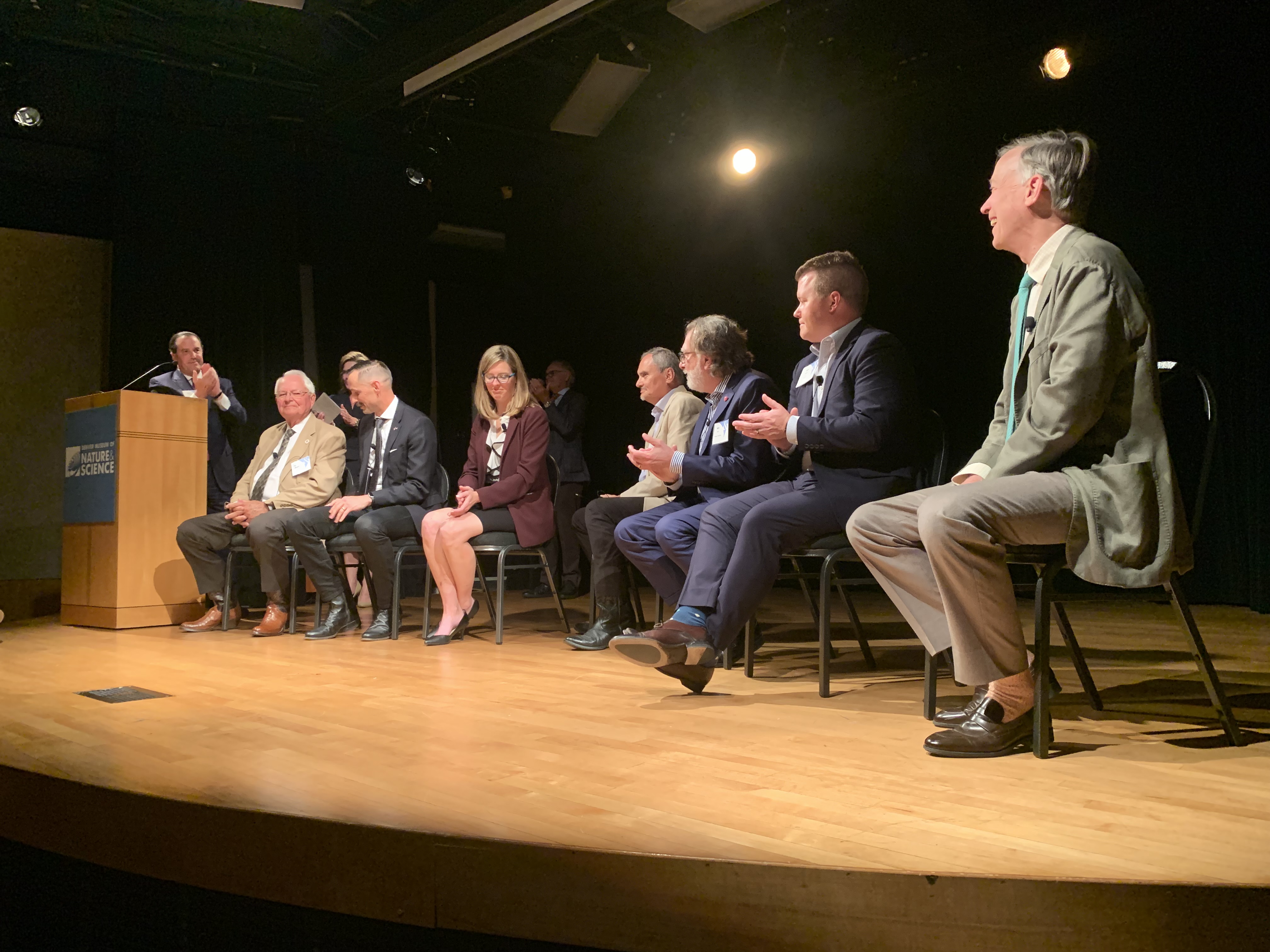
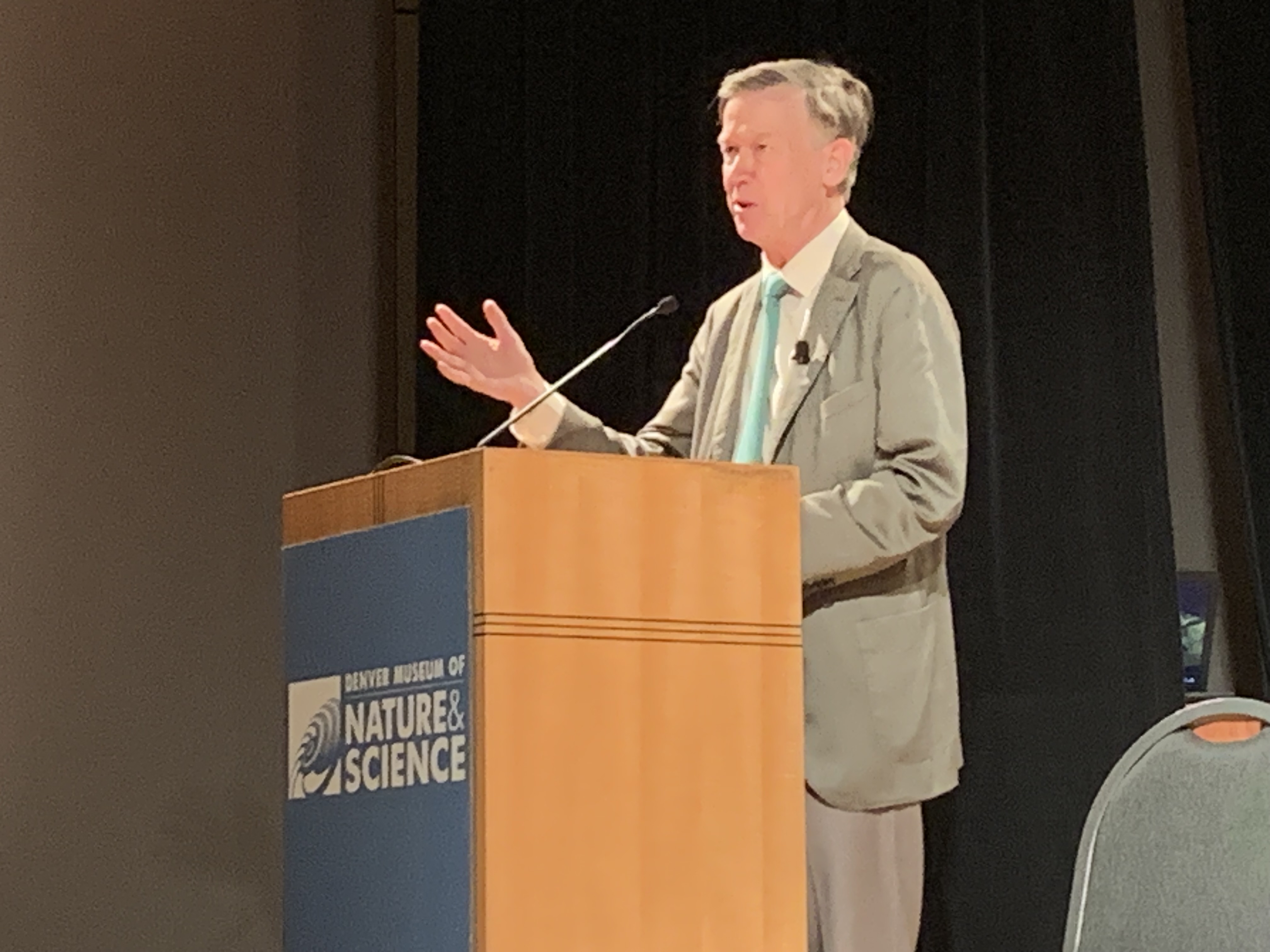
One effort, led by Colorado Concern and the Denver Metro Chamber of Commerce, began on Tuesday night in a forum at the Denver Museum of Nature & Science, where panelists, who included U.S. Sen. John Hickenlooper and Alan Salazar, the newly-appointed CEO of Denver Water, were asked how the business community can get involved.
About 100 business leaders attended the event.
J.J. Ament, CEO of the Denver Metro Chamber of Commerce, told Colorado Politics that the conversation starts with education.
What’s needed most, he said, is for business leaders to learn about water.
“Water is complicated,” he said, adding the knowledge gap on water is probably bigger than on any other issue in Colorado. “Water is essential, but our knowledge of water is pretty low.”
Business leaders need to make sure that water is part of every agenda until they can develop competencies and, eventually, solutions.
“We don’t even know the questions to ask,” he added.
In addition to Hickenlooper and Salazar, the panel included former Commissioner of Agriculture Don Ament; Sherman & Howard water lawyer James Eklund; Alice Jackson, senior vice president for system strategy and chief planning officer for Xcel Energy; Sam Bailey, manager of economic development policy for Amazon in Colorado; and, Will Sarni, CEO at Water Foundry, a water strategy consulting firm.
Could a company as small as 15 employees make a difference in Colorado’s water woes?
“Yes,” said Bailey, who previously worked in the Hickenlooper administration.
He said the water problem is a long term opportunity, albeit an expensive one. But a shift – from focusing on cost to opportunity – is an approach the business community can push, Bailey said.
He pointed to Amazon’s work on “water positivity,” which is to return more water than it consumes. In India, 212 operations are already water positive, he said, adding that can be scaled even with smaller companies.
What communities must do is figure out that right fit, one where employers respect the community’s long term plans around water, Bailey said.
Eklund outlined the challenges Colorado and the West face. Climate change has cut the amount of water the Colorado River can deliver by about half, from 20 million acre-feet 100 years ago to about 10 million acre-feet today, he said. An acre foot is the amount of water it would take to cover a football field by one foot.
Add to that municipal water needs and their junior water rights; senior water rights held by agriculture; urban interests for economic production versus rural needs; the environment, which is focused on the public good versus storage and development; and, the tensions between the upper basin states of the river – Colorado, Utah, New Mexico and Wyoming – and the lower basin states of California, Nevada and Arizona, which many say have overused their allotment over the years.
“This impasse means unless climate changes reverses, the draconian options will be impacts to health and human safety,” Eklund said.
In a world “dripping with uncertainty, if we act now, we can unlock voluntary, compensated and temporary water conservation,” he said. In previous interviews, Eklund said that can take the form of securing the cooperation of farmers to temporarily fallow land in exchange for financial compensation, which, he argued, would cut down water use but also ensure that farmers and ranchers won’t bear the burden unfairly.
On the other hand, failure means mandatory, uncompensated and permanent reductions, he said.
“It’s easy to cast blame,” he said.
As someone who comes from the Western Slope, the mantra is ‘”when in doubt, blame the Front Range,” he said. There’s also the blame coming from the upper basin states directed at the lower basin states. Or, he said, blame on Wall Street for investing in Colorado agriculture.
“Blame gets us nowhere,” Eklund said.
He suggested the the best way to defend water rights is through good offense – specifically, water conservation, which means partnering with agriculture on solutions that are voluntary, compensated and temporary.
It also means private sector innovation and it’s time for the Colorado business sector to lean on water, Eklund said.
Hickenlooper agreed that the old days of water aplenty are not coming back. Water is not a partisan issue, he added.
“It has the opportunity to be unifying,” which he said was proven with Colorado’s water plan back in 2015, when he was governor. That plan remains largely unfunded.
He also pointed to the federal government’s role. In recent years, that came in the form of two major pieces of legislation that are now providing billions of dollars to deal with the Colorado River crisis.
Ament, the former commissioner and state senator, said what troubles him most is that agriculture is a $40 billion annual business for Colorado. He’s “scared to death,” he said, about what’s going on with the Colorado River.
Resolving the crisis is critical for agriculture even on the Eastern Plains, where he farms and which gets water from the South Platte, including from the Colorado Big Thompson transmountain diversion that funnels water to the South Platte and on to Nebraska.
“As we’re moving forward with more demands, I’m really concerned about partnerships and who’s informing our partners about how we will handle all of this,” Ament said.
Water is a component of energy, added Jackson of Xcel Energy.
What’s needed is a smart business discussion about how water is used, and that’s a huge conversation at her company, he said.
“We have to provide energy in an economic and reasonable manner, and water is a component of that,” she said.
Companies, such as Xcel, are moving away from coal, which is water intensive, to solar and wind, which are not. But water will continue to be a part of that energy equation. She cited one study that says today, 22% of energy comes through the electrical system, and that by 2050, it could reach 76%.
Salazar, who took over Denver Water just this week, joked he was among those who discouraged Hickenlooper from the idea of a water plan.
“It’s a lesson for me,” he said.
He worries about the dysfunction of the political process, and not just from the Republican or Democratic perspective.
“We can avoid conflict,” Salazar said – by aiming for collaboration.
“My goal is to take public service ethic of collaboration,” he said.
Sarni, the CEO at Water Foundry, said he’s an optimist: “I believe we can solve the wicked problem of water.”
What’s broken, he added, is the status quo and the need to change it as soon as possible.
He said his work has largely been in the private sector, creating unusual partnerships. He noted the public sector has the size and scale to effect meaningful, lasting change, contrasted with the private sector, which has the ability to move quickly but doesn’t really have the resources to address big problems.
What’s missing, Sarni said, is entrepreneurs and investors.
“Let’s figure out how to harness” those stakeholders’ knowledge, experiences and resources, which, he said, would put Colorado in a position to be innovative with its water solutions.
The panelists agreed the conversation needs to continue.
“Show how we work with a community,” Bailey said. “We can have impact” in companies of 50 people.
Have the conversation, added Eklund.
“This is how we move forward with the business community,” he said.
“We are building the yellow brick road, one brick at a time,” said Xcel’s Jackson. She said it starts with education. Pick up a newspaper, research the issue, learn what’s going on in other states or even other countries, she said.
“We need an opportunity for collaboration,” coupled with a solution that doesn’t just come from any one sector, said Salazar. “You can have a role in helping. We’re in this boat together.”
Mark Williams of Sherman & Howard told Colorado Politics his firm plans to hold another similar program on the Western Slope within the year. The panel was sponsored by Sherman & Howard, the Denver Metro Chamber of Commerce, Colorado Concern and the Denver Museum of Nature & Science.
“We want to educate the business community throughout Colorado on how it can use its voice to support discussion and solutions on water management,” Williams said. “That’s why we want all Coloradans to be stewards” for water, to learn and to advocate for water management, both in Colorado and the Western U.S.
Business people have a duty to be at the table, he said.
“Great problems are solved when people take ownership for finding a solution,” said Mike Kopp, president of Colorado Concern.
Water is one of those issues that Kopp called “everyone’s problem and no one’s responsibility.”
“We’re looking for a way to transfer that responsibility to everyone who’s in any form of leadership,” he said, adding that applies to the private and public sectors.
It will take a series of sessions similar to Tuesday’s, with hopes that a central theme emerges with action plans to follow, he said, adding that discussion will succeed only if the majority of the business community is aligned on next steps.
Gov. Jared Polis welcomed the audience, telling them it’s important that the business community understands the challenges of Colorado’s water situation and how they can play a constructive role.
It will take innovation, the governor said, and thoughtful leaders who come together around water conservation.
“You being here is the first step,” he added.
The event was the brainchild of Celia Dietrich of Dietrich Partners, who worked with Sherman Howard and brought in the chamber and Colorado Concern.
marianne.goodland@coloradopolitics.com
marianne.goodland@coloradopolitics.com

It’s time to let unaffiliated voters caucus | Vince Bzdek
Vince Bzdek
vince.bzdek@gazette.com
Updated 6 hours ago
There’s no getting around it: Colorado’s 3,000 county caucuses, which just wrapped up recently, left half the electorate out in the cold. Since unaffiliated voters now make up 51% of all Colorado voters, a majority of Colorado electors are barred...
Governor warns energy development both a boon and a risk to Colorado | A LOOK BACK
Rachael Wright, Special to Colorado Politics
rachael.wright@coloradopolitics.com
Updated 3 days ago
Forty-Five Years Ago This Week: “The real opportunity and the dangers before us are both real,” said Gov. Dick Lamm in his January state of the state address before the Colorado General Assembly. Lamm argued that energy development would continue...
A Mile High, again: Capitol M | Week of March 21, 2026
Marianne Goodland
marianne.goodland@coloradopolitics.com
Updated 3 days ago
The lighter side of the Capitol, usually…. Local Journalism Day, except they forgot their very own local journalists. The state Senate on Thursday, March 19, passed a resolution recognizing Local Journalism Day. Everyone voted for it, which is good, because...

Colorado Politics Calendar Mar. 23-29
Rachael Wright, Special to Colorado Politics
rachael.wright@coloradopolitics.com
Updated 2 days ago
CoPo’s weekly political calendar will help you find political and public-policy events throughout Colorado. It includes candidate and issue campaign events, public policy meetings, court hearings, state and local party conventions, assemblies, debates, rallies, parades, speaking engagements, traveling dignitary appearances,...

The insular bubble of caucuses and assemblies | SONDERMANN
Eric Sondermann
eric-sondermann@coloradopolitics.com
Updated 2 days ago
Nearly 30 years ago, then-Federal Reserve Chairman Alan Greenspan coined the term “irrational exuberance” to describe the overheated stock market. That descriptive phrase could also apply to much of the political realm. The hype in politics often grossly exceeds the...

Lauren Boebert’s hard ‘no’ on Pentagon Iran funding request puts Mike Johnson in tough spot
Emily Hallas, Washington Examiner
emily.hallas.washington.examiner@gazetteedit.wpenginepowered.com
Updated 1 day ago
Colorado U.S. Rep. Lauren Boebert announced on Thursday that she will not support further funding for the United States’s war in Iran, marking an uphill battle for the Trump administration’s effort to secure additional financing from Congress. “I’ve already told...
Rubio gains ground in 2028 jockeying as Iran war elevates his profile
Samantha-Jo Roth, Washington Examiner
samantha-jo.roth.washington.examiner@gazetteedit.wpenginepowered.com
Updated 1 day ago
Secretary of State Marco Rubio’s high-profile role in the Trump administration’s response to the Iran war is boosting his standing in the early jockeying for the 2028 Republican presidential nomination — and positioning him as a possible rival to Vice...

Federal judge dismisses claims against medical contractor for Eagle County jail suicide
Michael Karlik
michael.karlik@coloradopolitics.com
Updated 1 day ago
A federal judge dismissed the claims against a medical contractor for the Eagle County jail and its employees earlier this month, concluding there were insufficient allegations that they violated the constitutional rights of a man who died by suicide in...

Colorado Senate committee advances bill increasing overtime threshold for farmworkers
Marianne Goodland
marianne.goodland@coloradopolitics.com
Updated 24 hours ago
The struggle to balance farmworker protections with the survival of Colorado’s family farms took center stage Thursday as senators debated two competing overtime bills. The Senate Business, Labor and Technology Committee held a rare double-bill hearing that led to a...

Colorado bill to fund mental health by raising alcohol taxes defeated in House committee
Marissa Ventrelli
marissa.ventrelli@coloradopolitics.com
Updated 2 hours ago
Colorado legislators on Wednesday narrowly rejected a second measure that would raised taxes on alcohol products in order to fund mental health care treatment in the state. Proponents said the new revenue is necessary to help pay for mental health...
PREV
PREVIOUS

Denver breaks record for underpaid worker reimbursement
Denver Labor collected $1,479,453 in restitution as of the end of July, surpassing the highest dollar amount recovered for unpaid workers within a year. “Every dollar matters to the people who earned that money, and no case is too small for us to investigate,” Denver Auditor Timothy M. O’Brien said in a press release. For reference, […]

Denver judge denies state motion to dismiss lawsuit over $5.4 billion transportation fees
A Denver District Court judge Wednesday dismissed a state motion to toss a lawsuit filed against a 2021 law setting up a series of transportation fees. The lawsuit was filed in April 2022 by Advance Colorado Institute, two individual plaintiffs and Americans for Prosperity. It challenged the General Assembly’s passage of Senate Bill 21-260, which established […]