

Colorado Supreme Court takes up 3 criminal appeals, ‘Indian child’ case
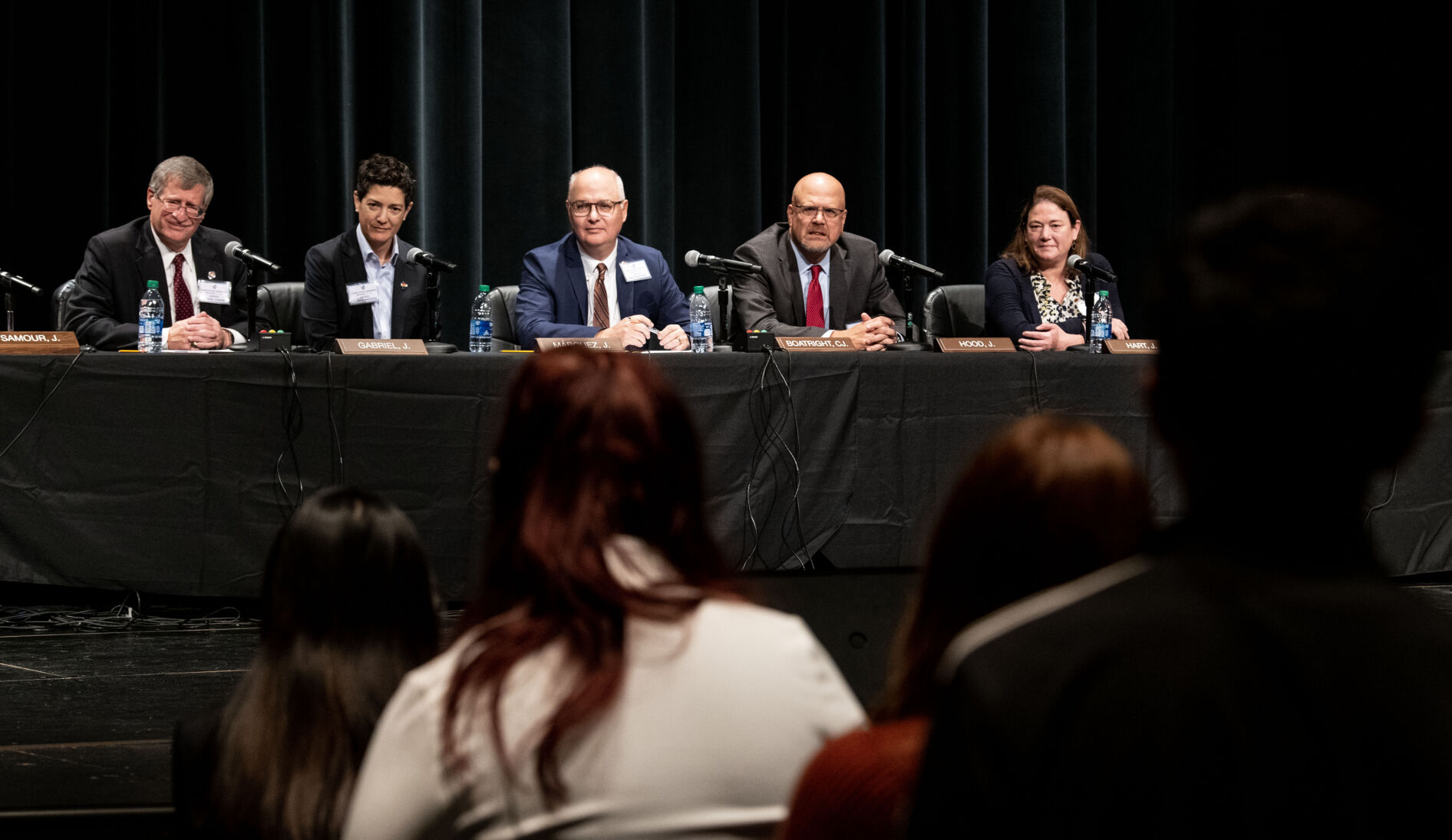
The Colorado Supreme Court announced on Monday it will hear three criminal appeals and one case exploring the government’s obligation to determine whether children in welfare proceedings qualify for the longstanding protections granted to American Indians.
At least three of the court’s seven members must consent to take up a case on appeal.
The criminal cases address different facets of the law, including what happens when a juror needs to be replaced mid-deliberations, the evidence required to convict someone for an attempted child sex crime, and whether trespassing is a lesser offense of burglary. In some of the cases, the Supreme Court will examine its own precedent and decide which of its past holdings still apply.
Due diligence, take two
In March, the Supreme Court was set to hear an appeal implicating the federal Indian Child Welfare Act of 1978 (ICWA). Congress enacted the law after learning American Indian children were being taken from their homes at high rates and placed with non-tribal institutions or families. The law, along with its accompanying regulations and state-level requirements, now provides protections for tribal nations in welfare cases involving an “Indian child.”
The justices were prepared to hold oral arguments in a case out of Denver that questioned what county agencies must do to ascertain whether a child is American Indian – meaning they belong to a tribe or they are eligible for membership as the offspring of a tribal member. But days before the arguments, the Supreme Court dismissed the case as moot after learning the parties had resolved the issue in the juvenile court.
Now, the justices will have a second shot at the issue.
In Adams County, a mother in a child neglect case claimed she had tribal heritage, but there were no further details and the juvenile court judge decided ICWA did not apply.
A three-judge panel for the Court of Appeals determined that, even though the judge had no “reason to know” the child was American Indian, the county still needed to perform “due diligence” in investigating the mother’s claim. The panel directed that the county should identify other people or organizations that might have information about the child’s tribal lineage and talk with them.
Since the panel’s decision in March 2022, Adams County reported that it attempted to talk with the mother and the child’s grandmother, but found no further reason to know the child is American Indian. Satisfied, the appellate panel agreed in August that ICWA did not apply.
On appeal to the Supreme Court, the justices will now consider an issue left unresolved with the dismissal of the prior case: If a parent believes they might belong to a specific tribal nation, does “due diligence” require counties to contact those tribes to verify whether the child is American Indian?
Proponents of the approach argue that because tribes alone decide the criteria for citizenship, they will always provide an accurate answer. Critics counter that tribal contact amounts to “wasting” resources when children are clearly ineligible for ICWA’s protections.
The case is People in the Interest of A-J.A.B.

The roadside conversation
Jurors at James Clayton Johnson’s trial heard that:
? A man driving Johnson’s truck, who may not have been Johnson himself, pulled beside a 10-year-old girl in a Lakewood neighborhood
? The man said the girl was “the perfect age for a boyfriend”
? He asked whether she had “ever touched it” and he was “just curious”
From that brief interaction, Jefferson County prosecutors charged Johnson with enticing a child, which occurs when someone attempts to persuade a child to enter a vehicle “with the intent to commit sexual assault.” The jury convicted him.
On appeal, assuming Johnson was the man in the truck, a Court of Appeals panel found the evidence was nonetheless insufficient to convict him. Specifically, the government did not prove beyond a reasonable doubt that Johnson attempted to invite the girl into the truck or intended to assault her.
“Although Johnson’s statements to (the girl) were highly inappropriate, making inappropriate statements to a child or asking an underaged stranger personal questions, without more, does not satisfy the ‘attempted to invite or persuade to enter a vehicle’ element,” wrote Judge Lino S. Lipinsky de Orlov.
The Colorado Attorney General’s Office appealed, arguing Johnson “would have been able to extend the invitation” had the alleged victim not walked away. Therefore, Johnson had taken a “substantial step” toward enticing her.
The Supreme Court will review the Court of Appeals’ reasoning and conclusion.
The case is People v. Johnson.
Juror down
After deliberating for more than 10 hours and breaking for the weekend, one of Ricardo Castro’s jurors had a heart attack. Denver District Court Judge Morris B. Hoffman learned the man would not be able to continue serving on the jury.
The following Monday, Hoffman addressed the remaining 11 jurors. Before sending them to deliberate, he had selected an alternate juror and told her not to discuss the case with anyone and to keep her mind open, just in case.
Would it be feasible, Hoffman asked the other jurors, to bring back the alternate and restart the deliberations with her?
“If you don’t think you can do it, just let me know,” he added.
Half an hour later, Hoffman received a note from the jury. Of the two child sex offenses Castro was charged with, the jurors had reached a unanimous verdict on Friday for one of them. They were close to unanimity on the second.
“If the question is whether we can approach new deliberations w/ an open mind, because the alternate will be bringing new perspective, yes, we believe it’s feasible. If the question is whether we can enter new deliberations in the same state of mind,“ read the note, “no, we can’t undo all the conversations/learning from prior deliberations.”
Hoffman summoned the alternate juror and explained to everyone that the jury would need to start completely anew. He asked each juror individually if they were able to do that. Yes, they all said. Five-and-a-half hours later, they returned a guilty verdict.
Castro appealed his convictions, but the Court of Appeals believed Hoffman had “painstakingly” ensured the juror substitution still resulted in a fair trial.
“The court took all appropriate precautions with respect to the alternate juror,” wrote Judge Matthew D. Grove for the appellate panel.
Castro then turned to the Supreme Court. It was unclear legally, he argued, if the Court of Appeals should have evaluated whether the substitution prejudiced the defense, or whether it was “harmless beyond a reasonable doubt.”
“This Court will have to decide whether the trial court’s precautions protected Mr. Castro’s constitutional right to a fair trial beyond a reasonable doubt,” wrote public defender Meredith K. Rose. “Because substituting a juror after 11 hours of deliberation cannot be harmless beyond a reasonable doubt when the reconstituted jury deliberated for only five-and-a-half hours, Mr. Castro’s rights were violated.”
The case is Castro v. People.

When burglary and trespassing combine
In 1997, the Colorado Supreme Court ruled in People v. Garcia that first-degree trespassing is not a lesser form of second-degree burglary. More than 20 years later, Taunia Marie Whiteaker challenged whether that remains true.
An Adams County jury convicted Whiteaker of first-degree trespassing and second-degree burglary, but she believed the two convictions should merge together. She argued that trespassing is a lesser offense of burglary, in that both crimes entail unlawfully entering and remaining in a dwelling.
Merging two convictions stems from the concept that a person should not be punished twice for the same conduct. If one criminal offense is included in another, the convictions merge.
Last July, the Court of Appeals decided Whiteaker’s convictions need not merge. The majority felt obligated to follow the Supreme Court’s decision in Garcia.
Judge W. Eric Kuhn wrote separately to say he believed the Supreme Court, in the years since Garcia, had subtly changed course.
“I agree with the majority that Garcia has never been explicitly overruled,” Kuhn acknowledged. But stringing together pieces of more recent decisions, he believed the Supreme Court has enabled judges to now find that trespass is a lesser offense of burglary after all.
On appeal, Whiteaker pointed out the importance of getting a definitive answer about the relationship between the two offenses.
In 2021, “almost 4,000 new district court cases included burglary charges, accounting for 9% of all felony filings in the state,” wrote public defender Leah Scaduto. “Over 2,000 new district court cases included trespass charges, accounting for 5% of all felony filings in the state.”
The Supreme Court will decide whether its conclusion in Garcia remains intact.
The case is Whiteaker v. People.


10th Circuit provides guidance on police searches of cloud-based data
Michael Karlik
michael.karlik@coloradopolitics.com
Updated 3 hours ago
The Denver-based federal appeals court provided guidance to law enforcement agencies on Monday for ensuring that searches of cloud-based accounts comply with the Fourth Amendment’s requirements. A three-judge panel of the U.S. Court of Appeals for the 10th Circuit noted...
Federal judge releases man after 2 immigration judges disobey order
Michael Karlik
michael.karlik@coloradopolitics.com
Updated 7 hours ago
A federal judge released a man from immigration detention on Thursday after two different immigration judges disobeyed his order in the same case. “At this point, the Court has granted Respondents two bites at the apple to prove detention of...

New rules for private judges in Colorado include discipline oversight, campaign contributions
David Migoya
david.migoya@gazette.com
Updated 1 day ago
The Colorado Supreme Court recently determined the state’s private judges — retired jurists appointed to oversee civil cases that rarely get public scrutiny — can now make political contributions freely and without reserve, overruling a prohibition that had been in...
Appeals court finds Prowers County judge incorrectly analyzed firetruck collision lawsuit
Michael Karlik
michael.karlik@coloradopolitics.com
Updated 1 day ago
Colorado’s second-highest court directed a Prowers County judge last month to take a second look at whether a firetruck operator and the county itself can be held liable for a collision with a motorist. Donald Williamson was driving through a...
Appeals court reverses assault convictions after jury received no definition of ‘harm’
Michael Karlik
michael.karlik@coloradopolitics.com
Updated 1 day ago
Colorado’s second-highest court reversed an Arapahoe County defendant’s assault convictions last week, concluding the trial judge neglected to define a key, ambiguous term for jurors. Police officers arrested David Cristobal Aragon at a house party for allegedly violating a restraining...
Colorado counties cannot challenge state law restricting immigration contracts, appeals court says
Michael Karlik
michael.karlik@coloradopolitics.com
Updated 1 day ago
Colorado’s second-highest court ruled on Thursday that counties lack standing to challenge a 2023 state law that restricts their ability to contract with the federal government or private entities for immigration detention. A three-judge Court of Appeals panel agreed with...

Colorado lawmakers propose changes to family court procedures | Bills in Brief
Marissa Ventrelli
marissa.ventrelli@coloradopolitics.com
Updated 2 days ago
Colorado lawmakers introduce hundreds of bills each year. Bills in brief cuts through the noise by explaining which proposals matter, what’s at stake, and how decisions at the Capitol could affect everyday life across the state. Colorado lawmakers from both parties are...
Federal judge partially allows second World Cup trafficking lawsuit to move forward
Michael Karlik
michael.karlik@coloradopolitics.com
Updated 2 days ago
A federal judge allowed some claims to move forward last month against companies operating out of Colorado that allegedly participated in a human trafficking venture involving Filipino laborers who constructed facilities for the 2022 World Cup in Qatar. There are...
Federal judge dismisses lawsuit seeking to force Colorado secretary of state to screen out scam filings
Michael Karlik
michael.karlik@coloradopolitics.com
Updated 2 days ago
A federal judge dismissed a lawsuit last week that sought to require Colorado’s secretary of state to verify corporate filings in the state’s database to reduce the risk of future fraud. Bernard Butts of Florida, who was 83 when he...

Federal judge finds no constitutional violation by Huerfano County well inspectors
Michael Karlik
michael.karlik@coloradopolitics.com
Updated 2 days ago
A federal judge concluded last month that two Huerfano County employees did not engage in an unconstitutional search when they approached the plaintiffs’ camper within 40 feet to investigate a potential code violation. In July 2021, the county’s building inspector,...
PREV
PREVIOUS

Metro Denver apartment rents and vacancies flat in first quarter
One word describes the first quarter “Vacancy & Rent Report” by the Apartment Association of Metro Denver, “flat.” As in, rents stayed basically flat from the last quarter of 2022 – rising only 0.5 percent to an $1,846 average for all unit types. Vacancies likewise remained flat, staying the exact same 5.6% level from the prior […]

Denver-based innovation school zone weighs next steps after DPS revocation
The irony isn’t lost on Eliot Lewis, president of the Beacon Zone Board. In a split vote last week, the Denver Public Schools Board of Education voted to revoke the innovation status of the zone, setting up what could be a test of a new state law designed to give recourse when disagreements arise with […]