

A bill to bust through state CMAS program’s wall | NOONAN
This week is the post-colored-egg-hunt time of year when the weather gets nice and Colorado’s public school children stay indoors in their classrooms for up to 7 hours and 45 minutes each for third and fourth graders to 12 hours and 45 minutes for eighth graders to endure the state-required but possible-to-opt-out-of CMAS tests. The Colorado Measures of Academic Success are mostly used to demonstrate lack of success, but that’s the name of the game for many organizations that want to dismantle our public schools.
The test-taking hours don’t reflect the full diversion from schooling in the CMAS program. School districts spend hours setting up the technology and preparing the children to do their best. The cost of the testing comes close to $100 million for the Colorado Department of Education and school districts when counting for inflation based on the 2014 report that attempted to total the bill. That number doesn’t count lost teaching and learning time.
Stay up to speed: Sign-up for daily opinion in your inbox Monday-Friday
That money also doesn’t cover the dollars funneled to the private sector for test prep. The Colorado Department of Education offers some test samples on its website. A third-grade reading piece, for example, refers to rococo toads in Argentina. A seventh-grade math example asks students to “find the expression that matches -3/5(7?31/3).” Third- and fourth-grade English language learners can take the tests in Spanish, but fifth graders and above are stuck with English-only.
Imagine being a non-fluent English speaker in seventh grade facing this passage from a sample CMAS test: “To produce healthy nuts, pistachio trees need nitrogen, so we add it to the soil with organic fertilizers. We add a ground-up fish solution to the sprinkling system, and we mix shovels full of composted chicken feathers or manure into the soil.” Now also imagine being a low-income English-speaking kid trying to answer questions on the passage. It would be helpful to have some experience with pistachio nuts, at least the ice cream version. In other words, there may be some socio-economic bias to the sample.
For non-low-income kids and their parents, there are plenty of resources to help children do well on the CMAS tests. Parents can purchase the Colorado Ultimate Practice Test book for $22.95. A third-grade CMAS assessment practice book goes for $24.86 through Abe Books.
There are a series of test-prep resources provided by TeachersPayTeachers.com. IXL.com, or I Excel, offers a variety of CMAS tests by subject and grade level. Lumos Learning offers the same. Then there’s Wyzant.com that provides tutors. One link at Wyzant ran the numbers from$75-per-hour on the low end to $115-per-hour on the high end.
Pearson, the United Kingdom-based company that creates the CMAS, offers its array of tools for students, at a price. For $9.99-per-month or $14.99/month, whatever your budget can afford, it’s possible to learn and study at one place in a re-imagined learning program.
No wonder a recent survey by the Colorado Parent Teachers Association found almost universal rejection of the CMAS system. With nearly 1,200 respondents, most of whom are parents or community members in the 35-to-54 age group, more than 80% voted “no” to the statement: “do you think annual standardized tests are an accurate measure of student learning?” More than 85% voted “no” to: “do you think spending $30 million annually (CDE’s estimated costs) on Colorado’s standardized tests is a good investment for improving public schools?” Almost 80 percent voted “no” to: “do you think test scores of English language learners and students with significant cognitive disabilities should be included in the evaluation of schools and school districts?”
Students and parents can opt out of these tests. Almost 70 percent of PTA respondents voted “yes” to exercising the right to opt out of CMAS.
It’s no surprise test results over the years haven’t been excellent for a large number of children, especially the almost 40% of Colorado’s students eligible for free or reduced lunch, generally without pistachio nuts as a side.
Despite the massive advantage to the 60% of students not eligible for free or reduced lunch, the state’s “education reform” gurus, including conservative organizations like Ready Colorado and Democrats for Education Reform and their well-paid cohorts, insist this annual rite of non-passage is critical to improving our kids’ education, especially for low-income students. It’s no matter that improvements have been spotty at best and often offset by losses, in the same year.
HB23-1239 on Local Innovation for Education Assessments, a bill to encourage some adaptability in the face of the brick wall of the state’s CMAS program, was set for a House Education hearing this week. It’s postponed to April 20. That gives the bill about three weeks to get through the chambers to Gov. Jared Polis’s desk. The testing season will be done, but results won’t be available to parents until the 2024 school year when their kids have moved to the next grade. Who came up with this mess, anyway? Does the guy running for mayor of Denver have something to do with it?
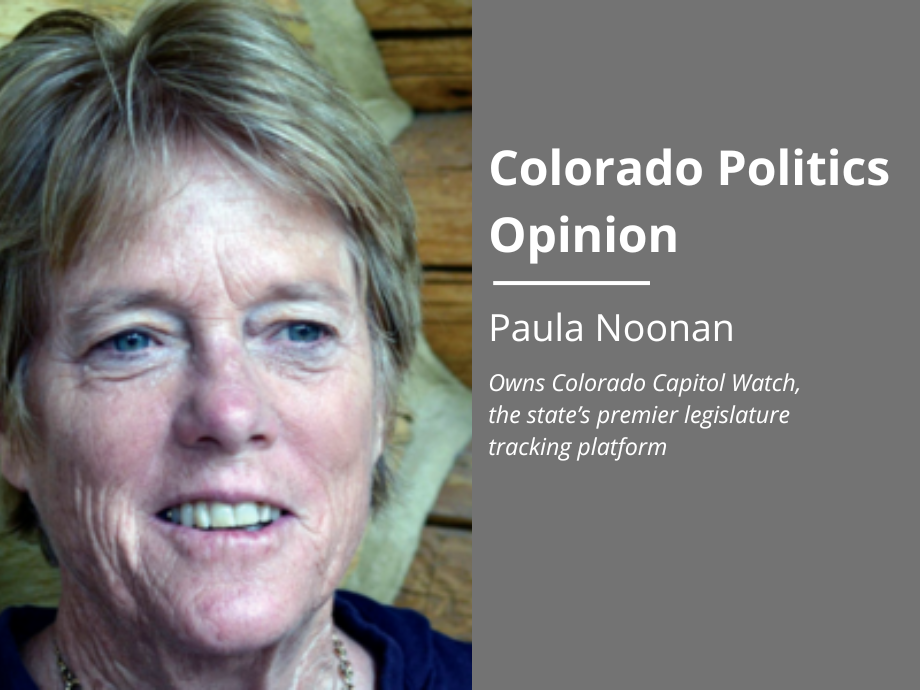
Paula Noonan owns Colorado Capitol Watch, the state’s premier legislature tracking platform.


Rounding up a year that mostly won’t be missed | BIDLACK
Hal Bidlack
hal-bidlack@coloradopolitics.com
Updated 11 hours ago
As I sat down to write this, my last column of 2025, I reflected back on a year that was, well, interesting from an old political science professor’s perspective, but which contained a lot of pain for a lot of...
Colorado Republicans at a crossroads on election integrity | OPINION
Colorado Politics
colorado-politics@coloradopolitics.com
Updated 11 hours ago
By Matt Crane For more than two decades, I have worked to make Colorado’s elections accurate, secure and transparent. As Arapahoe County Clerk, I strengthened audits, pushed for transparency, and advocated common-sense safeguards like photo identification. Later, as an election...

Colorado’s next governor should make kids in foster care a priority | OPINION
Colorado Politics
colorado-politics@coloradopolitics.com
Updated 11 hours ago
By Shari F. Shink The next governor of Colorado has the chance to improve the lives of thousands of children in foster care and we’re not talking about new legislation. It’s a matter of making these invisible kids a priority...

Colorado’s unaffiliated vote is up for grabs in 2026 | Dick Wadhams
Dick Wadhams
dick-wadhams@coloradopolitics.com
Updated 24 hours ago
Leaders of both parties often dismiss the stunning increase in “unaffiliated” voters as just a result of automatic registration when getting a driver license or some other government process. It must make them feel better about the plummeting number of...

The men and women of meatpacking on my mind | Rachel Gabel
Rachel Gabel
rachel-gabel@coloradopolitics.com
Updated 2 days ago
The meatpacking industry employees and their families are on my mind as the closure of the Lexington, Nebraska, Tyson plant nears its closure date in January. More than 3,200 employees will lose their jobs, realistically affecting half of the 11,000...

Thinking through what may be on tap in 2026 | HUDSON
Miller Hudson
miller-hudson@coloradopolitics.com
Updated 2 days ago
When the three-million-year-old bones of Lucy were unearthed in an Ethiopian valley in 1974, paleoanthropologists anointed her as the Eve to all of us. Though her skull was not big enough to accommodate our larger, homo sapiens’ brain, she was...

Democracy is under attack, right here in Colorado | Jon Caldara
Jon Caldara
jon-caldara@coloradopolitics.com
Updated 2 days ago
Remember during COVID, when the people screaming the loudest for government-mandated jabs were the very same people chanting “my body, my choice” when it came to abortion — I mean, “women’s health care”? They’re also the folks who insist a...
8 exemplars to guide us into the new year | SONDERMANN
Eric Sondermann
eric-sondermann@coloradopolitics.com
Updated 6 days ago
It started as a one-off in my first year of writing this regular column. To ring in the new year back in the eventful year of 2020, I offered a shoutout to eight Coloradans who served as models of how...

‘The canary in the democracy mine is local journalism’ | Vince Bzdek
Vince Bzdek
vince.bzdek@gazette.com
Updated 3 days ago
Colorado could do a lot more to save newspapers – and democracy – in rural areas By Vince Bzdek As another new year and another legislative session dawn for Colorado, it’s a good time to ask what the absolute most...
Put a moratorium on plastic pipes to protect our firefighters | OPINION
Colorado Politics
colorado-politics@coloradopolitics.com
Updated 5 days ago
By Stephen Clapham It may shock people to learn that cancer is the most dangerous threat to firefighter health and safety. In fact, cancer is the leading cause of fire fighter line-of-duty deaths. The risk from cancer can in large...
PREV
PREVIOUS

Delivery bill dangerous, misguided | OPINION
Max Rettig The Colorado General Assembly is considering a bill that would fundamentally change how platforms like DoorDash operate in Colorado – hurting workers, posing potential safety risks and costing Colorado taxpayers millions. According to its sponsors, Senate Bill 98 is about transparency and fairness. But this legislation flips those concepts on their head. At […]

DA’s pledge to 'get Trump' isn’t justice | BRAUCHLER
George Brauchler The problems with the Manhattan case against Donald Trump pre-date the grand jury’s indictment. They are unfixable. District Attorney Alvin Bragg created them and continues to perpetuate them. Aside from substantive issues related to Bragg’s origami-ing the law to make a felony or the statute of limitations, Bragg’s personal conduct in this case […]