

Colorado’s quality versus bad Brazilian beef | GABEL
There are three main groups that represent cattle producers across the country. Without getting too far into the weeds, the National Cattlemen’s Beef Association (NCBA) is the well-funded, well represented power player. R-CALF USA is a much smaller, grassroots group of fiercely independent ranchers who leverage litigation to attempt to move the needle. And the United States Cattlemen’s Association (USCA) is somewhere in the middle, with a strong lobbying presence and a belief in country of origin labeling for beef, a preference shared with R-CALF.
The three groups don’t agree on every aspect of the industry, but last week they proved, once again, their shared commitment to animal health, food safety and transparency.
U.S. Senators Mike Rounds (R-South Dakota) and Jon Tester (D-Montana) reintroduced legislation to suspend Brazilian beef imports to the U.S. until experts can conduct a robust review of the commodity’s impact on food safety and animal health.
U.S. consumers enjoy the safest, most affordable and most abundant food supply in the world, and it’s certainly true due in part to the rigorous food safety inspection process in this country. Consumers are also the beneficiaries of the serious commitment livestock producers and other professionals make to animal health and proper livestock handling.
Sens. Rounds and Tester initially introduced the bill in 2021 after Brazil revealed two cases of Bovine Spongiform Encephalopathy, more commonly known as “Mad Cow Disease.” According to releases from the USDA, the cases were discovered in June and not reported until November. Conversely, the United Kingdom and Germany both reported cases to the World Organization of Animal Health within days of occurrence that same year.
Brazil’s refusal to report cases for months or years continued with cases in 2012, 2014 and 2019. Though the limited number of cases themselves may not indicate health issues in the Brazilian cowherd, the pattern of delayed reporting hints at a lackadaisical or disorganized food safety and animal health reporting system. This becomes even more concerning knowing the protocols, testing and difficult decisions U.S. experts and producers are making to keep Highly Pathogenic Avian Influenza and African Swine Fever tamped down. In Colorado, about 80% of the state’s laying hens were destroyed to combat HPAI. Multiple reports of pork products seized at our borders that have tested positive for ASF have kept our nation’s hog herd making bacon safely.
Tester and Rounds’ bill would impose a moratorium on Brazilian beef imports until a recommendation has been made by a group of food safety, animal health and trade experts to allow the trade gates to open again.
All three major cattle trade organizations weighed in on the bill, pointing out several countries have already banned Brazilian beef imports; calling for all trade partners to be held accountable without exception; and aligning national security and food security to ensure all beef in the supply chain is safe.
And then, hours later, Brazil confirmed for the third time since 2021 an atypical BSE case has surfaced. In the releases I’ve read, it’s unclear when the case was confirmed.
Brazil not only has a huge slice of meat processing here in the U.S. – and Colorado, for that matter – they also run the world’s second-largest cattle herd at 232 million head and are the world’s largest exporter of beef with about 20% of total global beef exports, according to the USDA’s Economic Research Service.
China has historically been the largest importer of Brazilian beef, even with a since lifted, three-month embargo driven by BSE concerns, along with Hong Kong, South Africa, Iran and Iraq, among others. Brazil is also the largest producer of halal meat, which opens tremendous demand in heavily populated Muslim markets where incomes are climbing and with it, demand for beef.
In the U.S., foreign beef comprises about 10-20% of total supplies. According again to the USDA’s ERS, imported beef is more obvious to track, while beef on the hoof coming into the country is more difficult. Only some buyers and feeders have a business plan that allows them to feed imported cattle because, as a general rule, they are older and less efficient, require more days on feed and quality grade lower. That said, a cattle feeder once told me only the healthiest of cattle make it as far as a U.S. feedyard before natural selection sorts the herd. Most imports of livestock come from Canada and Mexico, though the two nation’s beef herds are different in many ways.
Our country’s cowherd is incredibly efficient, productive, healthy and well managed, and the need to import beef can be a sticking point for many producers. However, just as there are well-bred, well-fed cattle that are genetically superior and hang an impressive carcass, there is also a demand for drive-thru ground beef tacos. There is room for different kinds of beef, but no tolerance for bad players when it comes to food safety and animal health.
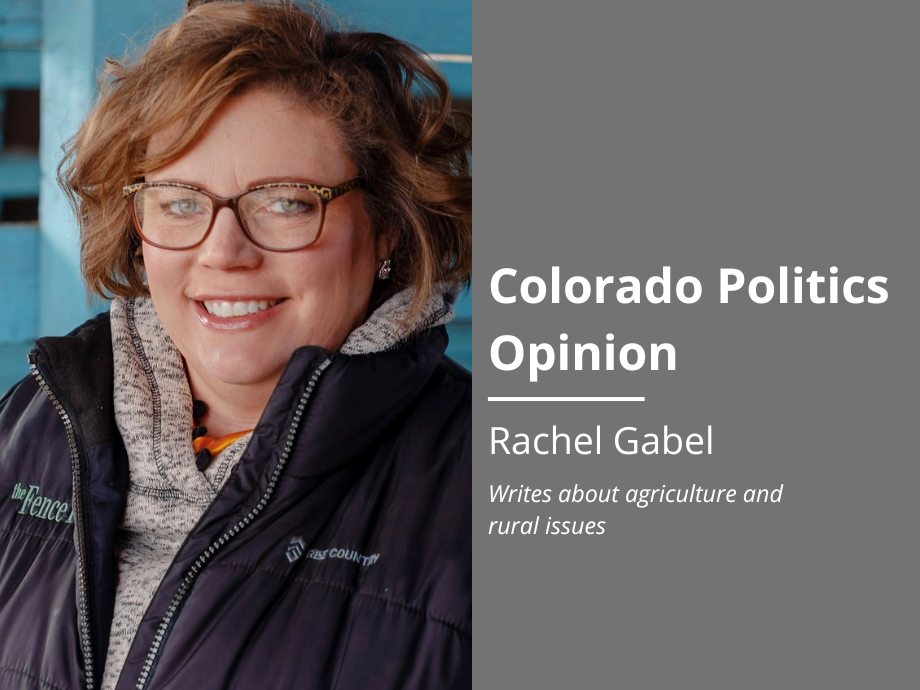
Rachel Gabel writes about agriculture and rural issues. She is assistant editor of The Fence Post Magazine, the region’s preeminent agriculture publication. Gabel is a daughter of the state’s oil and gas industry and a member of one of the state’s 12,000 cattle-raising families, and she has authored children’s books used in hundreds of classrooms to teach students about agriculture.


Irrelevant Hickenlooper draws a challenger | WADHAMS
Dick Wadhams
dick-wadhams@coloradopolitics.com
Updated 1 day ago
State Sen. Julie Gonzales should be ashamed of herself. Doesn’t Gonzales understand that U.S. Sen. John Hickenlooper is entitled to the Democratic nomination for Senate? Doesn’t Gonzales know that, just like in 2020, Hickenlooper “needs his sleep” and cannot be...
Conservation, ranching and the land always win | GABEL
Rachel Gabel
rachel-gabel@coloradopolitics.com
Updated 1 day ago
Sue Anschutz Rodgers sat in her downtown Denver office, far from her beloved Crystal River Ranch, but surrounded by photos of the ranch and a wall of plaques, photos and newspaper clippings evidencing her long support of young people in...

An early candidate for 2026’s word of the year: ‘affordability’ | HUDSON
Miller Hudson
miller-hudson@coloradopolitics.com
Updated 1 day ago
The Oxford Press linked to the famous British University and publisher of the world’s best known English Dictionary has selected its favorite new word for 2025: “rage bait.” It means exactly what you might guess, even if, like me, you...

Suddenly, Colorado has a private school choice program │ Vince Bzdek
Vince Bzdek
vince.bzdek@gazette.com
Updated 2 days ago
By Vince Bzdek When I was a kid going to St. John’s Catholic grade school in Denver, I remember asking my mom if she and dad minded paying taxes for public schools since all her kids attended Catholic ones. We...

Julie Gonzales’s long but not impossible odds | SONDERMANN
Eric Sondermann
eric-sondermann@coloradopolitics.com
Updated 11 hours ago
Allow me to start with a flashback. It was Thanksgiving 2024, just over 12 months back. For the first time, our son Clarke hosted the family Thanksgiving near New York City. It is a sign of our aging when the...

Dougco shoplifting ordinance victimizes victims | CALDARA
Jon Caldara
jon-caldara@coloradopolitics.com
Updated 1 day ago
Law enforcement must be respected. It also needs to be liked. And, above all, it must be trusted. Citizens should feel welcome to engage with police — not coerced. That balance is what makes American law enforcement different. Douglas County...

Rethinking Medicare after COVID-era Obamacare subsidies | SLOAN
Kelly Sloan
kelly-sloan@coloradopolitics.com
Updated 4 days ago
Congress is getting all twisted up over health care policy again, and every time they do so it is generally a polemical skirmish regarding one of two things: A) how to deal with whatever problem the government created in health...
Underlying design failures built into Colorado’s standardized tests | NOONAN
Paula Noonan
paula-noonan@coloradopolitics.com
Updated 5 days ago
Third graders can’t read. That’s a common assertion. How do we know? Colorado’s CMAS standardized tests for third graders tell us. What the chicken littles who bemoan these tests scores, mostly individuals on the “pro school choice” and “voucher” side...

What the Minnesota fraud case teaches Colorado about grant oversight | PODIUM
Colorado Politics
colorado-politics@coloradopolitics.com
Updated 6 days ago
By Erik Clarke State and local governments across the country rely heavily on nonprofit partners to deliver social-service programs. When these partnerships work well, they expand reach and improve outcomes for vulnerable communities. When oversight is weak, the consequences can...
What are we doing in the Caribbean exactly? | SLOAN
Kelly Sloan
kelly-sloan@coloradopolitics.com
Updated 6 days ago
There is, perhaps oddly, a chance the Trump administration is acting with a degree of geopolitical and strategic prudence regarding the endeavors directed toward Venezuela, but you would not know it from the administration itself. There are several dimensions to...
PREV
PREVIOUS

The most important Colorado health progress to make | OPINION
Hannah Sellnow My first experience managing the effects of poor air quality on health was as a physician assistant student while I was training at a pediatrics clinic in Aurora during wildfire season. The number of children we treated and hospitalized for asthma flares was startling. Over the nearly 10 years since, I’ve treated many […]

Denver doesn't deserve East Palestine-like disaster | HUDSON
Miller Hudson Although no one has died yet following the Norfolk-Southern train wreck in East Palestine, Ohio, the derailment of several tanker cars transporting vinyl chloride has dominated the news cycle the past few weeks. Network anchors love the spectacular and compelling visuals captured by drones following a decision to burn-off this flammable liquid which […]