

Denver approves ‘wage theft’ protection bill

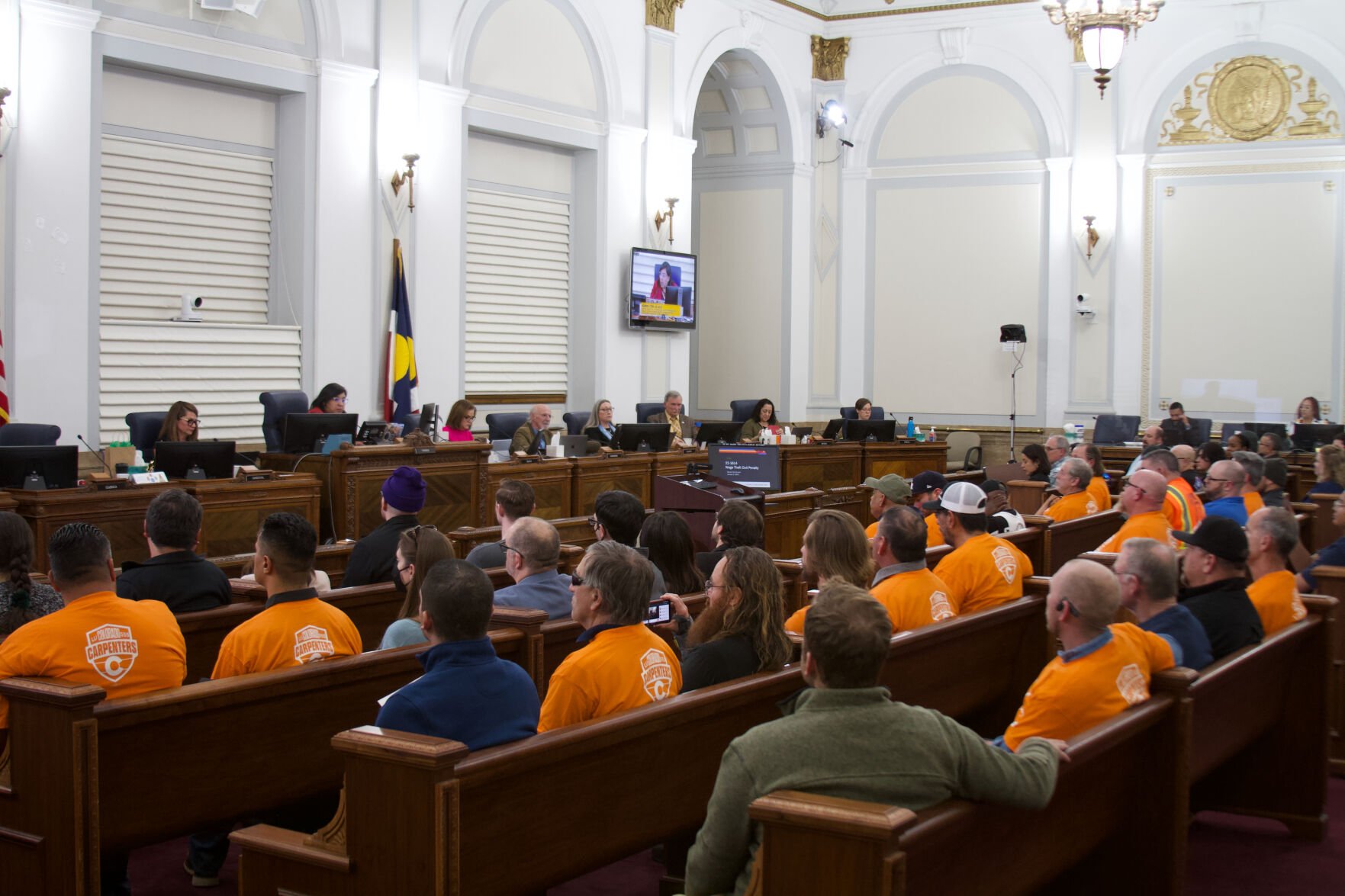
Orange flooded the Denver City Council chambers Monday during a public hearing on a “wage theft” protection bill.
The orange did not belong to fans of Denver Broncos, Clemson Tigers or Tennessee Volunteers, but to Carpenters Local 555 – a labor union in Denver.
“Wage theft” is pervasive in Denver, according to District 11 Councilwoman Stacie Gilmore. It has cost Denver’s accommodations, service, manufacturing, construction and retail workers $728 million annually, Gilmore and District 5 Councilwoman Amanda Sawyer said, citing a report from the Colorado Fiscal Institute.
The Colorado Fiscal Institute defines “wage theft” to include nonpayment, underpayment, employee misclassification, deduction violations, and “tipped job abuse.”
Backers of the proposal argue that it sends a message to workers that the city has their backs. Opponents, meanwhile, say they’re skeptical that another regulation solves the issue.
Many of the workers who spoke at the public hearing said they experienced wage theft first hand. Some said they confronted the person writing their checks head on, leading to heated or even exchanges where they said they sensed danger.
Rejected personalized Colorado license plate requests: NOLUCK
One of those workers is Michael Giznel, who said that he took a job three years ago at an apartment complex for a new contractor that a friend of his knew. After one week of work, Ginzel said he showed up to the worksite and found it abandoned. The contractor began dodging his calls and so he decided to speak with him in person, Ginzel said.
“He came out very startled and very aggressive, and that’s when I felt like I was in a dangerous situation,” Ginzel testified during the public hearing. “So, this ordinance isn’t just about doing what’s right for the workers, it’s also about what we need to do to protect the workers from situations that can become hostile.”
Some people become desperate when they’re not paid for the time they worked, which can cause more hostility, he said.
During past meetings, District 2 Councilman Kevin Flynn recalled hearing from employers, contractors and companies concerned about the penalties contained in the bill.
Flynn said the solution is simple.
“Pay your workers every damn cent they earn,” he said. “I’ve read the bill many times and I think I’ve found a loophole for them.”
Many who attended the meeting cheered and whistled in support of the legislation, as council passed the bill unanimously with District 9 Councilwoman Candi CdeBaca voting with a “hell yes.”
Mark Thompson, a member of Local 555, said the bill’s the passage is significant.
Multiple pedestrian versus car crashes kills one, injures four others across Denver
“This is a very bold statement to the industry, to the working community and to workers that the City of Denver has our backs,” Thompson said. “This is huge, and the hope is that surrounding communities in the state of Colorado are going to see what was done here and follow suit.”
Thompson, who has been a carpenter for 35 years, said he started when he was 19-years-old after stumbling across an apprenticeship opportunity. Since then, carpentry has put food on his table, and he said he’s grateful to the industry.
Dan Ridgeway, another member of Local 555 who has been in the business for 49 years, said the bill will benefit the city – even if that wasn’t brought up during the hearing.
“They mentioned the wages, but what about taxes?” He said. “The city’s hemorrhaging a huge amount of money on all these guys working for cash and not getting paid.”
Jessica Kostelnik, a senior government affairs manager for the Denver Metro Chamber of Commerce, said her group opposes the bill due to lingering concerns.
“Generally, we remain concerned about how this legislation will layer compliance with the Colorado wage theft law, as well as federal legislation,” she said. “As an organization, we are always skeptical of whether a new regulation is the right answer, especially before there’s ample evidence to suggest that existing regulation is not going to be adequate.”
The chamber also said the bill’s potential effect on small businesses is unknown.
National Western Stock Show parade attracts thousands; longhorns lead the way
Kostelnik said the chamber is looking forward to participating in the rule making process and expressed thanks to sponsors of the bill, despite the group’s “respectful opposition.”
After the meeting, Thompson looked to the future of carpentry and construction in Denver with optimism, saying people will see both as a good opportunity again. He hopes wages in Colorado become more competitive with other states, saying the comparison is not even close.
He also took time to reflect on his 35 years in carpentry.
“I knew I would never be rich being a carpenter,” he said. “But I knew I should be able to live with dignity and provide for my family, and I have.”





Appeals court shuts down path to challenge convictions if lawyer tells jury that defendant is guilty
Michael Karlik
michael.karlik@coloradopolitics.com
Updated 6 hours ago
Colorado’s second-highest court concluded on Wednesday that defendants cannot challenge whether the evidence was sufficient to sustain their convictions if their lawyer argues to the jury that it should find the defendant guilty. The U.S. Supreme Court has provided guidance...
Colorado legislature votes to make committee hearing livestreams permanent
Marianne Goodland
marianne.goodland@coloradopolitics.com
Updated 6 hours ago
The executive committee of the legislative council—the six top leaders of the House and Senate—voted 5-1 Wednesday to make permanent the video livestreaming of committee hearings, starting in the 2026 legislative session, which begins Jan. 14. And they managed to...

Here’s where House retirements stand as clock strikes midnight on 2025
Rachel Schilke, Washington Examiner
rachel.schilke.washington.examiner@gazetteedit.wpenginepowered.com
Updated 8 hours ago
The House will return on Jan. 6, and with it, some 10% of lawmakers will start their final year in the lower chamber, either retiring or seeking higher office in the 2026 midterm elections. The lower chamber will get its...
Colorado senator, local officials push for new Colorado Springs federal courthouse
Michael Karlik
michael.karlik@coloradopolitics.com
Updated 7 hours ago
Local officials and one of Colorado’s U.S. senators urged the judiciary earlier this year to explore placing a new federal courthouse and judge’s chambers in Colorado Springs, while the district court is cautioning that Congress must establish new judgeships before...

SNAP recipients in five states will be banned from using assistance for candy and soda, beginning 2026
David Zimmermann Washington Examiner
davidzimmermannwashingtonexaminer@wpstage.coloradopolitics.com
Updated 8 hours ago
More than 1.4 million recipients of the Supplemental Nutrition Assistance Program across five states will be banned from using federal food assistance for candy and soda purchases, starting Thursday. Indiana, Iowa, Nebraska, Utah, and West Virginia are the first group...

Trump’s first year back in office: Four successes and four failures
NAOMI LIM Washington Examiner
naomi-lim-washington-examiner@coloradopolitics.com
Updated 7 hours ago
President Donald Trump is closing a seismic year as the country’s commander in chief. Since the first day of his second administration, when he issued 26 executive orders, 12 presidential memos, and four proclamations, the most first-day actions of any...

Gov. Polis appoints Lindstedt to Colorado Senate District 25 after vacancy committee misses deadline
Marianne Goodland
marianne.goodland@coloradopolitics.com
Updated 4 hours ago
Despite a similar vote by a Senate District 25 vacancy committee last week, it was up to Gov. Jared Polis on Tuesday to make sure the Senate seat was filled and ready for the 2026 session. That’s because the vacancy...

‘Rot in hell’: Trump post reignites feud with Colorado Gov. Jared Polis over Tina Peters
Thelma Grimes
thelma.grimes@coloradopolitics.com
Updated 5 hours ago
Heading into the New Year, President Donald Trump said he would like Gov. Jared Polis and others in Colorado to “rot in hell.” The object of the president’s ire is Tina Peters, the former Mesa County clerk convicted of state...

US Rep. Lauren Boebert calls for override vote after Trump vetoes bipartisan Colorado water bill
Marianne Goodland
marianne.goodland@coloradopolitics.com
Updated 6 hours ago
President Donald Trump issued the first veto of his second term Tuesday, blocking a long-awaited bipartisan effort to finish a southeastern Colorado water project that supporters say is critical to delivering clean drinking water to roughly 50,000 residents of the...

From Pope Francis to Charlie Kirk, many deaths in 2025 had a wide impact
Bernard Mcghee
bernard.mcghee@associatedpress.com
Updated 12 hours ago
The death of Pope Francis brought change to the Catholic Church, which counts 1.4 billion adherents and is now led — for the first time — by an American pope. The fatal shooting of conservative activist Charlie Kirk as he...
PREV
PREVIOUS

Judge tosses lawsuit against Colorado treasurer over unclaimed property program
A federal judge has dismissed a lawsuit by two Colorado residents against Treasurer Dave Young that alleged the state is failing to provide adequate notice to potential owners of unclaimed property totaling roughly $1 billion. Although plaintiffs David Knellinger and Robert Storey filed a proposed class action lawsuit, which would cover an estimated 1.6 million people […]

Denver approves $325,000 settlement for couple injured by pepperballs in 2020 protests
Denver City Council on Monday approved two settlement payments totaling $325,000 to a couple who sued the city, police officer John McAndrews and unnamed police department employees over being shot with pepper balls during the 2020 George Floyd protests. The night officers shot them on May 30, the couple’s lawsuit claims – Brittany King was 19 […]