

Let’s uplift Colorado’s homeless | Denver Gazette
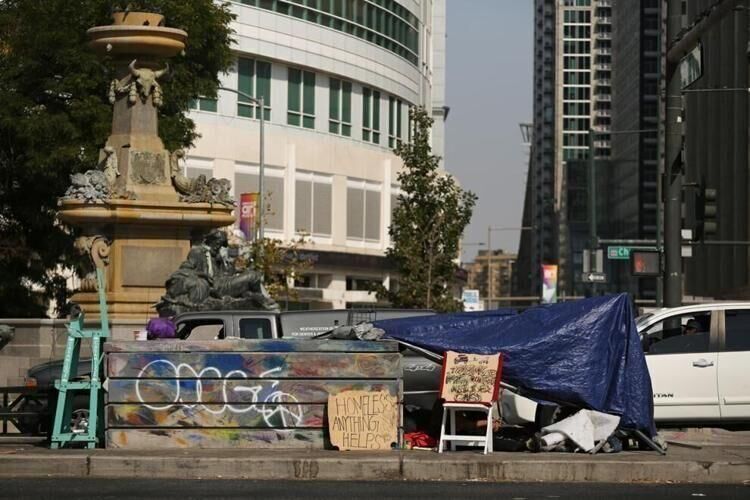
Subsidize anything, and you’ll get more of it – especially if it’s something you don’t want. It’s an old truism that long has served to expose the foibles of bad public policy.
Welfare rolls were once a prime example.
Until landmark, bipartisan welfare reform was signed into law by President Bill Clinton in 1996, the federal government was assured of ever more people living out unproductive lives on the public dole. The old Aid to Families with Dependent Children program essentially guaranteed welfare payments indefinitely with no incentive to move ahead in life.
The Personal Responsibility and Work Opportunity Reconciliation Act changed that by returning a lot of flexibility to the states in redesigning their welfare programs – and by setting a five-year lifetime limit on benefits. After passage, the number of people on welfare dropped substantially. It seems beneficiaries simply needed some carrots and sticks.
The same fundamental rethinking is needed in the way we deliver services to the homeless.
The Gazette reported this week that Colorado’s homeless population grew again this year, continuing a yearslong trajectory. The U.S. Department of Housing and Urban Development’s 2022 Annual Homeless Assessment Report counted 10,397 homeless in Colorado in early 2022, an increase of nearly 2,000 since 2021.
That’s troubling and even alarming. But before Colorado’s state and local policymakers call for one more dollar’s worth of funding for the homeless, some perspective is in order.
In a watershed study last year, Colorado’s Common Sense Institute found that in the metro Denver area alone, just under half a billion – billion, with a “b” – dollars a year was being spent on serving the homeless through public as well as private, nonprofit programs.
Common Sense updated that data with follow-up research released in October. The amount of annual spending on homelessness now is expected to rise to an estimated $660 million in 2023 – yes, two thirds of a billion dollars, and a 42% increase over two years ago.
And yet, the ranks of the homeless keep growing. Go figure.
So long as those who pilot public policy on homelessness keep throwing more money at the issue without assessing efficacy, Coloradans can expect more of the same. And to the extent the “housing first” ideology takes hold of policymaking – assuring housing without regard to why beneficiaries are homeless to begin with – it only will make matters worse.
To truly reinvent our approach to solving – not subsidizing – homelessness, some basic guardrails must be built in. Most notably:
Focus efforts such as transitional housing and job placement on the truly homeless – i.e., victims of circumstance like unemployment, evictions or domestic violence.
Require treatment first – not housing first – for the mentally ill and the substance-addicted who dominate the theoretically “homeless” population on our streets.
Pursue such programs as regional solutions that tie together resources and enforcement in multiple cities and counties – so as not to simply redistribute the homeless population.
Commendably, Aurora, Colorado’s No. 3 city, is making some progress down this path after having researched how some other U.S. metro areas approach the problem.
It will require a new level of resolve – political as well as legal. Municipal bans on “camping” by street dwellers must be enforced with zero tolerance. And cities will have to gird for court challenges from interest groups with a stake in the status quo.
None of this will be easy, of course. But what we’re doing right now clearly isn’t working – unless our goal is to create even more homelessness.
Denver Gazette Editorial Board


If only walls could talk in Colorado governor’s office | Dick Wadhams
Dick Wadhams
dick-wadhams@coloradopolitics.com
Updated 11 hours ago
Restoring the office of the governor in the Colorado State Capitol to its historic glory was a worthy project despite its cost. There is probably never a good time to spend $2.4 million on such a restoration but it is...

TABOR and the Colorado Constitution’s fiscal Gordian Knot | Miller Hudson
Miller Hudson
miller-hudson@coloradopolitics.com
Updated 10 hours ago
A corporate president advised me once there are two kinds of lawyers: “those who tell you why you can’t do things and those who figure out how to get things done anyway.” He only hired the latter. Since the adoption...

Fierce, capable women at the Super Bowl of livestock shows | Rachel Gabel
Rachel Gabel
rachel-gabel@coloradopolitics.com
Updated 10 hours ago
The first cattle to show in the CoBank Arena in the Sue Anschutz-Rodgers Livestock Center at the National Western Stock Show were the Herefords of the Catch-a-Calf program. Anschutz is an ardent supporter of the program and a big fan...
Election 2026 will be a big Democratic year, unless President Trump avoids the ‘sixth-year’ jinx | Bob Loevy
Bob Loevy
bob-loevy@coloradopolitics.com
Updated 10 hours ago
Here is analysis of which political party, the Democrats or the Republicans, will win the 2026 general elections for the U.S. Senate and the U.S. House of Representatives next November. Because the U.S. president will not be on the ballot...

Colorado is shrinking — time for our elected officials to take notice | Jon Caldara
Jon Caldara
jon-caldara@coloradopolitics.com
Updated 3 days ago
By Jon Caldara Something strange is happening in Colorado — strange enough that the political class should notice. People are leaving Colorado. After years of being one of the fastest-growing states in the nation, net in-migration has stopped and may...

Capitol M: Return to Gold Dome High, 2026 edition, and a salute to old IU
Marianne Goodland
marianne.goodland@coloradopolitics.com
Updated 4 days ago
Welcome back, campers! The 2026 legislative session is upon the good citizens of Colorado, and for a few, the first Monday of the session, Jan. 19, was pretty special. There are at least four folks in the Capitol who are...

The biggest accelerant of our political tribalism | SONDERMANN
Eric Sondermann
eric-sondermann@coloradopolitics.com
Updated 5 days ago
In years past, my go-to word in describing our political condition was “polarization.” I used it endlessly and still do on occasion. But as time has moved on, and the divide has only grown in depth and toxicity, polarization no...
The ramifications of President Trump’s pursuit of Greenland | Kelly Sloan
Kelly Sloan
kelly-sloan@coloradopolitics.com
Updated 3 days ago
President Donald Trump has evidently stepped back from his threatened fantasy of invading Greenland — the sovereign territory of a U.S. ally — to which many a sigh of relief has been expressed, including by the markets. There was next...
Let’s find out who’s up to the gubernatorial task post Polis | Paula Noonan
Paula Noonan
paula-noonan@coloradopolitics.com
Updated 4 days ago
Gov. Jared Polis is bold and his policies are bolder than bold. That’s the paraphrase of his State of the State speech to open the 2026 General Assembly and start off his last year in office. His sweeping review of...

We dream, we dare, we decouple — how Colorado turns values into policy | OPINION
Colorado Politics
colorado-politics@coloradopolitics.com
Updated 4 days ago
By Kathy White Gov. Jared Polis’ final State of the State address was a clear victory lap. After eight years as governor, he used the moment to highlight accomplishments, reflect on progress and remind Coloradans what his administration has delivered....
PREV
PREVIOUS

Dems’ silence on migrant crisis is deafening | SENGENBERGER
Jimmy Sengenberger While Denver’s City Council bickered with Mayor Michael Hancock over city crosswalks, a mass migration crisis was already building at the nation’s southern border. Migrants have been illegally crossing the southern border and transported to cities across the country. It was only a matter of time until Denver – a “sanctuary city” – was subsumed. […]

Why the food bill needs to pass | Grand Junction Daily Sentinel
One of the biggest stories of the year has been the rise in inflation, which has caused wide-spread economic pain. Outside gas prices, food is maybe the most visible place we see those increased costs. This is why we see Sen. Michael Bennet’s Affordable and Secure Food Act is an important piece of legislation that […]