

With Bennet’s election to a 3rd full term, Colorado senator takes aim at longevity record | TRAIL MIX
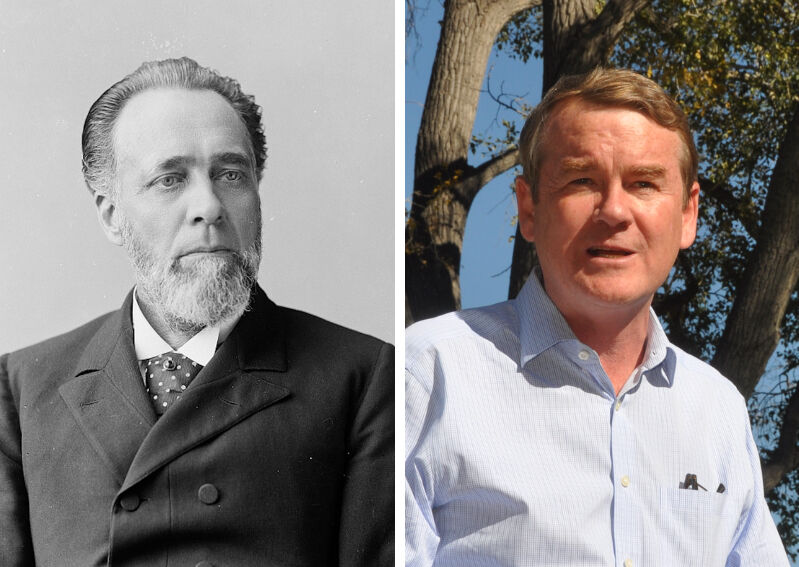
After winning reelection to a third full term last month, Michael Bennet, Colorado’s senior U.S. senator, is poised to become the state’s longest-serving popularly elected senator in a few years.
But if the Denver Democrat wants to claim the title of the state’s senator with the longest tenure, period, he’ll have to stick it out for nearly two more full terms after that.
Currently, Bennet ranks in fourth place for longevity in the upper chamber among the 26 senators elected by Colorado voters since 1913, when the 17th Amendment to the U.S. Constitution was adopted. That amendment, providing for the direct election of senators, replaced the previous method of states’ legislatures selecting members of the body.
In total, Colorado has sent 37 senators to Washington, counting the 11 chosen by state lawmakers and including a handful who served non-continuous terms. One of the state’s two inaugural senators, Henry M. Teller – the namesake of Teller County – was elected to the Senate five times under the old method, setting a benchmark record for duration in office that has endured for more than a century.
Bennet has already been a senator for longer than anyone elected from Colorado in the last 50 years, having passed that milestone on Jan. 22, 2020, when he accumulated the equivalent of two full six-year terms.
Bennet was sworn in for the first time on that same date in 2009 as the junior senator from Colorado by then-Vice President Joe Biden, after being appointed to fill the seat vacated by Ken Salazar, who resigned mid-term to join the Obama cabinet as secretary of the interior. He’s been reelected to full terms three times since, in 2010, 2016 and this year.
Before that, the state’s voters hadn’t sent a senator to DC for a third term since the mid-1960s, when the last Coloradan to earn the distinction won reelection.
Republican Gordon Allott, a former district attorney for the 15th Judicial District on the Eastern Plains, won the first of his three Senate terms in 1954 after serving as lieutenant governor for two terms from 1951-1955, back when Colorado’s statewide executive officers were elected to two-year terms. Allott was reelected in 1960 and 1966 but lost his bid for a fourth term in 1972 to Democrat Floyd Haskell, a former Republican who left the GOP to become a Democrat over disagreements with then-President Nixon’s Vietnam War policies.
Colorado’s other sitting senator in the early 1970s ran for a third term, but two-term Republican incumbent Peter Dominick was denied reelection in 1974 by Democrat Gary Hart. Since then, none of Colorado’s senators has even sought third terms, giving Colorado the distinction of going longer than any other state without being represented by a three-term senator.
Seniority doesn’t mean as much in the Senate as it used to, but it still matters – it can take years to inch major legislation across the line to the president’s desk, and attaining the chairmanship of a committee also takes time.
Bennet currently chairs two prominent subcommittees – the Agriculture, Nutrition and Forestry Committee’s Subcommittee on Conservation, Climate, Forestry, and Natural Resources, and the Finance Committee’s Subcommittee on Energy, Natural Resources, and Infrastructure. He also sits on the Senate Select Committee on Intelligence.
He’s the third Coloradan to win a third term by popular election, following Allott and Edwin C. Johnson, a towering figure known universally as “Big Ed,” who was elected to his first term in 1936 and reelected in 1942 and 1948. The larger-than-life Johnson bracketed his Senate terms with two stints serving as governor – two terms before his election to the Senate and one term after.
Since he served for two years following his appointment before winning a full term, Bennet stands to surpass Allott and Johnson’s longevity in the Senate on Jan. 22, 2027, just over four years into his next term.
First, though, Bennet will have to overtake the Colorado senator with the third-longest tenure among popularly elected senators, Republican Eugene Millikin.
An attorney and World War I veteran, Millikin became president of an oil company before being appointed to the Senate on Dec. 20, 1941, to fill the vacancy created by the death of Alva B. Adams, a Democrat who served two non-continuous stretches in the Senate – for about a year and a half in the early 1920s, after the incumbent died in office, and then again starting in the 1930s, when he won election to the seat twice but died in office before completing his second full term.
Alva B. Adams the senator was the son of fellow Democrat Alva Adams, who is the namesake of Adams County and served as Colorado’s governor three times, including on March 16, 1905, when Colorado famously had three governors in a single day.
After the elder Adams defeated Republican Gov. James H. Peabody in the 1904 election, he took office but was removed by the Republican-controlled General Assembly, which named Peabody to the seat with a requirement that he immediately resign so the lieutenant governor, Republican Jesse McDonald, could take over and serve out the term.
Fast forward a few decades, and Republican Gov. Ralph Carr appoints Millikin to fill out the second full term of the younger Adams, who died in office on Dec. 1, 1941.
Millikin won election to full terms twice in 1944 and 1950 and went on to serve chair the Senate Finance Committee and the Joint Committee on Internal Revenue Taxation. He was also chairman of the Senate Republican Conference.
If he remains in the Senate – no certainty, considering his predecessor departed the legislative body for a cabinet post, and Bennet explored another off-ramp recently when he spent the better part of a year running for president – Bennet will accumulate more days as a senator than Millikin’s total on Feb. 7, 2024.
Bennet will have to stay in the Senate – and win reelection two more times – until June 20, 2038, to beat Teller’s record of non-consecutive days served in the Senate, racked up in two stretches, from statehood into the first decade of the 20th century.
Teller was elected to the Senate by the General Assembly soon after Colorado was admitted to the union in 1876, and a few months later won election to a full term. He resigned, however, in 1882, shortly before completing the six-year term, to become secretary of interior under President Chester Arthur. Teller returned to the Senate in 1885 – since legislators elected senators, that didn’t happen until they’d been seated, into the year following their own elections – and was elected three more times by state lawmakers to represent Colorado in Washington.
Known for authoring the Teller Amendment, which prevented the United States from seizing Cuba in the Spanish-American War, Teller belonged to three different political parties during his long run in the Senate – first as a Republican, then as a Silver Republican, and finally as a Democrat, winning election at least once on each ticket.
As of Dec. 16, 2022, Bennet has served 5,077 days in the Senate, leaving 5,665 days – or about 15 1/2 years – until he ties Teller’s record of 10,742 days in office, and another day after that until he surpasses it.
Ernest Luning has covered politics for Colorado Politics and its predecessor publication, The Colorado Statesman, since 2009. He’s analyzed the exploits, foibles and history of state campaigns and politicians since 2018 in the weekly Trail Mix column.


Ballot access, dual-office ban bills move swiftly through Colorado legislature
Marianne Goodland
marianne.goodland@coloradopolitics.com
Updated 4 hours ago
With an eye on the 2026 election cycle and mounting tensions with the Trump administration, Colorado lawmakers are fast-tracking a pair of election bills they say will protect the state’s mail ballot system and tighten rules for elected officials. The...

Colorado GOP chair Brita Horn loses ‘no-confidence’ vote, vows to refocus on ‘mending that divide’
Ernest Luning
ernest.luning@coloradopolitics.com
Updated 4 hours ago
The Colorado Republican Party’s state central committee approved a resolution expressing “no confidence” in state chair Brita Horn in a landslide late Monday night near the end of an online meeting marked by rancor and confusion. Almost 80% of the...

Primary rival sues to prevent Democrat Eileen Laubacher from going through assembly in Colorado’s 4th CD
Ernest Luning
ernest.luning@coloradopolitics.com
Updated 9 hours ago
Democratic congressional candidate Trish Calvarese on Monday asked a judge to prevent one of her primary rivals, Eileen Laubacher, from participating in the caucus and assembly process to seek the nomination to challenge Republican U.S. Rep. Lauren Boebert in Colorado’s...
Colorado Senate swears in Adrienne Benavidez after district vacancy win
Marianne Goodland
marianne.goodland@coloradopolitics.com
Updated 1 day ago
Sen. Adrienne Benavidez, a Democrat from Adams County, was sworn in Monday to the Colorado Senate, just four days after winning a vacancy election in District 21. She was sworn in by Colorado Court of Appeals Justice Lino S. Lipinsky...

Democrat Michael Bennet turns in petitions for Colorado’s gubernatorial primary, plans to skip caucuses
Ernest Luning
ernest.luning@coloradopolitics.com
Updated 2 days ago
U.S. Sen. Michael Bennet, a Democratic candidate for governor, submitted nominating petitions for Colorado’s June primary ballot on Friday, his campaign and the Colorado Secretary of State’s Office said. Bennet plans to rely on his petitions to get on the...

Former House member picked to fill Senate vacancy in Colorado
Marianne Goodland
marianne.goodland@coloradopolitics.com
Updated 2 days ago
A vacancy committee on Thursday night chose a former House legislator to replace former Sen. Dafna Michaelson Jenet, who resigned on Feb. 13 to become the director of the David and Laura Merage Foundation for Combating Antisemitism. Adrienne Benavidez —...

Colorado delegation’s plus-one picks convey messages at Donald Trump’s State of the Union | TRAIL MIX
Ernest Luning
ernest.luning@coloradopolitics.com
Updated 4 days ago
It’s become a tradition for members of Congress to deliver messages of their own at the State of the Union address, though this year none of the Colorado lawmakers shouted at the president during the speech, nor did the delegation...

Colorado Democrat John Hickenlooper becomes first statewide candidate to submit nominating petitions
Ernest Luning
ernest.luning@coloradopolitics.com
Updated 3 days ago
U.S. Sen. John Hickenlooper on Thursday became the first statewide candidate to submit petition signatures for Colorado’s June Democratic primary, according to his campaign and the Colorado Secretary of State’s Office. Seeking reelection to a second term, Hickenlooper is facing...
Colorado lawmakers react along partisan lines to Donald Trump’s State of the Union address
Ernest Luning
ernest.luning@coloradopolitics.com
Updated 6 days ago
President Donald Trump could have been describing two different countries in Tuesday’s State of the Union address — one entering a “Golden Age” and the other enduring daily stress under a “lawless” regime — at least as far as the...

Colorado group files 6 ballot measures to counter redistricting proposals backed by Democrats
Marianne Goodland
marianne.goodland@coloradopolitics.com
Updated 5 days ago
A half-dozen congressional redistricting ballot measures were filed Friday by a Colorado advocacy group in response to proposals filed last week from a group seeking to flip three Republican-held U.S. House seats in two years. “The gist of it is...
PREV
PREVIOUS

Prosecutor struggled with alleged Club Q shooter's bomb threat case that was dismissed
Four days before the alleged Club Q shooter was scheduled to go to trial last year on charges of threatening to set off a bomb and become the “next mass killer,” a prosecutor handling the case could not provide key details to the presiding judge over why a key witness might not be available to […]

A year that could have been worse | SONDERMANN
Eric Sondermann Time away, especially following a noisy election, can be good for the soul. Moreover, such breaks can offer perspective and make the debates that fill our days seem rather small and narrow. Consider that southeast Asia, only a sliver of that massive continent, comprises nearly 700 million people. That is a population more […]