

No immunity for Loveland cop who shot puppy
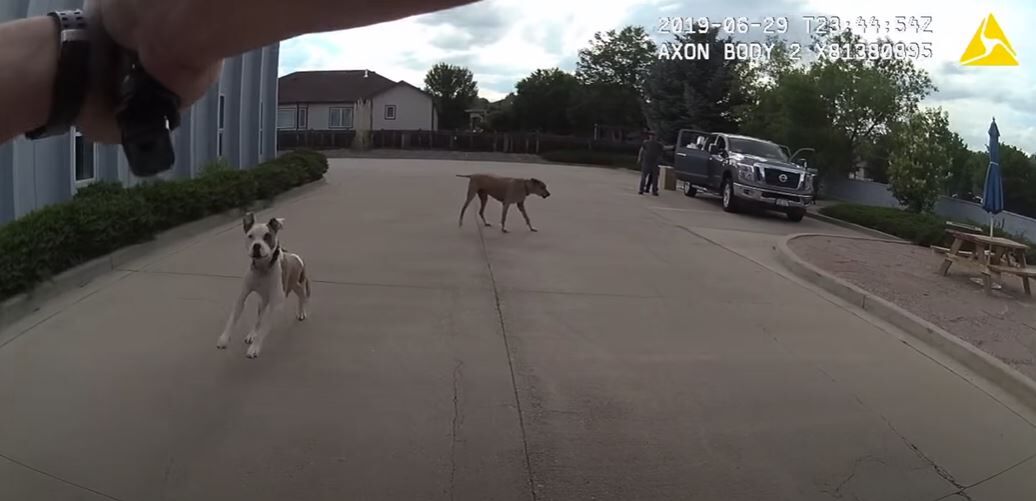
A Loveland police officer may be held liable for shooting a couple’s puppy in the head within seconds of exiting his car, a federal judge has ruled.
Last week, U.S. District Court Judge Raymond P. Moore refused to dismiss the civil rights claims against Officer Mathew Grashorn for the shooting. Moore noted the law is clear that killing a pet dog without justification, as Grashorn reportedly did with 14-month-old Herkimer, amounts to a constitutional violation.
“And regardless of whether Defendant Grashorn believed Herkimer posed an imminent threat justifying the use of deadly force, the allegations do not establish that shooting the dog was reasonable,” he wrote in a Sept. 21 order.
Grashorn had tried to assign blame for Herkimer’s death to his owners, plaintiffs Wendy Love and Jay Hamm, for not having Herkimer on a leash. Grashorn’s lawyers claimed he acted as “any other officer in his position would have.”
Moore did agree to dismiss the remaining defendants, the city of Loveland and Sgt. Philip Metzler, from the lawsuit for their roles in the shooting.
The sequence of events, as captured on Grashorn’s body-worn camera, was undisputed. Instead, the parties argued over whether the video showed Staffordshire terrier/boxer mix Herkimer had playfully “trotted” toward the officer or dangerously “charged” him when Grashorn decided to shoot.
Love and Hamm were delivering firewood for their business on the evening of June 29, 2019 when they stopped in the parking lot of a commercial building. It was a Saturday and there were no other people in the vicinity, so Love and Hamm let their three dogs out of their truck to stretch while Hamm made repairs to some equipment.
The owner of the building at 995 N. Wilson Ave. saw the couple on his surveillance feed and called Loveland police to investigate, citing previous tampering on the premises. Multiple officers responded, but Grashorn was the first to arrive.
Grashorn parked several yards away from Love and Hamm and his body-worn camera did not immediately begin recording audio. But the footage showed Bubba, a 16-year-old dog, get up from the pavement after Grashorn closed his car door and begin running toward Grashorn. The officer immediately pointed his gun at Bubba, and Love and Hamm called for Bubba to return.
Although Bubba turned around before reaching Grashorn, Herkimer, who had been resting in the couple’s truck, came outside at the commotion. Herkimer also ran toward Grashorn, and the officer shot him in the head and in the body.
“Get back to the truck,” Grashorn screamed at Love when she tearfully approached her wounded puppy.
“Please let me see him,” Love wailed, and Grashorn again ordered her back to the truck. Love nonetheless cradled Herkimer while Grashorn warned Love, “He will bite you, he’s hurt.” The video did not depict Herkimer biting anyone.
“You’re not gonna be able to help him,” Grashorn continued to yell at the couple.
An article from the Loveland-Reporter Herald at the time, relying on a statement issued by the police, reported Herkimer had run at Grashorn “aggressively” and that responding officers “immediately gave aide to the dog.”
The lawsuit alleged, in contrast, police officers had refused to let Herkimer be transported to a doctor until Metzler arrived and authorized it. Herkimer spent four days in intensive care and was ultimately euthanized.
Love and Hamm sued Grashorn for an unreasonable seizure under the Fourth Amendment, which is the constitutional provision governing excessive force claims. They also advanced a claim under a sweeping police accountability law the Colorado legislature enacted in the summer of 2020 amid international racial justice protests.
Grashorn believed he was entitled to qualified immunity, which shields government employees from civil liability unless they violate a person’s clearly-established legal rights.
“Herkimer was a full-grown dog, not a puppy, and not a small dog. It is absolutely irrelevant that Herkimer was allegedly a sweet, loving, playful, good boy, who had no history of biting or being dangerous to humans,” wrote Jonathan M. Abramson, an attorney for Grashorn.
The officer also claimed he “only had three seconds” to respond to the dogs, while at the same time arguing he “did allow Plaintiffs an opportunity to control” them. No case law prohibited him from using force under those circumstances, Grashorn added.
“There is no question the death of Herkimer is a tragedy, but this tragedy would not have occurred if Plaintiffs did not trespass or at least secure their dogs with a leash while trespassing,” Abramson wrote.
The plaintiffs countered there was a range of options available to Grashorn other than deadly force.
“No reasonable officer or reasonable person would have perceived this situation as a threat requiring the immediate destruction of an innocent citizen’s beloved pet,” wrote lawyer Sarah Schielke. “But Grashorn didn’t care. He had his gun out and was eager to shoot something.”
Moore, the district judge, did not watch the video before ruling on the motion to dismiss, but found the allegations in the plaintiffs’ complaint sufficiently described a clear constitutional violation. While Moore acknowledged Colorado’s police accountability law went into effect after Herkimer’s killing, he agreed with Love and Hamm that other courts are currently interpreting the law’s application and it would be premature to toss that portion of the lawsuit until there is clarity.
Although the plaintiffs claimed Loveland itself was also responsible for the shooting because the police department had an alleged policy of vigorously protecting businesses to the point of using excessive force, Moore did not find a pattern of similar incidents to support that narrative. Nor was there any indication Loveland received complaints about its police officers shooting pet dogs.
As for the plaintiffs’ claim against Metzler – that he retaliated against them after learning they planned to go to the media by ordering they be cited for a vicious dog – Moore believed his behavior was not “shocking.”
“Although the Court accepts as true Plaintiffs’ allegation that Herkimer ‘displayed no signs of aggression’,” Moore wrote, “that does not amount to a showing that Defendant Metzler could not have determined, based on the information given to him and viewing the footage, that probable cause existed to charge Plaintiffs with owning a dangerous dog.”
Metzler resigned from the police department last year. He was also involved in the violent arrest of an elderly women with dementia one year after Herkimer’s killing. That encounter resulted in a $3 million settlement with Loveland.
The case is Love et al. v. Grashorn et al.

Colorado Supreme Court blocks ‘child-to-parent violence’ testimony in Boulder County case
Michael Karlik
michael.karlik@coloradopolitics.com
Updated 13 hours ago
The Colorado Supreme Court concluded on Friday that a Boulder County judge incorrectly green-lit a psychologist’s expert testimony when the defendant had not laid the necessary groundwork for the evidence. State law requires criminal defendants to provide notice and undergo...
Colorado justices concerned about retrying defendant after jury signaled acquittal
Michael Karlik
michael.karlik@coloradopolitics.com
Updated 10 hours ago
Some members of the Colorado Supreme Court appeared uncomfortable on Tuesday with allowing a criminal defendant to stand trial a second time after a Larimer County jury signaled it was deadlocked on some counts but found him not guilty of...
Missy Woods pleads not guilty; trial set for fall
Jenny Deam
jenny-deam@coloradopolitics.com
Updated 11 hours ago
The former Colorado Bureau of Investigation DNA expert charged with more than 100 felonies entered a plea of not guilty to all of them Wednesday in a packed Jefferson County courtroom. The plea was entered by her defense attorney Tom...
Colorado justices question process for parole board appeals
Michael Karlik
michael.karlik@coloradopolitics.com
Updated 17 hours ago
The Colorado Supreme Court considered on Tuesday whether criminal defendants whose parole is revoked must appeal the decision internally to the state’s parole board before seeking review by a judge. The process for returning someone to incarceration for violating the...
Colorado justices weigh potentially faulty jury instruction in child abuse case
Michael Karlik
michael.karlik@coloradopolitics.com
Updated 19 hours ago
Members of the Colorado Supreme Court questioned on Tuesday whether a San Miguel County jury convicted a defendant of child abuse resulting in death, even though the instructions potentially allowed jurors to avoid finding that the child abuse resulted in...

Federal judge sanctions Pueblo for destroying evidence in lawsuit
Michael Karlik
michael.karlik@coloradopolitics.com
Updated 1 day ago
A federal judge imposed sanctions on the city of Pueblo last week after it disposed of a key piece of evidence shortly after the plaintiffs filed suit seeking damages for the destruction of their home. On June 25, 2022, a...
10th Circuit orders lawyer to pay $1,000 for faulty AI citations
Michael Karlik
michael.karlik@coloradopolitics.com
Updated 2 days ago
The Denver-based federal appeals court ordered a lawyer on Monday to pay $1,000 to the opposing side for submitting a legal filing with fake case citations generated by artificial intelligence. A three-judge panel of the U.S. Court of Appeals for...

Supreme Court finalists selected, federal judges slash backlogs | COURT CRAWL
Michael Karlik
michael.karlik@coloradopolitics.com
Updated 3 days ago
Welcome to Court Crawl, Colorado Politics’ roundup of news from the third branch of government. Coloradans learned who the three finalists are for a state Supreme Court vacancy, and new data show that Colorado’s federal trial judges reduced their backlog...
Federal judge blasts government for violating court order, confiscating man’s property
Michael Karlik
michael.karlik@coloradopolitics.com
Updated 4 days ago
A federal judge gave the government three hours on Friday to return the property of a man released from immigration detention, which it allegedly retained in violation of her previous order. “At its most benign, this failure is an unforced...
DA’s withdrawal from veterans treatment court not judge’s problem, ethics panel says
Michael Karlik
michael.karlik@coloradopolitics.com
Updated 6 days ago
There are no ethical concerns from a judge continuing to participate in a specialty veterans treatment court if the district attorney’s office has withdrawn from the program, the Colorado Supreme Court’s ethics committee advised on Wednesday. Colorado law permits chief...
PREV
PREVIOUS
Is snowmaking an answer to Colorado's water woes?
Colorado’s lawmakers want to consider the viability of turning water into snow at high altitudes as a way to store the precious resource. They also want to focus on water year-round. The Interim Water Resources and Agricultural Review Committee, which wrapped up its summer work on Sept. 22, voted to send the two measures to […]

Colorado, 9 other states sue pesticide makers for anti-competitive practices
Colorado and nine other states joined the Federal Trade Commission’s lawsuit against pesticide makers Syngenta and Corteva on Thursday, accusing them of engaging in anti-competitive practices. The lawsuit filed in U.S. District Court alleges that the companies use loyalty programs with pesticide distributors to exclude generic competitors from the market. The lawsuit claims the companies […]